Behind the headlines of conflict, a generation is quietly losing ground to drugs, HIV and despair — but a network of families, students and volunteers is fighting to turn it around
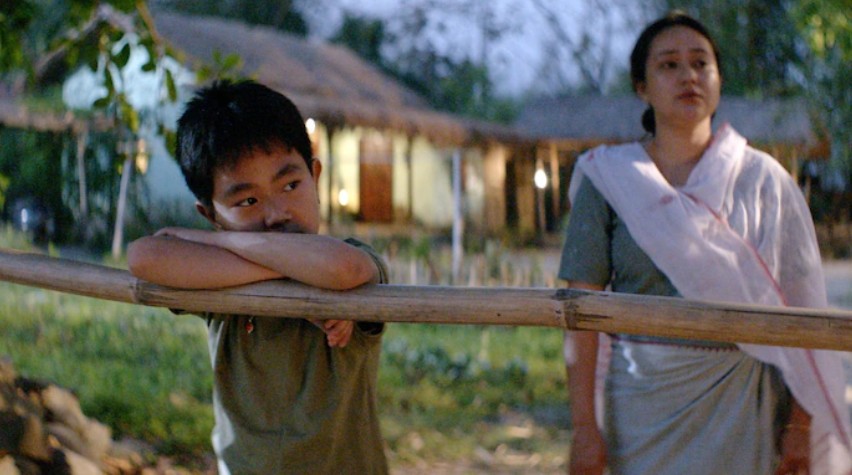
The numbers have been repeating themselves in Manipur for so long that they risk becoming background noise: heroin from across the Myanmar border, needles shared in back rooms, HIV infection rates the highest in India. But talk to teachers, health workers and student leaders here and a newer worry surfaces just as often — a generation of adolescents growing up amid displacement and conflict since 2023, and showing the strain in ways the state’s Child Rights Commission has now begun to formally track.
Manipur’s geography has long made it vulnerable. Sitting on the edge of the Golden Triangle, one of the world’s largest opium-producing regions, the state has watched heroin move across its border since the 1980s. What started as a public-health problem confined to a small population of injecting drug users has metastasised, over four decades, into something broader: a tangle of addiction, infection, family breakdown and youth disengagement that today’s civil society groups describe not as separate crises, but as one continuous chain.
A Chain Reaction
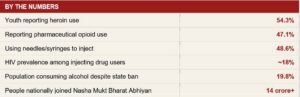
Recent survey research on Manipuri youth paints a stark picture. Heroin remains the most commonly reported substance of abuse, followed closely by pharmaceutical opioids and methamphetamine; nearly half of those surveyed reported using needles or syringes to inject. Alcohol, too, remains widespread — nearly a fifth of the state’s population drinks regularly, despite a prohibition law that has stood, largely unenforced in practice, since 1991.
The consequences run deeper than addiction itself. Manipur has for years recorded India’s highest HIV prevalence, driven overwhelmingly by needle-sharing among injecting drug users; state health surveillance still puts prevalence among that group at roughly 18 percent. Researchers have found that the youngest users — those who start injecting before the age of 25 — take the biggest risks with unclean needles, meaning the youngest are also the most exposed to new infection.
“We now have a community of trained facilitators, engaged parents, and hopeful youth. The time is ripe to take this further.”
That line belongs to Hijam Priyokumar, president of the Coalition Against Drugs and Alcohol (CADA), describing a family-resilience programme his organisation ran with the United Nations Office on Drugs and Crime this year. Fifty families in Imphal took part in sessions built around storytelling, role-play and group discussion — an attempt to strengthen the first line of defence against addiction: the home.
Civil Society Steps In
If there is a reason Manipur’s crisis hasn’t spiralled further, many here point to the state’s unusually active civil society. Student organisations and women’s collectives, including the meira paibi movement, have a long history of direct, sometimes confrontational action against drug peddling in their own neighbourhoods — stepping into gaps left by formal enforcement. That grassroots muscle is now being drawn into more structured programming, with CADA and UNODC working alongside Manipur’s Social Welfare Department to train facilitators and expand family-based prevention beyond its pilot scale.
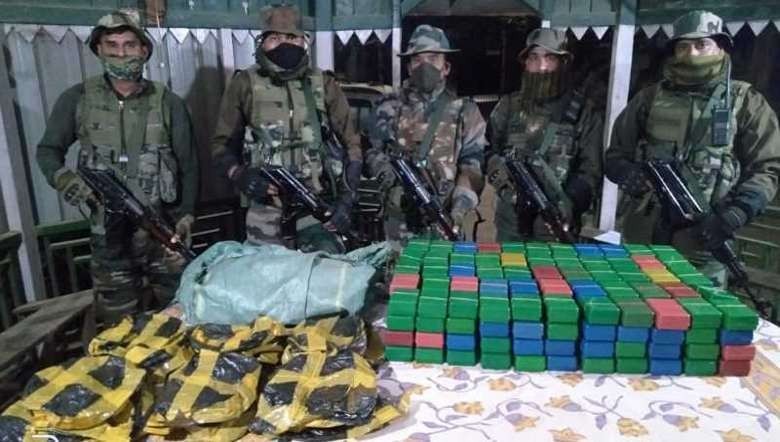
Government enforcement continues in parallel. In late October, a joint operation by Assam Rifles and the Narcotics Control Bureau led to an arrest in Churachandpur district. State officials have tied broader anti-drug campaigns to law-and-order priorities, and the central government’s Nasha Mukt Bharat Abhiyan says it has drawn participation from more than 14 crore people nationwide, including over four lakh educational institutions.
The Unfinished Work
Even so, gaps remain. Needle-exchange programmes designed to curb HIV transmission have historically seen low uptake among the drug users they’re meant to serve. Media coverage, several observers note, still leans heavily on arrests and seizures — an enforcement-first framing that can make treatment and reintegration feel like an afterthought rather than the goal. And the psychological toll of the 2023 conflict on Manipur’s children remains, by the Child Rights Commission’s own admission, only beginning to be understood.
What the evidence does suggest is that the tools for turning things around already exist in Manipur — they simply need to be scaled. Family- and school-based prevention modelled on CADA’s programme, wider access to harm-reduction services, real investment in youth employment, and a more central role for the student and women’s organisations that already command trust at the community level: these are not new ideas so much as unfinished ones. The state’s next chapter may depend less on any single new policy than on whether Manipur commits, at scale, to programmes it has already shown work in miniature.

The writer is a former Member of Parliament and a former Union Minister of State External Affairs and Education, Government of India.