

More than three years after violence erupted in Manipur on May 3, 2023, the state has entered a new but uncertain political phase. The government is functioning, the Legislative Assembly has resumed, public transport has returned to Imphal-Dimapur National Highway 2 (NH-2), and political representatives who had remained physically separated from Imphal have begun to re-enter the constitutional space.
Yet these developments cannot by themselves be equated with peace.
The opening of the eighth session of the 12th Manipur Legislative Assembly on September 2 provided the clearest illustration. Saikul MLA Kimneo Haokip Hangshing and Saitu-Gamphajol MLA Haokholet Kipgen entered the Assembly complex in Imphal and attended the session in person – the first physical attendance by Kuki-Zomi legislators in the Assembly since the conflict began in May 2023.
Their presence was significant because physical absence from Imphal had itself become a symbol of the conflict. Since May 2023, Kuki-Zomi legislators had stayed away from the state capital and, after the formation of a new government in February 2026, participated in proceedings virtually. Their return therefore represented a small reopening of a constitutional political space closed by violence.
But it would be premature to call it a return to normalcy.
The Kuki Inpi Manipur (KIM), the apex Kuki organisation, had directed all Kuki legislators to boycott the session, arguing that the demand for a separate administration remains unresolved. It warned that participation in the Assembly should not be used to create the impression that the political crisis had ended.
The decision of the two MLAs to attend despite the directive is politically significant. It suggests that the Kuki-Zomi constituency cannot be assumed to speak with one voice. Community organisations, elected representatives, political parties, civil society bodies and militant groups may share broad objectives while differing over strategy.
That divergence could become important to any future peace process. Participation in the Assembly need not mean abandonment of the demand for political autonomy, just as continued pursuit of that demand need not require withdrawal from constitutional institutions.
At the same time, eight of the nine Naga legislators led by Deputy Chief Minister Losii Dikho wrote to Union Home Minister Amit Shah seeking what they described as decisive action against Kuki leaders and militant groups whom they alleged were responsible for attacks on Naga civilians. Their demands included action against persons they alleged were involved in the killing and dismemberment of six Liangmai Naga civilians, action against Kuki National Front (President) – KNF-P leader Thangboi Kipgen, action concerning Deputy Chief Minister Nemcha Kipgen over alleged links with militant groups, Thangboi Kipgen being her husband, and abrogation of the Suspension of Operations (SoO) agreement with Kuki militant groups.
These remain allegations and political demands, not judicial findings. But their significance lies in their entry into the constitutional arena.
The contrast is striking – while two Kuki legislators were returning physically to the Assembly, Naga legislators were appealing to New Delhi against what they described as continuing Kuki militant violence.
The Assembly has thus become both a symbol of political reconnection and a forum for deepening ethnic distrust.
That is the paradox at the heart of Manipur’s search for peace.
Beyond the Kuki-Zomi and Meitei conflict
For most of the past three years, Manipur’s crisis has been understood principally as a conflict between Kuki-Zomi and Meitei communities. That remains the central political conflict and the principal source of the state’s territorial and administrative fragmentation.
But that description is no longer sufficient.
The increasingly violent Kuki-Naga confrontation in the hills has added a new and potentially destabilising dimension. The relationship between the two communities has a longer history of competing territorial interests, political claims and disputes over identity and customary authority. What has changed since February 2026 is the intensity with which those tensions are now being expressed within a landscape already transformed by displacement, militarisation and ethnic separation.
Since May 2023 buffer zones, restricted roads and the concentration of populations along community lines have weakened the everyday mechanisms through which different communities previously interacted.
The Kuki-Naga confrontation therefore cannot be treated simply as a secondary or unrelated conflict. It is becoming part of the larger conflict system produced after May 3, 2023.
This matters because the Nagas have their own political aspirations, customary institutions, territorial interests and relationship with the State. A peace process constructed only around the Kuki-Zomi–Meitei dispute will consequently be incomplete.
Indeed, the emergence of a second major ethnic fault line could make an eventual settlement considerably more difficult.
The politics of fear has replaced the politics of coexistence
The most disturbing transformation in Manipur is not merely the continuation of violence but the expansion of the geography of fear.
The violence that began in 2023 has increasingly generated new fault lines, particularly between Kuki and Naga communities. Communities that once maintained difficult but functioning relationships are increasingly viewing one another through the lens of threat.
The events of May 13, 2026, demonstrated how quickly this new conflict could escalate.
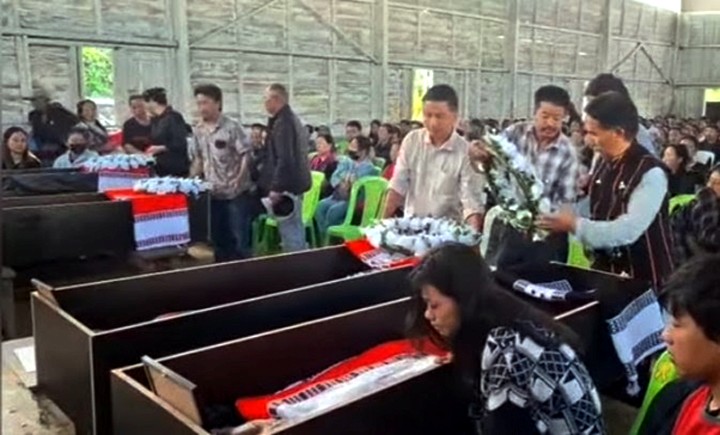
Three Thadou church leaders were killed in an ambush between Kotlen and Kotjim in Kangpokpi district. The killings were followed by the abduction of Liangmai Naga civilians and a hostage crisis with retaliatory detention of Kuki-Zomis in which civilians became instruments of pressure between competing communities. Twelve of the eighteen Liangmai Naga hostages were eventually released on May 14-15 following appeals from political and community leaders including church leaders.
But the crisis did not end there.
Six Liangmai Naga civilians who had not been released along with the twelve were subsequently found dead and their bodies mutilated after the fourteen Kuki detainees were safely released on June 9 by the Nagas.
The killings transformed an already dangerous confrontation into a profound crisis of trust between the Kuki and Naga communities.
The importance of these events extends beyond the individual victims. They reveal a dangerous logic in which civilians are no longer simply casualties of conflict but can become instruments of pressure, collective targets or symbols of retaliation.
The distinction between combatant and non-combatant becomes increasingly blurred when one community’s civilians are held responsible, explicitly or implicitly, for the actions of another community’s armed actors.
The hostage crisis demonstrated that Manipur’s security problem is no longer simply about armed groups confronting one another. Ordinary civilians themselves have become part of the political equation. A person travelling through a particular area, belonging to a particular community or being caught on the wrong side of an emerging territorial boundary or buffer zones can become vulnerable regardless of any involvement in the conflict.
The subsequent killing of the six Liangmai civilians therefore had consequences far beyond their families. It reinforced among Nagas the perception that their civilians could not depend on existing security arrangements when travelling through areas dominated by another community. At the same time, Kuki-Zomi communities remained deeply conscious of their own vulnerability to attacks and reprisals.
Fear thus becomes self-reinforcing.
A Kuki family sees Kuki civilians killed and concludes that the neighbouring community cannot be trusted. A Naga family sees Naga civilians abducted and killed and reaches the same conclusion. Each community’s memory of victimhood becomes evidence of the other’s presumed hostility.
This is how localised violence becomes a security dilemma.
Roads that once connected villages increasingly become perceived as ethnic corridors. Markets become associated with particular communities. Movement becomes conditional upon perceived ethnic control. Communities increasingly look to their own networks for security rather than to common state institutions.
The killing of the Liangmai civilians is therefore significant not only because of the brutality involved but because it represents the erosion of a basic principle of civil order – that civilians are entitled to protection irrespective of their ethnicity.
Roads can be reopened and houses rebuilt. Trust destroyed through abduction and killing is much harder to restore.
The Naga legislators’ subsequent appeal to the Union Home Minister represents the movement of this conflict from village-level confrontation into the constitutional arena. Their demand for abrogation of the SoO agreement reflects their perception that the existing security framework has failed to protect Naga civilians from Kuki militant groups. The Meiteis have been demanding the abrogation of SoO for many years.
For the Centre, however, the SoO framework remains an important instrument for larger counter-insurgency operations besides managing Kuki militant organisations and maintaining a channel for political dialogue.
This creates a difficult contradiction. A mechanism intended to contain armed conflict can itself become a source of political distrust if one community believes that it protects another community’s armed actors while leaving its own civilians vulnerable.
The danger is that Nagas may increasingly conclude that the State cannot protect them, while Kuki-Zomi communities may reach the same conclusion for themselves.
When that happens, common institutions lose legitimacy.
The politics of fear thrives because every community can point to its own dead.
Peace, however, cannot be constructed by balancing the number of victims between communities. It must begin with the principle that no civilian can be held responsible for the actions attributed to his or her community, and no civilian can become legitimate collateral in a political confrontation.
That requires two things above all – civilian protection and credible accountability.
The killings of the three church leaders, the abduction and killing of the six Liangmai civilians, further killings of Liangmai Nagas in Langka village, IT Road ambush, Teikhang Kuki village killing, and other attacks on civilians on both sides must be investigated impartially. Justice cannot depend upon the identity of either victim or alleged perpetrator.
Without accountability, every community will continue to interpret justice through its own ethnic lens. Without justice, reconciliation becomes little more than a political slogan.
The SoO dilemma
The controversy over the Suspension of Operations agreement illustrates another contradiction at the centre of the peace process.
The SoO framework was stated to maintain a ceasefire arrangement with Kuki militant groups which never fight with the Indian Security Forces while allowing political dialogue to continue. Its continuation has therefore been justified as a means of preventing wider armed confrontation and retaining a channel for negotiation.
But a ceasefire framework is sustainable only when its rules are credible.
The revised SoO arrangements provide for monitoring of designated camps, weapons and cadres, with the Joint Monitoring Group responsible for compliance. Yet the Naga legislators’ demand for abrogation demonstrates the erosion of confidence in the arrangement among another affected community.
The issue cannot therefore be reduced to whether the SoO should simply continue or end.
The fundamental question is whether it can remain a credible peace instrument if allegations of violations are not investigated and communities – Nagas and Meiteis – believe militant groups operating under its framework enjoy political protection.
If violations occur, there must be consequences. If cadres are involved in attacks, the law must operate. If weapons are to be deposited, verification must be genuine. If designated camps are restricted, those restrictions must be enforced. If proxies are used, that must be banned.
Otherwise, the SoO risks becoming less a peace mechanism than an institutionalised system for managing armed politics.
Yet abruptly terminating it without an alternative could create a security vacuum.
The answer must therefore be credible enforcement, transparent monitoring and a clear connection between compliance and political dialogue.
The Nemcha Kipgen controversy
The confrontation surrounding Deputy Chief Minister Nemcha Kipgen illustrates the collapse of political trust.
Deputy Chief Minister Losii Dikho and Naga legislators have raised allegations concerning Nemcha Kipgen and her husband, Thangboi Kipgen, including alleged links with Kuki militant activity. Nemcha Kipgen has rejected the allegations as false, vexatious and baseless.
She has pointed to her interventions during periods of heightened Kuki-Naga tensions, including appeals for the release of Liangmai Naga hostages, and has said she attempted to facilitate dialogue between Naga civil society organisations through Losii Dikho.
These competing claims illustrate the need to distinguish political accusation from established fact.
Political denial cannot resolve serious allegations, but allegations cannot substitute for evidence either. The appropriate response is institutional investigation. If allegations are false, that should be established. If they have substance, the law must act.
What cannot be allowed is an environment in which allegations become permanent instruments of ethnic mobilisation.
Peace requires both accountability and fairness.
The Hill Areas Committee and constitutional space
Interestingly, the September 3 meeting between Hill Areas Committee Chairman Diganglung Gangmei and other Naga and Kuki legislators with the Governor assumes significance in this context.
The meeting reportedly addressed the welfare and aspirations of hill communities whether Kuki or Naga, including local governance, tribal rights and development priorities.
Its timing is revealing. Diganglung Gangmei was the only Naga MLA who did not sign the letter to the Home Minister. Yet he subsequently led in a delegation involving legislators from both Naga and Kuki backgrounds.
This demonstrates that elected representation does not necessarily follow a single ethnic line rather raises common interests of the Nagas and Kukis.
The constitutional system retains spaces in which representatives can meet even when their communities are in conflict. The danger is that elected institutions become subordinate to community organisations on one side and militant groups on the other.
The Assembly must instead become the arena in which competing claims are negotiated through constitutional politics.
The hill areas require meaningful representation, protection of tribal rights, responsive governance and development. At the same time, the constitutional framework and territorial integrity of Manipur cannot be altered through violence or unilateral territorial consolidation.
The challenge is to achieve political accommodation without institutional disintegration.
The return of the Kuki legislators: an opening with limits
The physical return of two Kuki MLAs should therefore be viewed neither as surrender nor as proof that normalcy has returned.
It is an opening.
Their presence demonstrates that a political barrier created by the violent conflict can begin to be crossed. But the KIM’s opposition demonstrates the limits of the development. The separate administration demand remains unresolved, and distrust of the existing political arrangement remains deep.
The episode may nevertheless reveal something important about a future peace process – no community should be assumed to possess a single political voice.
A durable settlement will require elected representatives, community organisations, civil society, women and youth, churches, religious leaders, displaced people and, where constitutionally appropriate, engagement with armed organisations through established governmental mechanisms.
The objective must be to move political demands from territorial coercion into constitutional negotiation respecting coexistence in Manipur.
Separate administration and the limits of symbolic normalcy
The “Kuki-Zo” demand for separate political administration remains one of the principal obstacles to restoring the pre-2023 political order.
For the “Kuki-Zo” community, the demand is rooted in experiences of violence, displacement and loss of trust in the existing State structure. It cannot simply be dismissed.
At the same time, political arrangements cannot legitimately be created solely through territorial realities produced by violence.
This is the constitutional dilemma.
For Meitei political opinion, territorial integrity is fundamental. For “Kuki-Zo” organisations, political separation is presented as the necessary guarantee of security and self-governance. For Nagas, neither position necessarily encompasses their political aspirations and concerns.
A serious settlement must therefore confront these competing claims rather than pretend that one of them does not exist.
The Assembly can provide a space for such negotiation. Participation by Kuki MLAs need not mean acceptance of the status quo, just as the demand for political autonomy need not require withdrawal from every constitutional institution including Manipur State.
The possibility of peace lies in creating political space between these positions.
The danger of declaring peace too early
The present government faces a fundamental temptation – to equate partial restored administration with restored normalcy.
There are visible signs of normalisation. The Assembly is functioning. A government has been formed. Public transport has resumed on Imphal-Dimapur stretch of NH-2 after more than three years. Kuki legislators have returned physically to the House.
These are important developments.
But partial administrative normalisation is not social peace.
People remain displaced. Communities remain territorially segregated. Fear continues to shape movement. Armed groups retain influence. Civilian killings continue.
The recent Kuki-Naga violence is a particularly powerful warning against prematurely declaring victory.
A State can restore its administrative machinery without restoring society.
The deeper test is whether displaced families can return safely, citizens can travel without fear, markets, hospitals, schools, colleges and universities can function across community boundaries, property disputes can be resolved and people can trust the police and security forces irrespective of ethnicity.
That is peace in the human sense.
From frozen conflict to fragmented conflict
For more than three years, Manipur has increasingly resembled a frozen conflict – the intensity of violence has fluctuated, but the underlying political disputes remain unresolved.
The danger of a frozen conflict is that temporary arrangements gradually become permanent realities. Buffer zones become de facto borders. Displacement becomes demographic separation. Community-controlled roads become normal. Virtual legislative participation becomes institutionalised. Armed groups acquire a continuing role in political bargaining. A generation begins to grow up regarding separation as normal.
But the latest developments suggest something more dangerous. The conflict may no longer be merely frozen. It may be fragmenting.
The emergence of serious Kuki-Naga violence means that the original two-sided conflict is generating secondary conflicts among communities that previously maintained forms of coexistence. Each cycle creates new victims, memories, territorial fears and political constituencies.
The killings of the three Thadou church leaders, the subsequent hostage crisis and the killing of six Liangmai civilians, and further killings of Liangmai Nagas and Kukis illustrate how one episode can generate another.
The conflict begins to acquire its own momentum.
A settlement between Kuki and Meitei representatives would not automatically resolve Kuki-Naga conflict. Reconciliation between Kukis and Nagas would not resolve the fundamental Kuki-Meitei political dispute.
Manipur is consequently moving towards a situation in which several conflicts overlap geographically and politically.
That makes a comprehensive peace process more urgent, not less.
What a meaningful peace process requires
A serious peace process must first recognise that Manipur no longer has a single conflict.
First, political dialogue must become genuinely multi-layered. The Kuki-Meitei dispute must be addressed alongside the concerns and aspirations of Nagas and other ethnic groups.
Second, civilian protection must be the immediate priority. Roads and villages cannot remain places where security depends upon ethnicity.
Third, the SoO framework requires credible enforcement. A ceasefire arrangement not trusted by all affected communities cannot remain politically sustainable.
Fourth, allegations involving political leaders and armed groups must be independently investigated. Neither ethnic solidarity nor political office should provide immunity.
Fifth, freedom of movement must be restored in practice. Reopening of Imphal-Dimapur stretch of NH-2 is important, but genuine normalcy requires safe movement along NH-2 including Imphal-Churachandpur sector, Imphal-Ukhrul NH-202, Imphal-Moreh NH-102, Imphal-Jiribam NH-37, the Imphal-Tamenglong routes and other roads connecting the hills and Valley.
Sixth, displaced people must remain central to the peace process. A settlement that permanently institutionalises displacement will merely convert wartime separation into a new demographic reality.
Seventh, the Assembly must be reclaimed as the principal democratic arena. The return of Kuki legislators provides an opportunity to restore political interaction across the conflict divide.
Finally, peace negotiations cannot be reduced to a bargain among political elites. Those who have lost homes, relatives, livelihoods and freedom of movement must have a meaningful place in determining what peace should mean.
Beyond the politics of victory
Manipur’s deepest problem is that each side increasingly defines peace through its own conception of political victory.
For the Meiteis, peace is associated with freedom of movement, constitutional protection, territorial integrity and coexistence of all the ethnic groups.
For “Kuki-Zo” organisations, it is inseparable from political security, protection of their population and a separate administrative arrangement.
For Nagas, it increasingly means protection from attacks, freedom of movement, recognition of political and customary rights and security from being drawn into another community’s conflict.
These positions cannot simply be wished away.
The task of politics is to find a framework in which competing claims can coexist without violence becoming the mechanism through which political outcomes are determined.
Political autonomy cannot be created through armed territorial consolidation.
Territorial integrity cannot mean political exclusion.
Constitutional unity cannot mean denial of legitimate fears.
And community security cannot be achieved by making another community permanently insecure.
That is the central political challenge before Manipur.
The meaning of September 2
The arrival of the two Kuki MLAs in the Assembly on September 2 is therefore neither the end of the conflict nor an insignificant event.
It is a small opening in a political wall that has hardened over three years.
But at precisely the same time, another wall is rising – the increasingly dangerous Kuki-Naga divide.
If that divide deepens, Manipur could move from a frozen two-sided conflict into a fragmented conflict involving several communities, territories, armed actors and competing political claims.
The recent violence shows that this is no longer a theoretical possibility.
Manipur stands at a crossroads.
One path leads towards institutionalised separation – ethnically secured territories, guarded roads, displaced peoples, competing political authorities and armed organisations embedded in political bargaining.
The other leads towards negotiated coexistence – reopening political institutions, enforcing ceasefire arrangements, protecting civilians irrespective of ethnicity, restoring freedom of movement, facilitating the return of displaced people and creating constitutional mechanisms through which competing political aspirations can be addressed.
The September Assembly episode offers a narrow opening towards the second path.
But peace will not be measured by how many legislators sit in the Assembly.
It will be measured by whether an ordinary citizen of Manipur irrespective of ethnic groups can travel through Manipur without fear; whether displaced families can return home; whether civilians are protected irrespective of community; whether armed groups can be held accountable; whether political differences can be argued without guns; and whether communities again believe that the institutions of the State belong to them all.
That is a much higher standard than the resumption of legislative proceedings.
After more than three years of conflict, it is the standard by which Manipur’s search for peace must be judged.

Senior Editor: Imphal Review of Arts and Politics


1 thought on “Manipur’s Difficult Road to Peace: From Frozen Conflict to a Fragmented Political Landscape”
What an insightful and thought-provoking article!
Comments are closed.