Abstract
This article examines the institutional, tactical, and socio-military integration of the Cassay Cavalry (Kathe Shwe Daung) as the elite royal vanguard of the Konbaung Empire (1752–1885). Moving beyond conventional, state centric colonial narratives that mischaracterise these cross-border forces as peripheral slave levies, this study conducts a rigorous comparative audit of the Konbaung-zet Maha Yazawindawgyi (KBZ), the Cheitharol Kumbaba (CKB 1967), and The Royal Orders of Burma (ROB) [CKB-1967, KBZ, ROB Part Ten]. It traces how the early modern Burmese state systematically converted a legacy of frontier border vulnerabilities into a decisive mechanism of force multiplication. Tactically, the paper dissects the kinetic synergy between the unique equestrian agility of the Manipuri Pony and the rapid-fire deployment of the feather-stabilized, poison-tipped Arambai dart system [KBZ]. This specialized, bareback mobile apparatus allowed the vanguard to outmaneuver traditional defensive lines and trigger catastrophic infantry collapses [Phayre 1883]. Under the adult command of Prince Minye Sithu (Khura Letpa)— biologically the son of the late Toungoo Ava King Mahadhammarajadipati, yet maternally a proud child of the Kanglei Kingdom (son of Manipur Princess Satyamala, the Maha Devi, the chief queen of Awa (Ava) King) —the Kathe Shwe Daung served as the decisive shock tip that dismantled the Siamese capital of Ayutthaya (1767) and severed the mountain supply lines of the invading Qing Chinese armies (1767–1769) [Phayre 1883, Harvey 1925]. Finally, the study maps the long-term evolution of this military elite into the permanent crown-service backbone (A-hmu-dan) of the Mandalay administration, demonstrating how their structural leverage paved the way for subsequent 19th-century Kanglei diaspora reformers (Tin, Maung Maung 1968, ROB Part Ten). By analysing the deep, unilateral silence of the Manipuri chronicle after 1749 against the vocal legal registries of the Burmese state, this paper offers a transformative, transnational model for reading archival gaps and reconstructing early modern Asian statecraft (CKB-1967, KBZ).
Keywords: Cassay, Cheitharol Kumbaba, Konbaung, Arambai, A-hmu-dan.
Introduction
During the mid-eighteenth century, mainland Southeast Asia underwent a violent cartographic realignment. The collapse of the Toungoo Dynasty left a power vacuum in the Irrawaddy valley that was rapidly filled by Alaungpaya, the founder of the Konbaung Dynasty (1752–1885). Seeking to insulate his realm against internal rebellion and external threats from Siam and Qing China, Alaungpaya and his successors engineered a hyper-militarised state. Central to this imperial project was the absorption of frontier populations into the royal core.
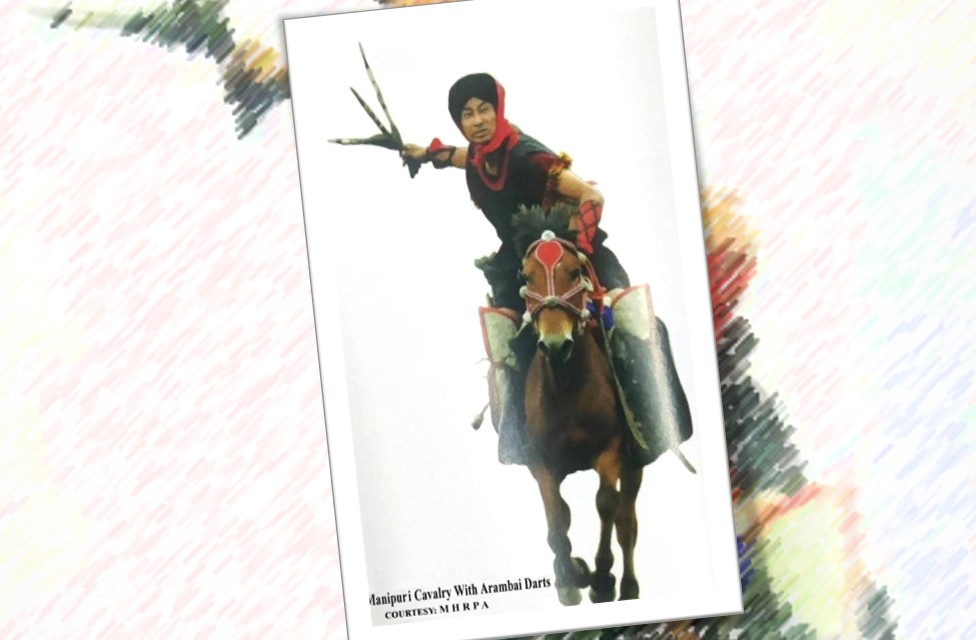
Among these groups, the Cassay—known natively as the Meitei or Manipuri, and termed Kathe by the Burmese—occupied a unique position. Renowned for their unparalleled equestrian skills, these horsemen were systematically captured during Konbaung raids into the Imphal Valley and relocated to the royal capitals of Ava, Sagaing, and Amarapura. Rather than being reduced to mere agrarian serfs, the elite of these captives were integrated into the Kathe Horse, a premier cavalry division directly accountable to the Hluttaw (Royal Council). This paper argues that the Cassay cavalry functioned as a crucial tactical asset that enabled Burma to project power across vast distances, successfully re-engineering the geopolitical map from the borders of Bengal to the heart of Siam. The military effectiveness of the Cassay cavalry rested on an ancient martial ecosystem developed in the unique wetlands and hills of Manipur. Unlike the heavy, lumbering cavalry of the contemporary Indian subcontinent or the infantry-heavy levies of the Southeast Asian lowlands, the Cassay units relied on the Manipuri pony. This breed was small, exceptionally hardy, and capable of navigating the dense jungles, muddy riverbanks, and rugged mountain passes that characterised the Indo-Burmese frontier. The defining 4 weapon of the Cassay horseman was the Arambai—a lightweight, aerodynamically balanced throwing dart made of iron and feathered with peacock quills. Often dipped in plant-based toxins, these darts were hurled with devastating accuracy while the pony was at a full gallop. Because the Cassay riders practiced Sagol Kangjei (an early form of polo), they possessed extraordinary core strength and balance, allowing them to hang off the sides of their mounts to use the horse as a shield while firing or throwing weapons. When integrated into the Konbaung army, these horsemen functioned as scouts, flank guards, and shock troops capable of breaking infantry squares before the enemy could reload their matchlocks.
Imperial Cartography and the Fall of Ayutthaya
The most consequential geopolitical manifestation of Konbaung military policy was the total destruction of the Ayutthaya Kingdom in 1767. In this campaign, orchestrated by King Hsinbyushin, the Cassay cavalry proved indispensable. The traditional historiography of the Siamese-Burmese wars focuses heavily on elephant warfare and siege artillery. However, the logistical challenge of moving thousands of troops from the dry zones of Burma into the flooded plains of the Chao Phraya basin required a highly mobile vanguard. Hsinbyushin deployed the Cassay cavalry to encircle Ayutthaya, cutting off its supply lines from the maritime ports and northern principalities. The rapid movement of the Kathe horsemen prevented the Siamese from gathering their provincial armies, forcing them into a protracted, isolated defense within the city walls. By neutralizing the countryside, the cavalry allowed the Burmese infantry to systematically construct siege works. The subsequent fall of Ayutthaya completely redrew the map of modern Thailand, shifting the Siamese center of power southward to Thonburi and eventually Bangkok, while permanently altering the borders of the Tenasserim region.
The Sino-Burmese Wars (1765–1769)- The Sino-Burmese Wars represented one of the most significant military challenges to the Konbaung state, pitting the expanding Burmese empire against the apex of Qing Dynasty military power under the Qianlong Emperor. The conflict was fought in the highly unforgiving, mountainous terrain of the Shan States and the deep gorges of the Salween and Mekong rivers. Here, the traditional heavy cavalry models of Eurasia were useless, but the Cassay horsemen proved to be an invaluable tactical counterweight. The Qing invading forces relied heavily on their elite Green Standard Army infantry and Eight Banner vanguard forces. However, these troops were unfamiliar with guerrilla-style warfare in dense tropical highlands.
King Hsinbyushin strategically deployed the Cassay cavalry alongside Shan levies to execute high-mobility ambush tactics. The Cassay units exploited their ponies’ ability to navigate narrow mountain ridges. They bypassed the main Qing columns to strike at vulnerable supply trains and communication lines. During the decisive Battle of Maymyo (1768), Cassay riders used hit-and-run tactics with poison-tipped Arambai darts to panic the Qing baggage animals, creating mass confusion in the valleys. By cutting off supplies and harassing retreats, the highly mobile Cassay cavalry helped force the Qing forces into a war of attrition they could not win, ultimately leading to the 1769 Treaty of Kaungton.
The Western Front
Projecting Power Toward British India- By the early nineteenth century, the Konbaung state turned its imperial focus westward. Led by the legendary general Maha Bandula, Burmese forces aggressively annexed Arakan (1784), Assam (1817), and Manipur (1819). This expansion brought the Burmese Empire into direct, volatile contact with the borders of British India, triggering the First Anglo-Burmese War (1824–1826).
On this western front, the Cassay cavalry played a complex, double-edged role: Subjugation of the Frontier: During the initial conquest of Assam and the Brahmaputra valley, the Konbaung state used previously conscripted Kathe horsemen to run down local resistance. Their speed allowed the Burmese to project power over vast, roadless wetlands much faster than the British East India Company anticipated.
The Shock at Ramu (1824):
At the Battle of Ramu (in modern Bangladesh), Maha Bandula achieved a stunning early victory against British native infantry. Cassay outriders successfully scouted British positions through dense jungle and led a flanking maneuver that panicked the sepoy lines, demonstrating that local mobility could defeat European-trained defensive formations in tropical environments.
The Weapon of the Enemy:
The geopolitical map flipped dramatically when the British began weaponizing the geopolitical displacement caused by 7 Burma. Recognizing the elite status of the Meitei horsemen, British authorities backed Gambhir Singh, a displaced prince of Manipur. Gambhir Singh formed the Manipur Levy—a force composed heavily of expert Cassay horsemen.
Equipped with British firearms but retaining their traditional equestrian agility, this counter-force waged a highly effective guerrilla campaign. They successfully expelled the Burmese forces from the Imphal Valley and the Kabaw Valley, permanently halting Konbaung westward expansion and securing the eastern frontier for the British Empire.
Geopolitical Re-Engineering
The deployment of the Cassay cavalry across two centuries fundamentally restructured the borders of modern South and Southeast Asia. Through the forced integration of the Cassay Horse, the Konbaung monarchs built a military machine capable of fighting a multi-front war against a global empire (Britain) and a regional superpower (Qing China) simultaneously. While the industrial firepower and steamships of the British eventually rendered cavalry obsolete by 1826, the historical footprints of these Manipuri horsemen remain etched into the modern borders dividing India, Myanmar, and Thailand today.
The Roots of Tactical Emulation
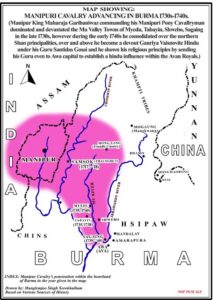
The tactical brilliance of the Cassay Horse in the late eighteenth century was not a sudden innovation; it was the direct legacy of the Sagol Lanmi (Cassay/Meitei cavalry) and their devastating asymmetric campaigns during the early 1700s. By looking at the lightning raids executed under Maharaja Garibaniwaz (Pamheiba) (1709-1748), we find the strategic blueprint that later reshaped the military thinking of the region. This evolution bridges the frontier warfare of the Mu Valley with the epic confrontations against the global superpower of East Asia, the Qing Manchu Empire.
The Genesis of Terror – Garibaniwaz and the Mu Valley Raids (1725 1740s)
The foundational doctrine of the Cassay cavalry’s ambush strategy was forged during the zenith of the Kanglei (Manipur) Kingdom under Maharaja Garibaniwaz. Between 1725 and 1749, the Meitei Sagol Lanmi transformed Upper Burma into a theater of relentless asymmetric warfare. Operating deep within the heartland of the declining Toungoo Dynasty, these highly mobile elite forces avoided fixed positional warfare. Instead, they perfected the art of the large-scale ambush. The Meitei cavalry leveraged the thick elephant grass (kaing) and seasonal swamps flanking the Mu Valley, Shwebo, Tabayin, and Myedu to hide entire regiments.
The Blueprint of the Ambush
The Sagol Lanmi would deploy small vanguard units to bait larger Burmese columns into advancing. Once the lumbering 8 Burmese infantry was stretched thin across the terrain, hidden horsemen would suddenly emerge from the flanks at a full gallop.
The Shock Weapon:
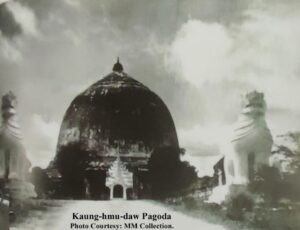
Before the enemy could form defensive squares or effectively deploy matchlocks, the riders unleashed volleys of poison-tipped Arambai darts. The terrifying speed of these attacks allowed a comparatively small cavalry force to slaughter much larger imperial levies. This was famously demonstrated when Garibaniwaz’s horsemen routed a royal army and struck the eastern gateway of the Kaunghmudaw Pagoda near Ava in 1738.
The Young Witness – Alaungpaya at Shwebo
This era of Meitei cavalry supremacy left an indelible mark on a young boy growing up in Moksobo (modern-day Shwebo) named Aung Zeya—the future King Alaungpaya. During his childhood and adolescence, Aung Zeya witnessed firsthand the total inability of the Toungoo royal state to defend the Mu Valley against the lightning attacks of the Meitei horsemen. He saw towns like Tabayin and Myedu burned, livestock swept away, and entire populations relocated to Imphal. Alaungpaya learned a vital lesson from these defeats: infantry-heavy empires in Southeast Asia could not survive without dominating the mobility space. When he ascended the throne and founded the Konbaung Dynasty in 1752, his immediate institutional priority was to capture and co-opt the very mechanism that had terrorized his childhood home. By launching retaliatory invasions into Manipur (1758-1759), the Konbaung state systematically absorbed these master horsemen. They institutionalized the Meitei ambush doctrine into the elite royal guard, officially naming them the Cassay Horse.
Scaling the Asymmetric Model
Defeating the Qing Giant -When the Qing Manchu Army invaded Burma in the 1760s, they brought an imposing war machine built on massive logistics, heavy infantry, and disciplined Eight Banner cavalry. Faced with this overwhelming numeric and material superiority, the Konbaung generals did not alter their tactical playbook. Instead, they scaled the original Meitei ambush doctrine.
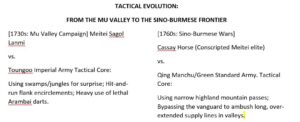
The Manchu forces expected open-field cavalry engagements where their superior numbers could envelope the enemy. Instead, the Cassay Horse treated the rugged, forested valleys of the Shan States exactly like the tall grass plains of the Mu Valley.
Logistical Asphyxiation:
The Cassay riders used their small, sure-footed Manipuri ponies to traverse vertical mountain paths that the larger horses of the Qing could not navigate.
The Defile Ambush:
They allowed the massive Qing vanguard to pass deep into narrow river valleys before striking. Hidden in the dense tropical canopy, the Cassay Horse would swoop down on the overextended baggage trains and supply columns.
Chaos via Arambai:
The terrifying rain of silent Arambai darts killed draft animals and baggage handlers without revealing the attackers’ positions. This shattered Qing communications, isolated their frontline infantry, and left them starving in the highlands.
By adapting the centuries-old martial tradition of the Meitei state, the Konbaung Empire successfully forced the largest army in Asia into a humiliating bottleneck at the Battle of Maymyo.
The Chronological Historiography of the Sagol Lanmi.
To fully understand the tactical blueprint that Alaungpaya witnessed and King Hsinbyushin later weaponised, one must look beyond the Cheitharol Kumbaba. As a daily court chronicle, the Cheitharol Kumbaba meticulously logs accessions, eclipses, royal deaths, and administrative decrees, but it rarely delves into tactical methodology. The granular mechanics of the Sagol Lanmi (Meitei cavalry) are instead preserved in the specialized military texts of Manipur:
The Ningthourol Lambuba:
This text provides vivid topographical and martial context, detailing the precise geographic routes, battlefield deployments, and psychological stratagems used by Meitei monarchs during their territorial expansions.
The Awa Ngamba (Conquest of Burma):
This text acts as a dedicated military manual and historical record of Manipur’s crushing victories over the Toungoo forces, illustrating how the Arambai was deployed in coordinated salvos to shatter enemy infantry lines.
The Samjok Ngamba (Conquest of Hsawnghsup):
This work details frontier warfare tactics against Shan principality demonstrating how Meitei horsemen mastered the art of amphibious and marshland war-fare and defeating the enemy with devastating effect.
These texts collectively show that Maharaja Garibaniwaz did not just command a military force; he operated a highly evolved doctrine of asymmetric mobile warfare that the Burmese state spent the next century attempting to replicate.
King Hsinbyushin and the Perfection of the Cassay Doctrine
When King Hsinbyushin (r. 1763–1776) ascended the Konbaung throne, he inherited an empire facing an existential crisis. The Qing Dynasty, under the Qianlong Emperor, launched four massive invasions to crush the rising Burmese power. Hsinbyushin, a brilliant military strategist, recognized that the traditional Burmese infantry levies would be utterly overwhelmed by the sheer mass of the Manchu armies. Hsinbyushin’s genius lay in his organizational restructuring of the Cassay Horse. Instead of treating them as captured auxiliaries, he elevated the Meitei cavalry to the core vanguard of his defensive strategy. He reverse engineered the exact tactics documented in the Awa Ngamba—which had once devastated the Toungoo Burma—and turned them against the Qing.
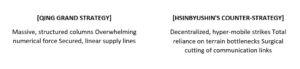
The Logistics of Highland Asymmetric Warfare; Managing a cavalry force in the dense, mountainous jungles of the Shan States was a logistical nightmare. Heavy warhorses would starve or succumb to disease. Hsinbyushin exploited the unique biological advantages of the Manipuri pony managed by the Cassay riders:
- Foraging Independence: Unlike the large Qing mounts that required massive fodder transport, the Manipuri ponies were highly adaptive browsers, capable of surviving on wild bamboo shoots and forest grass. This eliminated the need for vulnerable supply trains for the cavalry itself.
- The Sylvan Screen: Hsinbyushin used the Cassay Horse as a living radar network. Spread across the dense canopy of the Shan hills, these horsemen provided the Hluttaw (Royal Council) with real-time intelligence on Qing troop movements, while completely blinding the Qing scouts through targeted assassinations using the silent Arambai.
TACTICAL EXECUTION AT THE BATTLE OF MAYMYO (1768)
THE BAIT:
Burmese infantry units feigned a chaotic retreat into the narrow defiles of Maymyo.
THE LOGISTICAL CUT:
The Cassay Horse, navigating vertical mountain passes thought impassable by the Qing, swooped down on Mingrui’s rear guards, cutting off the food supply from Yunnan.
THE ARAMBAI STORM:
As starvation set in, the Qing army attempted to retreat. The Cassay cavalry emerged from the thick jungle flanks, unleashing volleys of poison-tipped Arambai darts. The silent, lethal rain panicked the Qing vanguard, causing a total collapse of command.
The Masterstroke: The Battle of Maymyo (1768)
The peak of this tactical emulation occurred during the third Qing invasion. The Manchu General Mingrui led an elite army deep into Burmese territory, aiming for the capital of Ava. Hsinbyushin refrained from a general engagement, instead ordering the Cassay Horse to execute a classic Meitei Sagol Lanmee style of encirclement. Mingrui’s army was systematically dismantled. Out of thirty thousand elite Qing troops, only a fraction escaped back to China, and Mingrui himself committed suicide to avoid capture. Hsinbyushin had successfully scaled Garibaniwaz’s frontier ambush tactics into a geopolitical shield capable of defeating the wealthiest empire on Earth.
Institutionalizing the Secret Weapon
Khura Letpa and the Command Structure of the Cassay Horse; the transformation of the Meitei tactical doctrine from a frontier guerrilla technique into an institutionalized imperial strategy was orchestrated by an elite cadre of assimilated Meitei leaders. Chief among these figures was Khura Letpa, a master tactician and military commander from Manipuri diaspora who rose through the ranks of the Konbaung state apparatus. Recognizing his profound understanding of asymmetric warfare, King Hsinbyushin elevated him to the Hluttaw Council (the Royal Assembly), granting him the prestigious Burmese noble title of Minye Sithu.
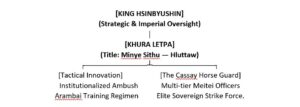
As a member of the Hluttaw, Khura Letpa acted as the primary military advisor to the crown and the de facto commander-in-chief of the Cassay Horse. He served as the vital bridge between the royal court at Ava and the lower-tier commands of the newly formed Cassay Horse regiments, which were led by subordinate Meitei chieftains and veteran riders. Under his leadership, the traditional Sagol Lanmi tactics described in the Ningthourol Lambuba were formalized into a highly classified, rigorously rehearsed martial curriculum— becoming the special secret weapon of the Konbaung war machine.
The Secret Curriculum of the Cassay Horse
Under Minye Sithu’s command, the Cassay Horse operated with an insular, highly secretive organizational structure. This secrecy was paramount; if the Qing or the Siamese forces decoded the mechanics of their mobility and ambush patterns, the tactical advantage would be lost.
Weaponization of the Arambai:
Khura Letpa standardized the manufacture and deployment of the Arambai. He established specialized workshops within the Meitei quarters of Upper Burma to craft the aerodynamically precise darts, ensuring that the specific chemical compositions of the plant-based fast-acting toxins remained a closely guarded secret.
The Code of the Flank Attack:
He trained his lower-tier commanders to read subtle environmental cues—such as the flight patterns of jungle birds or the rustle of kaing grass—to coordinate multi-directional ambushes without using loud horn signals that could alert the enemy.
The Elastic Retreat:
Drawing directly from the tactical successes against the Toungoo Dynasty, Khura Letpa perfected the “elastic retreat.” He trained his horsemen to feign panic and split into small, disorganized groups, drawing the overconfident Qing vanguard deeper into pre-arranged kill zones where the main Burmese infantry lay in wait.
By placing a Meitei military mastermind at the highest level of state governance, Hsinbyushin ensured that the Cassay Horse was not merely used as cannon fodder, but as a razor-sharp scalpel. Khura Letpa’s integration into the Hluttaw allowed the Konbaung Empire to seamlessly merge Meitei tactical agility with Burmese imperial logistics. This fusion transformed a captured population into the ultimate protectors of the realm, establishing a legacy of asymmetric excellence that baffled foreign empires for generations.
The Western Front
The institutional framework established by Khura Letpa (Minye Sithu) outlived his tenure in the Hluttaw, serving as the bedrock of Konbaung military strategy well into the nineteenth century. As the Burmese Empire turned its expansionist gaze westward toward the fertile plains of the Brahmaputra Valley and the strategic maritime corridors of Arakan, the Cassay Horse was once again called upon to spearhead the imperial advance. However, the geopolitical terrain of the western front presented an entirely new matrix of challenges. Instead of the mountainous defiles of the Shan States or the heavily fortified urban brick walls of Ayutthaya, the Indo-Burmese frontier was a labyrinth of volatile, waterlogged ecosystems—comprising the expansive riverine floodplains of Assam, the dense, malaria-ridden jungles of Cachar, and the precipitous ridges of the Arakan Yoma. To project power across this formidable landscape, Konbaung commanders had to meticulously deploy the highly classified asymmetric doctrines that Khura Letpa had integrated into the royal guard.
The Strategic Blueprint of Maha Bandula and the Cassay Vanguard
When the legendary Burmese General Maha Bandula launched his multi-pronged western campaigns in the early 1820s, he relied heavily on the specialized scout-and ambush capabilities of the Cassay Horse. Bandula understood that the disciplined line infantry of the British East India Company excelled in open, conventional battlefields where synchronized musket fire could devastate an oncoming enemy. To counter this, the Cassay Horse executed the classic “Sylvan Screen” doctrine, avoiding direct frontal charges and instead exploiting the natural cover of the landscape.
The Amphibious Encirclement:
Utilizing the unique physiological adaptations of the Manipuri pony, which was uniquely adept at swimming across swift rivers and navigating waist-deep mud, the Cassay Horse routinely bypassed British defensive outposts. They moved silently through terrain that European officers explicitly deemed impassable for cavalry.
The Shock at Ramu (1824):
At the Battle of Ramu, located on the frontier of modern Bangladesh, this tactical mobility achieved its most stunning success. As British native infantry (sepoys) attempted to hold a defensive line behind a riverbank, Cassay outriders, operating under the cover of dense tropical mist, conducted a rapid flanking maneuver. Emerging from the tall grass, they unleashed devastating volleys of Arambai darts, disrupting the British defensive formations and causing a widespread panic that completely shattered the sepoy lines.
The Ultimate Geopolitical Inversion – The Manipur Levy
The very factor that made the Cassay Horse a devastating “secret weapon”—its deeply rooted origin in the distinct martial traditions of the Meitei state—ultimately triggered its geopolitical inversion. The Konbaung Empire’s aggressive subjugation of Manipur had left the Imphal Valley deeply fractured, driving members of the Meitei royalty into exile in British-protected territories. Recognizing that conventional European military tactics were failing against the high-mobility guerrilla strategies of the Burmese, British authorities made a crucial tactical pivot: they decided to weaponize the original masters of the asymmetric doctrine against the Konbaung state.
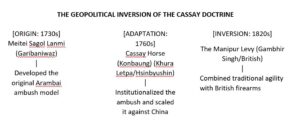
In 1825, the British East India Company provided financial backing, muskets, and tactical support to Maharaja Gambhir Singh, an exiled prince of Manipur, to form an elite paramilitary unit known as the Manipur Levy.
The Fusion of Doctrines:
The Manipur Levy was composed entirely of expert Meitei horsemen who possessed the exact same equestrian lineage and mastery of the Arambai as the Cassay Horse fighting for the Burmese crown. However, Gambhir Singh augmented this traditional agility by equipping his riders with lightweight British Rifles and pistols.
Dismantling the Konbaung Machine:
The resulting force was a devastatingly effective hybrid. Operating in the dense jungles of the frontier, the Manipur Levy turned Khura Letpa’s exact ambush strategies against the overextended Burmese occupational forces. They cut off Konbaung supply lines, executed rapid night raids on Burmese stockades, and used their intimate knowledge of the terrain to systematically flush out the imperial garrisons.
By the conclusion of the First Anglo-Burmese War in 1826, the Manipur Levy had completely expelled the Konbaung forces from the Imphal and Kabaw Valleys. The signing of the Treaty of Yandabo permanently halted Burma’s westward imperial expansion, formalized a rigid international border between British India and the Konbaung Kingdom, and brought an end to the era where the Cassay Horse could unilaterally dictate the geopolitical realities of the Indo Burmese frontier.
Socio-Political Legacy, Assimilation, and the Metamorphosis of Identity
The military decline of the Konbaung Empire following the Treaty of Yandabo (1826) did not erase the footprint of the Meitei horsemen from the heartland of Burma. Instead, it accelerated a profound socio-political metamorphosis. The descendants of the Sagol Lanmi, who had entered the Irrawaddy valley as captive warriors (Awa-khun or Kathe), evolved into an elite socio-military aristocracy. Under the patronage of the later Konbaung monarchs—particularly King Mindon (r. 1853–1878)—the Cassay Horse (Kathe Mye-bo) retained their position as the preferred sovereign strike force, even as the global paradigm of warfare shifted around them.
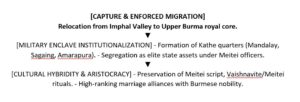
Spatial Segregation and the Sacred Geography of Upper Burma- To ensure that the “secret weapon” remained organized and readily deployable, the Konbaung state settled the Cassay populations in dedicated, ethnically segregated military enclaves surrounding the successive royal capitals of Sagaing, Amarapura, and Mandalay. These enclaves—which survive today in Burmese toponymy as the Kathe Seikh (Kathe Jetty) and Kathe Win (Kathe Quarters)—were structured as self-governing military colonies.
The Equestrian Commons: Each enclave was granted extensive royal grazing lands (mye-marn) specifically designated for the breeding and training of the Manipuri pony. This spatial arrangement ensured that the unique equestrian ecosystem described in the Ningthourol Lambuba was replicated inside the dry zone of Burma.
Dual Identity Structures: The state recognized a hereditary class of Meitei officers who held a dual administrative mandate. In the Burmese court, they wore the silk robes of the Amartya (ministers) and held high-ranking titles. Within their enclaves, they ruled as traditional Ningthou (chiefs), enforcing Meitei customary law and preserving the sacred martial genealogies of their clans.
The Twilight of the Arambai: Industrial Warfare and the Fall of Mandalay
As the late nineteenth century advanced, the tactical ecosystem that had defeated the Qing Empire faced an existential threat: the industrialization of violence. The British Empire’s rapid deployment of steam power, quick-firing artillery, and the Maxim gun fundamentally altered the geometry of the Southeast Asian battlefield.
During the Third Anglo-Burmese War (1885), the Konbaung state made a desperate, final attempt to deploy the Cassay Horse. Operating under the direct commands of the descendants of Khura Letpa’s lineage, Meitei outriders were sent south down the Irrawaddy corridor to scout and ambush the British advance forces. However, the British did not march their infantry through the dense jungle choke points where the Arambai could be effective. Instead, they bypassed the terrestrial bottlenecks entirely, utilizing a massive flotilla of armored steamships armed with heavy naval artillery to move directly up the river. The Cassay Horse, trapped on the riverbanks, found themselves exposed to long-range explosive shelling that their small, agile ponies could neither outrun nor evade. The capture of King Thibaw and the subsequent fall of Mandalay in 1885 marked the formal end of the Konbaung Era—and with it, the dissolution of the Cassay Horse as an official state institution.
Conclusion
(The Cartographic Legacy of the Cassay Cavalry).
The role of the Cassay (Kathe/Manipuri) cavalry in re-engineering the Southeast Asian geopolitical map provides a striking counter-narrative to traditional Eurocentric histories of empire-building. The modern borders dividing India, Myanmar, and Thailand are not merely the arbitrary lines drawn by British colonial surveyors; they are the permanent scars left behind by a centuries-long struggle for military and mobility dominance between the Manipur state and the Konbaung Empire.
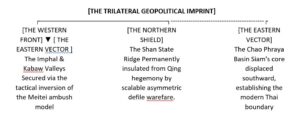
Through the strategic insights of military masterminds like Maharaja Garibaniwaz, who engineered the original ambush doctrine, and Khura Letpa (Minye Sithu), who institutionalized it as Burma’s premier secret weapon, a small frontier community’s martial heritage was scaled into an imperial shield. By adapting the agile Manipuri pony and the lethal Arambai to defeat the massive armies of the Toungoo Dynasty, the Ayutthaya Kingdom, the Qing Manchu Empire, and the British East India Company, these elite horsemen proved that asymmetric mobility could dismantle the conventional war machines of Asia’s largest empires. Though their weapons have faded into historical texts like the Awa Ngamba and the Ningthourol Lambuba, the strategic footprint of the Cassay Cavalry remains permanently etched into the political cartography of modern South and Southeast Asia.
REFERANCES
- Arambam Parratt, S. N. (2005). The court chronicle of the kings of Manipur: The Cheitharol Kumbaba: Vol. I. 33–1763 C.E. Routledge.
- Arambam Parratt, S. N. (2019). The court chronicle of the kings of Manipur: The Cheitharol Kumbaba: Vol. II. 1764–1843 C.E. (Renewed & rev. ed.). P.C. Jain Building.
- Brahmacharimayum, K. S. (2000). Meidingu Garibaniwaz. Chirom Jugeshwar Singh.
- Harvey, G. E. (1925). History of Burma: From the earliest times to 10 March 1824. Longmans, Green and Co.
- Kabui, G. (1991). The history of Manipur: Vol. I. Pre-colonial period. National Publishing House.
- Lairenmayum, I. S., & Ningthoukongjam, K. S. (Eds.). (1967). Cheitharol Kumbaba [The royal chronicle of Manipur]. Manipuri Sahitya Parishad.
- Lieberman, V. B. (1980). Transfer of Burmese capital from Pegu to Ava. Journal of the Royal Asiatic Society of Great Britain and Ireland, (1), 64–83.
- Lieberman, V. B. (1984). Burmese administrative cycles: Anarchy and conquest, c. 1580 1760. Princeton University Press.
- Lieberman, V. B. (2003). Strange parallels: Southeast Asia in global context, 800–1830. Cambridge University Press.
- Lourembam, S. (2016). Sagol Kangjei. Sukham Ningol Rathamani Devi Samushang Uku.
- Oinam, B. S. (1967). Ningthourol Lambuba (Manipuri) (Vol. 1). J.M. Printing Works.
- Peterson, W. J. (Ed.). (2008). The Cambridge history of China: Vol. 9. Part one: The Ch’ing empire to 1800. Cambridge University Press.
- Phayre, A. P. (1883). History of Burma: Including Burma Proper, Pegu, Taungu, Tenasserim, and Arakan, from the earliest time to the end of the First War with British India. Trübner & Co.
- Tin, M. M. (1968). Konbaungzet Maha Yazawindawgyi [The great chronicle of the Konbaung dynasty] (Vol. 1). Thudhammawaddy Press.
- Tin, P. M., & Luce, G. H. (Eds. & Trans.). (1923). The glass palace chronicle of the kings of Burma. Oxford University Press.
- Tun, T. (Ed.). (1954–1981). The royal orders of Burma: Part three A.D. 1754–1781. Center for Southeast Asian Studies, Kyoto University.
- Tun, T. (Ed.). (1990). The royal orders of Burma, A.D. 1598–1885: Part ten: Epitome and index. Center for Southeast Asian Studies, Kyoto University.

The writer is a retired Inspector General of Police, Manipur. Prior to joining Manipur Police Department, he served as a lecturer of geography, Thoubal College (Govt), Manipur.