
I am at this crucial crossroads of my life’s journey, now in my mid-20s, some pals are in research, some are preparing for competitive exams. Meanwhile, in this journey, if I were to compare myself with older people, I feel young. As my parents’ oldest child, however, I am not young anymore.
Somewhere in this journey, Manipur became a current-affairs topic for aspirants. While in Central Delhi, I remember having a conversation with a senior from Manipur, over what one infamously calls ‘chai pe charcha’ that aspirants from Manipur, have been impacted so much by this violence that one had to take a year off from examination. While often fearful of being prejudiced as ‘katan’, ‘lairik paningdaba /paningdabi’, ‘nama napagi paisa manghanba /manghanbi’ as some tend to say so, it did impact.
Going back to the day the violence started, I vividly remember being in Vijaynagar. I ran to a Manipuri friend’s rent, for one may relate, as the news gets worse, it gets harder to be alone in your rented room. On the way, I met two friends from Uttar Pradesh. I told them Manipur might come under President’s Rule as it was all over the social media, and they said, “Sab thik ho jayega, sabr rakho.” I had no sabr. Sab thik nahi huwe. We did get President’s Rule, though much later, against the backdrop of continuing violence.
Manipur had the attention of many mainlanders asking what exactly was happening; from metro rides, to even evening walks in Mirabai Park, we often got bombarded with questions of the happenings in Manipur, and of course, their inquisitiveness was justifiable if one considers the scale of the violence.
Fast forward to 2025 and 2026, and I see that people have increasingly normalized the violence in Manipur. Suddenly, Manipur became every aspirant’s current affairs topic, making its way into last-minute revision schedules, YouTube lectures, and shorts by prominent coaching institutions. Quite saddeningly, the information was, at times, incorrect.
I know I am not young anymore to not be pissed when people talk about plurality, merely from the point of beauty. Diversity is indeed beautiful, but it has got to be met with a stance of equity, not as a mere decoration to the nation.
I am also old enough to know that honesty, spoken very bluntly, may not always go your way. A touch of eloquence and inclusive diplomacy goes a long way while your core remains truthful to your purpose.
The Gen Z has been popularized as doers, and also aggressors, especially while being active on social media. With this activeness comes a point where I find myself thinking: if violence erupts again, which has been very likely, this active online presence may come with pressure to react or talk our hearts out at the instant. While that is rightfully our freedom of expression, at one small note; even peer pressure to react instantly, makes it feel somewhat all for the show and prejudices that the people who do not post are the ones not affected at all.
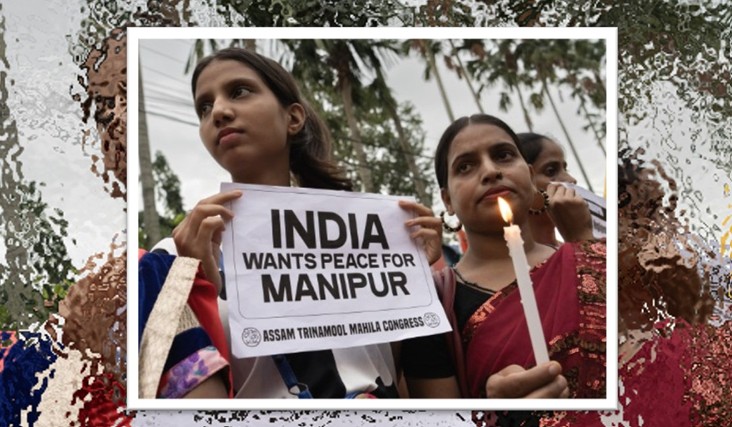
In the initial period of the violence, I remember typing out certain words, and I am now tired of those words, such as “I condemn.” Of course, I do condemn from the core of my heart, but it seems like a loop of action and reaction. Somewhere along the way, the violence in Manipur became normalized, both in public discourse and on social media. What was once lived trauma for many gradually became a current-affairs topic to be discussed, revised, and reacted to, while creating its own pressures on those directly affected to constantly respond.
My heart wails for how brutal the killings were. How I wish our hearts felt as strongly about restoring the overly used word “Peace.” Yet, with the violence continuing and the possibility of its resurgence never feeling too distant, peace remains more than a word waiting to be restored.
We will need a lot of time to heal.

The writer completed her postgraduation in Modern History from University of Delhi and her area of interest is in collective memory, historical trauma, conflict and healing relating to contemporary Manipur.

4 thoughts on “How the Turmoil Manipur Clouded its Gen-Z’s Vision of the Future, and how they Long for Peace and Healing”
❤️🙏🥺So beautifully written!
❤️🙏🥺Reading this felt deeply personal and heartbreaking. You put into words something many of us from Manipur have struggled to articulate—the exhaustion of watching our pain become a topic of discussion while still living through its consequences. The line about peace being an overly used word that still feels so distant stayed with me. Thank you for writing with such honesty, vulnerability, and grace,Riddhi. I hope one day we can read pieces like this as memories of a past we have healed from, not a reality we are still enduring.Best wishes, write more, thanks again for writing and giving voice to feelings we quietly carry😭❤️🫂
❤️🙏🥺Reading this felt deeply personal and heartbreaking. You put into words something many of us from Manipur have struggled to articulate—the exhaustion of watching our pain become a topic of discussion while still living through its consequences. The line about peace being an overly used word that still feels so distant stayed with me. Thank you for writing with such honesty, vulnerability, and grace,Riddhi. I hope one day we can read pieces like this as memories of a past we have healed from, not a reality we are still enduring.Best wishes, write more, thanks again for writing and giving voice to feelings we quietly carry😭❤️🫂
Loved this piece, beautifully written and straight from the heart.
Comments are closed.