Imphal/Ulaanbaatar – For the first time in its history, the world observed World Horse Day this July, following a landmark resolution adopted at the 79th session of the United Nations General Assembly. The resolution, titled “World Horse Day” (A/79/L.89) and introduced by President Khurelsukh Ukhnaa of Mongolia, was adopted on June 3, 2025, and proclaims July 11 of every year as a day to honour the horse’s role in human history, culture and livelihood. Fifty-six countries co-sponsored the resolution.
Mongolia – home to more horses than people, with an estimated 3.4 million horses for a population of roughly 3.3 million – marked the inaugural observance as part of its grand Naadam Festival, held annually from July 10 to 13. Naadam, centred on the “three manly games” of wrestling, archery and horse racing, is Mongolia’s most important national celebration, and this year’s edition doubled as the global stage for World Horse Day, with an opening ceremony at Khui Doloon Khudag outside Ulaanbaatar. Introducing the resolution at the UN, Mongolia’s Permanent Representative described the horse as one of the most consequential animals in human history, citing its enduring role in transport, agriculture, sport and tourism.
Manipur’s Own Chapter in Equine History
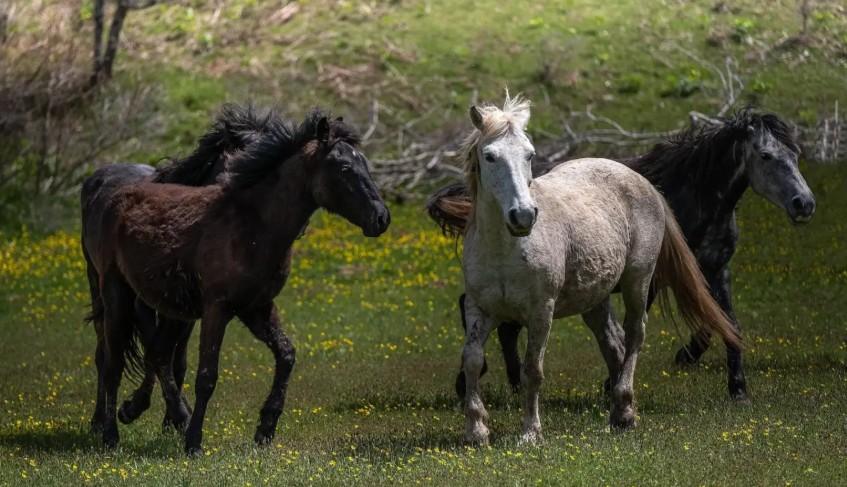
Nearly 3,500 kilometres to the south, in India’s north-eastern state of Manipur, the occasion carries a resonance of its own. Long before the UN resolution existed, Manipur had already built an entire civilisation around the horse – specifically, the small, hardy Manipuri pony, standing just 11 to 13 hands high but woven into the region’s statecraft, mythology, warfare and identity for close to two thousand years.
The Pony That Carried a Kingdom
For the ancient and medieval princely kingdom of Manipur, the pony was not a pastime – it was the instrument of sovereignty itself. The Cheitharol Kumbaba, the royal chronicle of the Ningthouja dynasty said to record the reigns of successive kings from the year 33 CE onward, repeatedly documents the horse-mounted authority through which Manipur’s monarchs asserted, defended and expanded their realm. The chronicle recounts how King Khagemba, in the early seventeenth century, rode a white charger at the head of his cavalry to extend Manipur’s sway eastward to the Chindwin river – a campaign later cited to substantiate the kingdom’s claim over the Kabaw Valley. Historians of Manipur’s military organisation note that by the fifteenth century, under King Punshiba (1404-1432 CE), the kingdom had already formalised a structured military system in which cavalry, drawn from ponies bred in the valley’s own wetlands, formed the most effective arm of the state’s forces.
So renowned were Manipur’s horsemen that after the Burmese conquest of 1758, the Konbaung court of Burma pressed captured Manipuri riders and their mounts into its own army as the “Cassay Horse Cavallari” – a force that, at its height, made up roughly two-thirds of Burma’s entire cavalry strength and campaigned as far afield as the Burmese – Siamese wars. That a neighbouring empire built a significant part of its military power on captured Manipuri horsemanship is itself a measure of how deeply the pony was bound up with the kingdom’s standing among the powers of the region.
This same animal that carried kings into battle and upheld the sovereignty of the Manipuri state also carried the rituals and games of its people. The Manipuri pony is widely regarded by equestrian historians as the original polo pony. Local tradition traces Sagol Kangjei, a cavalry-honed game and forerunner of modern polo, to the same martial tradition that produced Manipur’s horsemen; the Mapal Kangjeibung ground in Imphal, still in use today, is recognised as the oldest functioning polo ground in the world. It was here, in the 1850s, that British tea planters and soldiers first encountered the game, later carrying it to Silchar-Calcutta, England and the wider world.
Beyond statecraft and sport, the pony occupies a sacred place in Manipuri, or Meitei, cosmology. It is venerated as a manifestation of Samadon Ayangba, a mythical winged horse of Manipuri folklore, and ponies remain central to Lai Haraoba, the traditional festival honouring the Umang Lai forest deities (Sacred Groves) – a role not unlike the horse’s place at the heart of Mongolia’s Naadam. Taken together, the chronicle record, the martial tradition, the sport and the ritual life built around the pony form the connective tissue of a distinct Manipuri civilisation stretching back roughly two millennia.
A Crossroads of Civilisation
Scholars and cultural historians note that the pony’s significance in Manipur goes well beyond ritual and recreation. Sitting at the strategic crossroads between South Asia and Southeast Asia, the Manipuri kingdom used its cavalry to project power, defend its frontiers and maintain its sovereignty along the routes connecting the Indian subcontinent with Myanmar and onward to mainland Southeast Asia. It was precisely this location – and the mobility the pony gave its rulers – that allowed a comparatively small valley kingdom to hold its own for centuries against larger neighbouring powers, including the Ahom kingdom of Assam and the Konbaung empire of Burma. The Manipuri pony, some equine experts argue, may itself descend from hardy Central Asian and Mongolian stock – a living thread connecting the steppe traditions celebrated at Naadam with the valley traditions of Manipur.
This geographic position has long made Manipur a bridge of cultures, statecraft and commerce between two of Asia’s great civilisational zones – a role in which the pony, as warhorse, throne-bearer and sporting companion, was indispensable to nearly two thousand years of continuous political and cultural life.
An Endangered Legacy
The observance of World Horse Day also arrives at a sobering moment for Manipur’s pony. Conservationists have repeatedly flagged the breed as critically endangered, its numbers falling sharply as urbanisation and encroachment destroy the marshy commons where ponies traditionally grazed and bred. A heritage park established in 2005 by the Manipur Horse Riding and Polo Association, along with a formal breed standard adopted in 2009, represent efforts to reverse this decline.
The cause has also been pressed at the highest levels of government. During discussion on the Wild Life (Protection) Amendment Bill-2021 in the Lok Sabha on August 2, 2022 – a debate on record in the Lok Sabha transcript of that sitting – DR. Rajkumar Ranjan Singh, then Union Minister of State External Affairs and Education and a Member of Parliament from Inner Manipur, intervened to draw the attention of the Prime Minister’s office to the plight of the Manipuri pony, urging that it be taken up as a dedicated national conservation project on the lines of Project Tiger, India’s flagship species – conservation programme launched in 1973. He has separately raised the issue during Zero Hour on another sitting of the House, underscoring it as a recurring concern rather than a one-off intervention.
The Minister has also drawn on personal experience of Mongolia’s own horse culture. During an official visit to Ulaanbaatar from November 23 to 25, 2021, he observed first-hand the scale of Mongolia’s pony and horse population – a country that maintains more horses than people. In a casual conversation with Mongolia’s Ambassador to India, Mr. Ganbold Dambajav, the Minister raised the possibility of sourcing live breeding stock or frozen semen from Mongolian ponies to widen the genetic base and boost the dwindling population of the Manipur pony, an idea that echoes scholarly suggestions that the two breeds may share common Central Asian ancestry.
As the global community marks World Horse Day, advocates in Manipur see an opportunity: to draw the same international attention that Mongolia has secured for its equestrian heritage toward the preservation of the Manipuri pony – not as a sporting animal alone, but as the very seat on which a princely kingdom built and defended its sovereignty for close to two thousand years, at one of Asia’s most consequential crossroads.

The writer is a former Member of Parliament and a former Union Minister of State External Affairs and Education, Government of India.