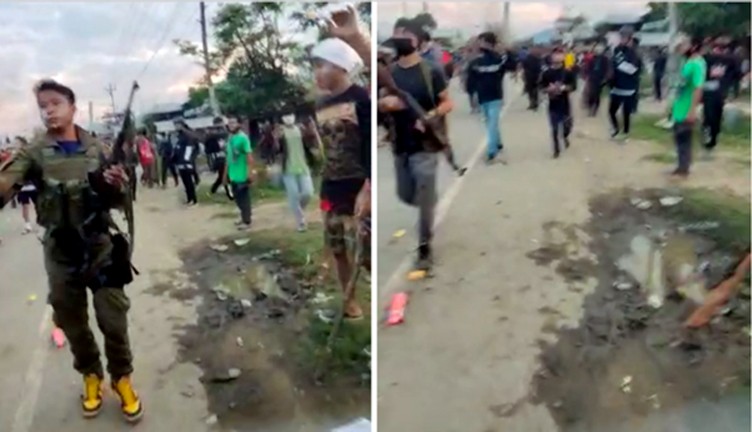
When violence broke out in Manipur on May 3, 2023, it shocked the Manipuris – if not India as whole – with its speed, intensity, and brutality. Overnight, villages were set ablaze, homes destroyed, and neighbours turned against each other. The violent attacks by Kuki-Zomis against the Meiteis in the Kuki-Zomi dominated districts and the retaliatory actions of the Meiteis against the Kuki-Zomis in Imphal spiralled into one of the worst violent conflicts the State had witnessed in decades. The human cost was staggering – thousands displaced, hundreds killed, and deep scars etched into Manipur’s fragile social fabric.
In the months that followed, in March 2024, the People’s Union for Civil Liberties (PUCL) constituted an Independent People’s Tribunal (IPT) to document, analyse, and shed light on the events. Their report, recently released on August 20, 2025, is a voluminous account of what they describe as the “ongoing ethnic conflict in Manipur.” Here, the Chapter 4: Events of Violence of the report is critically analysed as at its heart the chapter lies, which attempts to reconstruct the path to May 3 and the days that followed. The Executive Summary also said, “Chapter 4 is a critical exposé of the systematic ethnic violence that unfolded in Manipur, rooted in long-standing grievances but triggered by political and judicial insensitivity, and enabled by organized militias and state complicity.”
The chapter is detailed, methodically sourced, and ambitious in scope. It traces a chain of events – eviction and land surveys affecting Kuki-Zomi villages, the Meitei demand for Scheduled Tribe (ST) status, controversies over recruitment reservations at the Regional Institute of Medical Sciences (RIMS), and a series of protests that escalated into open conflict. It situates the violence within a broader political climate marked by hate speech, government missteps, and simmering grievances. No doubt, in many ways, it is a necessary record in a time when truth itself is bitterly contested.
And yet, on closer reading, one begins to notice something troubling and a disquieting gap emerges. The chapter consistently foregrounds accusations made against Meiteis, accepts much of what was said by Kuki-Zomi groups, and sidelines the counter-narratives of Meitei survivors and organisations. For all its detail, the Tribunal’s narrative appears imbalanced. It gives ample space to Kuki-Zomi grievances as if tribal grievances of all the tribal people in Manipur, state failures, and government rhetoric but sidesteps the uncomfortable possibility that the violence was not entirely spontaneous – that it bore hallmarks of planning and militant orchestration. In doing so the chapter risks presenting a partial truth that may reinforce existing fault lines rather than bridge them.
The Story as the Tribunal Tells It
The Tribunal begins by rejecting the simplistic notion that the Manipur High Court’s April 2023 order – directing the Manipur government to consider including Meiteis in the Scheduled Tribe list—was the sole trigger of violence, which the majority of the Meiteis also argues. Instead, it insists that the roots ran deeper.
- Evictions of “illegal settlements”, especially the demolition of K. Songjang in Churachandpur district which sparked anger and mobilisation by groups like the Indigenous Tribal Leaders’ Forum (ITLF) and Kuki Students’ Organisation (KSO).
- The Meitei demand for ST status, portrayed largely as a threat to tribal land rights and reservations.
- Reservation dispute at the Regional Institute of Medical Sciences (RIMS), where tribals alleged they were denied their quota in clerical appointments and tribal bodies saw as systematic exclusion of their communities.
- Protests and shutdowns called by tribal groups – especially the All Tribal Students’ Union Manipur (ATSUM), which the Tribunal frames as defensive responses to government high-handedness.
The report then situates these tensions within a broader context – the Manipur government’s withdrawal from Suspension of Operation (SoO) agreements with certain Kuki-Zomi militant groups – Kuki National Army (KNA), Kuki Revolutionary Army (KRA) and Zomi Revolutionary Army (ZRA); growing discontent among BJP MLAs against the Nongthombam Biren government reflecting political instability; and a climate of hate speech where Chin-Kukis were named as “poppy cultivators,” “narco-terrorists,” and “illegal immigrants.”
It resists the temptation of reducing May 3 to a single cause. Instead, it reconstructs the multi-causal web of grievances, giving the reader a sense of the combustible atmosphere in which violence erupted. In this telling, the outbreak of violence is portrayed as a kind of inevitable eruption of “tribal grievances”, stoked by state repression and Meitei demands.
The Missing Lens of Non-Spontaneity
But here is where the Tribunal falters. By focusing so heavily on grievances and government missteps, it underplays – or almost ignores – another line of evidence: the claim that the violence was premeditated, coordinated, and militant-driven, particularly from the perspective of Meiteis.
This silence is telling. To probe non-spontaneity would have required confronting the role of Kuki-Zomi militants – the Zomi Revolutionary Army, Kuki National Army, and others – whose presence looms large in valley narratives. Instead, the report prefers to cast the violence as state-induced grievance spilling over, a framing that exonerates Kuki-Zomi militant agency.
For many in the valley, the events of May 3 were not simply a protest spiralling out of control. The scale of the destruction, the sophistication of weapons used, the near-simultaneous targeting of multiple localities – all suggested organisation. Survivor testimonies, widely reported in independent media, pointed to Kuki-Zomi armed groups descending on villages from the surrounding hills with sophisticated guns often far superior to the rifles looted later from police armouries, looting arms from a Meitei owned gun shop in Churachandpur town and police stations, and executing attacks that bore military precision.
The Tribunal does mention that ATSUM, in its April 29 statement, declared protests were “not a spontaneous phenomenon” but an outburst of grievances. But it treats this as evidence of tribal discontent, not as a hint that mobilisation was carefully planned. By failing to interrogate this angle, the chapter skirts around one of the central debates in Manipur – Was May 3 a people’s protest, or was it a militant-orchestrated assault dressed up as protest?
For a report that prides itself on collecting testimonies, the absence of Meitei survivor voices is striking. Where are the accounts of villagers describing how they were attacked? Where are the details of weapons used, or the timelines of coordinated assaults? Without these, the chapter risks appearing one-sided, leaning towards validating Kuki-Zomi perspectives as tribal perspectives while dismissing Meitei fears as overblown.
The Kuki-Zomi Militant Question
Closely tied to this omission is the chapter’s treatment of Kuki-Zomi militant groups.
It notes that the Manipur government withdrew from SoO agreements with Kuki militants in March 2023, even as the Centre continued with the agreement. It acknowledges that this decision bred discontent in Kuki-Zomi dominated areas. But it remains curiously silent on how these groups may have acted in the lead-up to May 3.
Government claims that protests were “propped up” by the Zomi Revolutionary Army and Kuki National Army are mentioned – but only to be dismissed as propaganda. Yet, the Tribunal does not subject Kuki-Zomi denials to the same scrutiny. The result is an asymmetry: the State is presumed manipulative, while Kuki-Zomi organisations are presumed authentic.
This is problematic. Even if one rejects the government’s narrative, the fact remains that Kuki-Zomi militant groups have long histories of armed mobilisation, extortion, and area domination, stationed with Central Security Forces side by side. To ignore their agency in an outbreak of large-scale armed violence is to leave a gaping hole in the story.
The State vs. the People Binary
Another limitation lies in the Tribunal’s framing of the conflict as a binary – State vs. Tribal Communities.
The narrative consistently casts the Manipur government as the aggressor – ordering evictions (which were not only in the Kuki-Zomi dominated areas only), demonising Kuki-Zomis, and violating reservation policies. Kuki-Zomi organisations, meanwhile, are framed as defensive actors responding to state excess. The Meitei community’s mobilisation is seen largely through the prism of privilege – a dominant group pushing into tribal rights.
What this framing neglects is the reality that both communities were fearful, insecure, and reactive. For the Meiteis, the demand for ST status was not simply about land greed, as the report implies, but also about fears of demographic marginalisation, cultural erosion and becoming refugee in their own native land. For the Kuki-Zomis, eviction drives and reservation disputes were seen as existential threats.
When Kuki-Zomi groups rejected allegations of being “illegal immigrants,” their denials are presented as conclusive, while Meitei allegations of cross-border illegal migration are dismissed as propaganda.
Moreover, the Tribunal underplays intra-tribal differences. Several Naga organisations, like United Naga Council (UNC) and All Naga Students’ Association, Manipur (ANSAM), Naga People’s Organisation (NPO) publicly distanced themselves from ITLF and Kuki-Zomi-led protests, even welcoming government action against “illegal encroachers.” By asserting Kuki-Zomis only the tribals in Manipur and homogenising “tribals” into one camp, the chapter flattens the complexity of Manipur’s hill politics.
Over-Reliance on Public Statements
A significant portion of the chapter relies on press releases, social media posts, and public statements. While these are important, they cannot substitute for deeper investigative work.
Take the vandalism of the open gym in Churachandpur ahead of the Chief Minister’s visit. The report notes that “suspected volunteers” of ITLF were responsible, but leaves it at that. Who organised it? How were they mobilised? Was it part of a larger pattern of escalating provocation? These questions remain unanswered.
Similarly, when discussing hate speech, the chapter documents Manipur Chief Minister Nongthombam Biren Singh’s inflammatory Facebook posts and the rhetoric of some Meitei organisations. This is valuable. But it does not equally analyse the circulation of militant propaganda among Kuki-Zomis or the rhetoric of Kuki-Zomi nationalist groups. The result is an uneven ledger of accountability.
What the Tribunal Gets the Chapter Right
To be fair, the Tribunal does perform an important service.
- It foregrounds state culpability, inflammatory rhetoric from the Chief Minister created fertile ground for mistrust.
- It highlights the role of hate speech, demonstrating how the entire Chin-Kukis were painted as “illegal immigrants”, “outsiders”, “poppy cultivators” and “narco-terrorists” in public discourse, justifying violence against them.
- It situates violence within a longer arc of grievances rather than reducing it to one trigger only.
For readers unfamiliar with Manipur, the chapter provides a timeline of grievances that helps readers understand why Kuki-Zomis felt besieged and an introduction to the fault lines that underpin the conflict.
Why Balance Matters
But the imbalance in representation matters because truth in Manipur is contested. Every narrative is weaponised. For Meiteis, the Tribunal’s silence on militant orchestration confirms their belief that outside observers are blind to their suffering. For Kuki-Zomis, its emphasis on State excess validates their sense of victimhood. The net result? Each side finds what it wants, while the larger public is left none the wiser about what really happened.
In a violent conflict involving ethnic groups, the role of a tribunal is not just to document but to interrogate competing claims with equal rigour. By failing to examine Meitei perceptions of pre-planned violence, the report risks perpetuating the very distrust it seeks to resolve.
Towards a Fuller Picture
A more balanced account of May 3 and its aftermath would need to:
- Document Meitei survivor testimonies with the same depth as Kuki-Zomi testimonies.
- Investigate the involvement of Kuki-Zomi militant groups both SoO and Non-SoO –weapons used, coordination of attacks, movement of armed groups.
- Investigate the roles of both the Central Security Forces and State Forces
- Scrutinise Kuki-Zomi groups’ statements with the same scepticism applied to government claims.
- Acknowledge intra-tribal divergences, especially the positions of Naga groups that distanced themselves from Kuki-Zomi protests.
- Situate Meitei insecurities not merely as majoritarian greed but as reflections of their own fears of marginalisation.
Such an approach would not only enrich the factual record but also signal to both communities that their narratives are being taken seriously.
Conclusion: Partial Truths, Dangerous Silences
Chapter 4 of the PUCL Tribunal report is an important document, but it is also a partial one. It captures the grievances of Kuki-Zomi groups as tribal grievances and the culpability of the State with commendable detail. But it leaves unsaid the other half of the story – the Meitei perception of organised, militant-driven violence against them to dismember Manipur.
In conflicts like Manipur’s, partial truths can be as dangerous as outright falsehoods. They entrench divisions, delegitimise pain, and foreclose dialogue. A tribunal tasked with seeking justice must resist the temptation of easy binaries and confront the messy, uncomfortable possibility that all sides – State (Government of India, Government of Manipur and their agencies including Security Forces), Meitei, Kuki-Zomi, tribal, militant groups – bear responsibility in different ways.
The violence of May 3, 2023 was not born in a vacuum. It was the product of structural problems, grievances, rhetoric, State missteps, and militant strategy. The truth of May 3 lies not in neat binaries but in the messy intersection of all these dimensions. Any report that seeks to explain it must grapple with all these dimensions. Otherwise, it risks becoming not a mirror of truth, not a light to resolve the conflict and build peace, but another fragment in Manipur’s fractured story. Until fact-finding efforts confront this complexity head-on, Manipur’s tragedy will remain trapped in competing narratives – and justice will remain elusive.

Senior Editor: Imphal Review of Arts and Politics