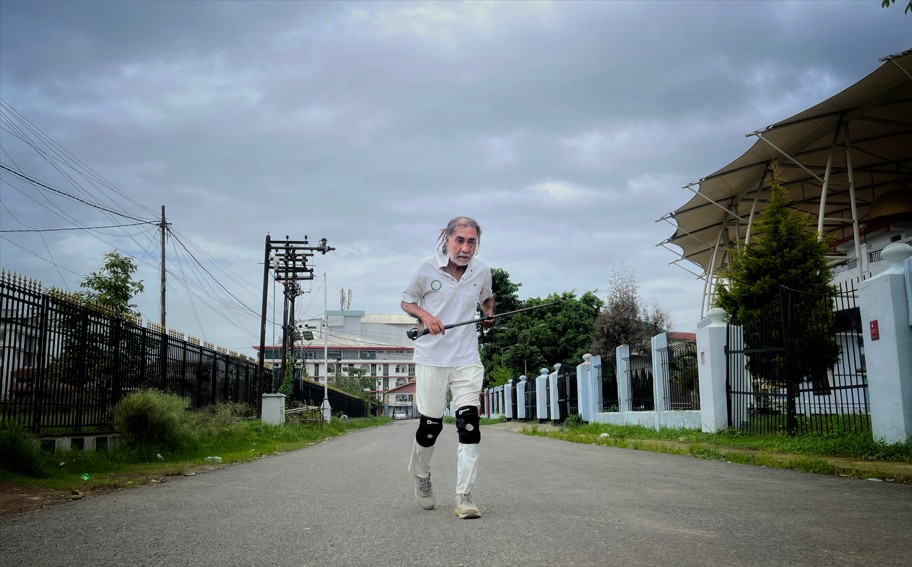
At around 6:30 am on a calm morning in Imphal, Choudhurumayum Joykumar returned from a long walk and sat down near the fence of Hapta Kangjeibung. At 68, he still walks with the ease of someone for whom walking is less an exercise than an instinct. He carried a stick. His clothes were damp with sweat. For a few minutes, he sat quietly, exhaled and caught his breath before beginning the conversation.
A few metres away, the city was beginning to stir. Traffic police stood along the road between Palace Gate and Govindajee Temple, directing vehicles and asking drivers not to park on the stretch. VIPs were expected at the City Convention Centre, where a Van Mahotsav programme was scheduled to begin at 10 a.m. The morning had an environmental theme.
For Joykumar, walking is more than a way of staying fit or getting from one place to another. It has become a personal philosophy and, eventually, a form of environmental activism. Joykumar owns motor vehicles. Yet he rarely uses them unless there is an actual need: a medical emergency, a long journey, carrying something heavy or travelling somewhere inaccessible on foot.
For shorter journeys, he walks. The habit predates his environmental consciousness. Joykumar was born in Wangoo and grew up in a poor family. As a child, he walked about six kilometres to school. As the eldest son, he also walked whenever his family needed him to run an errand.
“I was born in a village called Wangoo and I grew up in a poor family,” he says. “When I was a kid, I walked to school, which was around six kilometres from home.” There was no environmental philosophy behind those early journeys. He walked because circumstances required it.
Even after he became financially capable of owning a vehicle, however, he continued walking. His workplace was roughly six kilometres from home, and he often covered the distance on foot. Necessity became a habit. Habit became a choice. And choice eventually acquired a larger purpose. Over the years, Joykumar began connecting his everyday movement with the environmental problems that concerned him: global warming, climate change, deforestation, greenhouse-gas emissions and biodiversity loss.
“I automatically started focusing on environmental issues,” he says. “I started walking to focus on this issue.” Today, he prefers to walk within a radius of about three to four kilometres.
His reasoning is practical. “If we want to buy some vegetables or onions or potatoes or ngari (from a nearby market, what is the need to use a car or another vehicle?” he asks. “We can walk.”
He does not argue that people should abandon vehicles altogether. Medical emergencies, long journeys and heavy loads may make vehicles indispensable. Some places simply cannot be reached conveniently on foot. But where there is a choice, he believes people should consider the distance before turning the ignition.
“If the distance is within walking distance, we should not use motor vehicles,” he says. “We should form that habit and change our lifestyle.” His walking has also taken him far beyond his daily routes. He has undertaken long-distance walks across Manipur, speaking about forests, biodiversity, environmental protection and eco-friendly practices. He has participated in environmental programmes and undertaken solo initiatives, including long-distance walks and marathons.
He has completed an Indo-Nepal Friendship walking tour. In the coming months, he plans an Indo-Bhutan Friendship walking tour, and in 2027, he says, he plans to walk through Uzbekistan and its countryside. The distances have grown. The message has remained the same.
Joykumar’s life presents an unusual form of climate activism: one built not around a large organisation or campaign office, but around the repetition of a personal choice. He walks. And he hopes others will consider doing the same.
Gaiduanung Kamei, a father to a three-year-old daughter, is one of them. Kamei knows about climate change and the idea of a carbon footprint, but does not describe himself as an environmental activist. He owns a car and a two-wheeler, but rarely uses either to travel to his workplace, which is only about a kilometre from home.
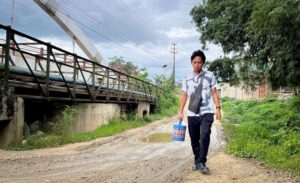
Gaiduanung Kamei owns a car and a two-wheeler, yet walks to and from work — a small daily choice made with pride, for the planet.
The road is hardly inviting. Under the sun, it becomes dusty. During the rainy season, it turns muddy. Kamei walks anyway. He works from 8 a.m. to 7 p.m. By the time he finishes, he is often tired. Yet he still walks home rather than taking out his vehicle. “As an individual, even though I may not be able to take up a massive initiative to tackle climate change, I can at least walk to and from work,” he says. “It may be a small step, but I am still reducing my carbon footprint.”
“I hope every individual can choose to walk when the distance is not too far,” he says. Then his reasoning moves beyond himself. He has a three-year-old daughter.
“Someday, when my daughter grows up, I want her to find a world where everyone is making an effort to slow down climate change—or, at the very least, not contributing to making it worse.”
The distance between Kamei’s home and office is only a kilometre. It is almost too small to register in a climate crisis measured in billions of tonnes of greenhouse-gas emissions. But that is precisely what makes it interesting. How much can an individual really do about a global problem? Science does not suggest that walking to work will solve climate change. It will not. But transportation is a major source of greenhouse-gas emissions, making everyday travel one area where individual choices can contribute to reducing emissions.
Dr Likmabam Sanjoy Meitei, Assistant Professor in the Department of Environmental Science at Dhanamanjuri University, says motor vehicles are a significant source of emissions. “It is true that a major contributor of greenhouse gases is from the transportation sector,”
Dr. Sanjoy says. “Carbon dioxide and hydrocarbons are released from motor vehicles.”
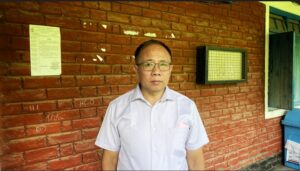
Dr. Likmabam Sanjoy Meitei, Assistant Professor, Department of Environmental Science, Dhanamanjuri University.
He says consuming one litre of petrol in a motor vehicle releases around 2.35 kilograms of carbon dioxide into the atmosphere. The significance of that figure becomes clearer, he says, when individual journeys are multiplied across a population. “If somebody uses a motor vehicle to travel to their workplace, to the market or for other business activities, we must be well aware of the fact that we are releasing 2.35 kilograms of carbon dioxide to the atmosphere,” he says. “Likewise, if we calculate the number of people using motor vehicles in Manipur, India or worldwide, it is quite a huge quantity of greenhouse gases daily.”
His suggestion is not that people abandon motor vehicles altogether, but that unnecessary journeys be reconsidered. He points to the possibility of a “no driving day” once a week or once a month as one way of reducing emissions, while encouraging people to walk when the distance is short enough. “If the distance is within walking distance, we should not use motor vehicles,” he says. “We should form that habit and change our lifestyle.”
For Dr. Sanjoy, climate-conscious behaviour can also spread socially. People imitate habits, particularly those of figures they admire. “We sometimes also follow trends started by role models. We imitate people’s habits too,” he says. If celebrities or other influential figures publicly encouraged people to walk, or to walk part of the way to their destinations, he believes others could follow. “If that happens, the greenhouse gases will be drastically reduced from the individual level,” he says.
That is the case for walking as a climate action: one person walking one kilometre makes only a small difference, but a habit repeated by thousands or millions of people can have a larger cumulative effect. Yet people cannot be expected to walk simply because they are told to do so. The streets have to make walking possible.
Asked about infrastructure, safety and accessibility in Manipur, Dr. Sanjoy says dedicated pedestrian spaces are necessary. “There should be dedicated footpaths in cities and congested areas,” he says, arguing that pedestrian infrastructure is essential for safety and accessibility. People may want to walk, he says, but the state does not yet provide sufficient convenience or properly planned pedestrian infrastructure.
“If that happened, we would be able to reduce our carbon footprint drastically,” he says. This creates a tension at the heart of individual climate action. People may be willing to walk. But are their cities prepared for them?
Kamei walks along a road that becomes dusty in the sun and muddy in the rain. Joykumar has spent decades developing a tolerance for long distances on foot. Not everyone can.
A person with a disability may not be able to walk several kilometres. An elderly person may find a route difficult. A parent carrying a young child may need another form of transport. A worker carrying a heavy load may have little choice but to use a vehicle. And where there are no safe footpaths, even a short journey can become dangerous.
Individual action therefore has limits. The larger responsibility belongs to the systems around the individual: city planning, public transport, pedestrian infrastructure and policies that make low-carbon choices practical rather than merely aspirational.
The Manipur State Action Plan on Climate Change (MSAPCC) published in 2013 offers a reminder of why the issue matters locally. According to the report, during the 57 years from 1954 to 2011, Manipur’s mean minimum temperature rose from 13.9°C to 15.3°C, while the mean maximum temperature increased from 26.6°C to 27.3°C.
These are not changes confined to scientific reports. They have implications for health, agriculture, water, forests and livelihoods. For people living in Manipur, climate change need not be imagined as something happening somewhere else. It can be experienced through changes in rainfall, agricultural uncertainty, heat, flooding and an increasingly unpredictable relationship between familiar seasons and everyday life.
Joykumar has also noticed changes in rainfall and speaks of farmers facing difficulties in cultivating paddy when rainfall is insufficient. He says he has tried to raise environmental concerns with the government and has prepared a “charter of demands” for authorities.
“I want to give the government my charter of demands,” he says. “However, I observed that most government officials would simply say, ‘We will see,’ and do nothing most of the time.”
For Joykumar, however, walking remains something he can do himself. His long-distance walks have taken him across Manipur and beyond, but his message can also be practised in everyday life: walking to the market, to work or for other short journeys instead of using a motor vehicle.
For Kamei, the choice is much simpler. His workplace is about a kilometre from home, and despite owning a car and a two-wheeler, he walks to and from work. He often returns home tired after working from 8 a.m. to 7 p.m., but continues to make the journey on foot. His three-year-old daughter is part of his motivation.
“Someday, when my daughter grows up, I want her to find a world where everyone is making an effort to slow down climate change—or, at the very least, not contributing to making it worse,” he says.
Neither Joykumar nor Kamei suggests that walking alone can address climate change. But their choices illustrate one way individuals can reduce unnecessary motorised travel. Dr. Sanjoy says people also tend to imitate habits, particularly those of role models. If walking or cycling for shorter journeys becomes more common, he believes others may follow.
For that to happen, however, people need safe and accessible places to walk. Dr. Sanjoy says cities and congested areas need dedicated footpaths so that people can walk safely.
Walking, therefore, is only one part of a much larger climate response. But it is a habit that can be adopted without waiting for a new technology or a major policy change. A single walk will make little difference to global emissions. Repeated across households and communities, however, everyday choices about how people travel can reduce unnecessary fuel use and become part of a broader culture of lower-carbon living.
For Joykumar, walking began as a necessity and became a habit. For Kamei, it is a choice between home and work. For both, the journey is small. But as climate action increasingly becomes part of everyday life, walking can be one of the many ordinary habits through which citizens contribute to reducing emissions. And this can be one small expression of citizen-led climate action.
(This feature is published under the 7th State Level Media Fellowship Programme on Climate Change, under the sponsorship of the Directorate of Environment and Climate Change, Government of Manipur.)

The writer is a media scholar and professional