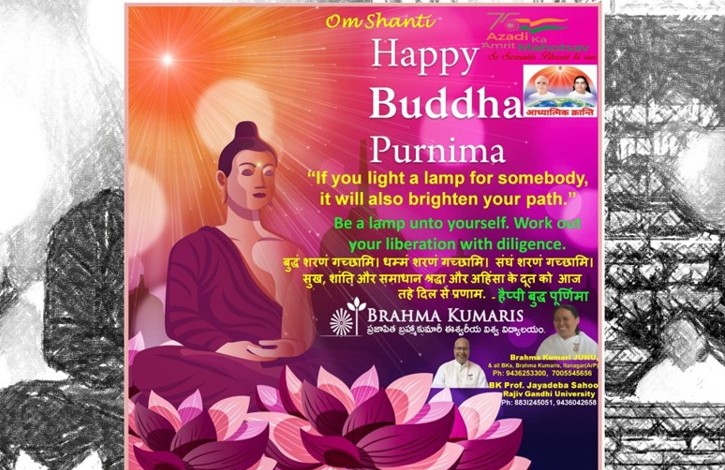
Ahimsa Paramo Dharma, Dharma Hinsa Tathaiva Cha (Non-violence is the highest duty/virtue, and so too is violence in defence of righteousness/dharma).
This profound dictum, though often associated with later traditions, resonates deeply with the spirit of Buddha’s teachings. In a world fractured by aggression, could this ancient philosophy be the balm humanity desperately needs?
Prelude: When Cannons Roar, Can Compassion Speak?
In the grim theatre of the twenty-first century—where missiles eclipse metaphors and battlefields proliferate across continents—the human conscience trembles under the weight of its own creations. From the embattled plains of Ukraine to the devastated enclaves of Gaza Strip, from civil unrest in Sudan to geopolitical tensions simmering across West Asia, the world appears ensnared in a vortex of violence, hatred, and delusion.
Amidst this cacophony of conflict, the timeless teachings of Gautama Buddha emerge not as distant whispers from antiquity, but as urgent, luminous calls for a civilizational reawakening. His Dharma—etched in the stillness of Bodh Gaya and radiating across millennia—offers not merely solace, but a radical blueprint for peace, reconciliation, and inner transformation.
The Anatomy of Conflict: A Buddhist Diagnosis of War
dvesho hi dveshen na nivartate (hatred is never appeased by hatred)
At the heart of every war lies not merely political discord but a deeper psychological malaise. The Buddha’s penetrating insight into the roots of suffering, craving), aversion, and ignorance—provides a profound lens through which to interpret contemporary conflicts.
- Craving for Power and Possession. Nations, like individuals, are often driven by insatiable desires—for territory, resources, dominance. The relentless pursuit of hegemony fuels cycles of aggression.
- Aversion and Hatred – Ethnic, religious, and ideological divisions crystallize into hostility, dehumanizing the “other” and legitimizing violence.
- Ignorance – A failure to recognize the interconnectedness of all beings perpetuates the illusion of separateness, justifying conflict.
The Buddha’s framework reveals that war is not merely a geopolitical but a manifestation of collective psychological affliction.
The Four Noble Truths: A Universal Framework for Conflict Resolution
The Truth of Suffering. The Buddha’s Four Noble Truths, though articulated in the context of individual liberation, possess profound implications for global peace:
Dukkha (Suffering): War inflicts immeasurable suffering—loss of life, displacement, trauma.
Samudaya (Cause): Rooted in greed, hatred, and delusion.
Nirodha (Cessation): The possibility of ending conflict through transformation of consciousness.
The Middle Path: Navigating Extremes in a Polarized Age
Modern discourse is increasingly characterized by polarization—ideological extremes that resist dialogue and compromise. In such a climate, the Buddha’s Middle Path offers a framework of balance. Neither indulgence nor asceticism, neither absolutism nor relativism—the Middle Path advocates for nuanced engagement.
This principle is particularly relevant in governance and policy-making. It encourages leaders to transcend binary thinking, to seek solutions that integrate diverse perspectives. In economic terms, it aligns with sustainable development—balancing growth with ecological preservation. In social contexts, it fosters harmony amidst diversity.
The Eightfold Path: An Ethical Architecture for Modern Society
The – Arya Ashtangika Marga (Noble Eightfold Path) constitutes a comprehensive ethical system. It emphasises unlearning over learning, that is, learning to unlearn and discover. The path consists of eight steps that work together to help you go past the conditioned responses that prevent you from seeing your true self. The Ashtangika-Marga consists of the following components:
- Right Vision (Samma-Ditthi/Samyak Drishti – It is about comprehending the nature of reality and the path of transformation.
- Right Thought/Intention/ Attitude – intention of renunciation; of good will and of harmlessness. It denotes emotional intelligence as well as behaving out of love and compassion.
- Right or Whole Speech (Samyak Vāk/Samma-Vacca) – It refers to communications that are truthful, straightforward, uplifting, and non-harmful.
- Right or Integral Action –Samyak Karma /Samma-Kammanta) – abstaining from taking life; from stealing; and from sexual misconduct. It denotes a moral foundation for life based on principles of non-exploitation of oneself and others. It consists of five precepts that serve as an ethical code of conduct for monastics and laypeople alike.
- Right or Proper Livelihood –Samyak Aajivika/Samma-Ajiva – It emphasises livelihood based on correct action and non-exploitation ethical standards. This is seen to be the foundation of a perfect society.
- Right Effort or Energy – Samyak Vyayam. Samma-Vayama – the effort to restrain defilements; to abandon defilements; to develop wholesome states; to maintain wholesome states. It refers to intentionally directing our life energy toward the transformative path of creative and healing action that promotes wholeness and so moves us closer to conscious evolution.
- Right Mindfulness – Samyak Smṛti/ Samma-Sati or Thorough Awareness Samma-Sati) – It entails understanding oneself and observing one’s own behaviour. “If you value yourself, keep a close eye on yourself,” the Buddha said.
- Right Concentration –Samyak Samadhi. Samma-Samadhi or Meditation (Samma-Samadhi) – Samadhi literally means “fixed, absorbed in.” It entails immersing one’s entire being in several levels or modes of consciousness and awareness.
This framework transcends individual spirituality, offering a blueprint for societal transformation. Imagine media guided by Right Speech—eschewing sensationalism and misinformation. Imagine industries aligned with Right Livelihood—eschewing exploitation and environmental harm. Such a paradigm shift could recalibrate the moral compass of contemporary civilization.
Education for Peace: Cultivating Dharmic Consciousness
Sa Vidya ya Vimuktaye– True knowledge liberates
Education systems must transcend rote learning to cultivate Ethical awareness, Emotional intelligence and Global citizenship. Integrating Buddhist principles into curricula can nurture generations capable of resolving conflicts without violence.
Media, Misinformation, and Mindful Communication
In modern conflicts, narratives are as powerful as missiles. The Buddha’s principle of (Samyak Vacha– Right Speech) offers guidance for (Satya-truthfulness) over propaganda, (Sambad– dialogue) over demonization and (Sayam-restraint) over sensationalism. Responsible journalism, aligned with these principles, can become an instrument of peace rather than polarization.
Case Reflections: Glimmers of Dharma in Dark Times
- Peace Dialogues Inspired by Mindfulness- Negotiators employing contemplative practices to enhance clarity and empathy.
- Monastic Interventions-Buddhist monks mediating local conflicts in parts of Asia.
- Grassroots Compassion Movements-Communities rebuilding trust through shared humanitarian efforts.
These examples illustrate that the Buddha’s teachings are not abstract ideals but living practices.
The United Nations and the Dharma of Global Governance
Institutions like the United Nations embody aspirations for peace, yet often falter due to political interests. Infusing such frameworks with Buddhist ethics could enhance their efficacy in Nirnaya-Decision rooted in compassion, Policies guided by interdependence & Leadership grounded in humility.
Epilogue: From Ranbhoomi to Dhyanbhoomi
The war-ridden world stands at a critical juncture. It may continue along the path of violence, leading to annihilation, or turn towards the luminous path illuminated by the Buddha.
The teachings of Gautama Buddha do not promise utopia; they offer something more profound—a method for transforming suffering into wisdom, conflict into compassion, and (battlefield) into (field of meditation).
The Dawn Beyond the Darkness
As humanity stands at the crossroads of destruction and redemption, the teachings of Buddha offer not a utopian fantasy, but a deeply practical मार्ग (path). They invite us to reexamine our assumptions, to question our impulses, and to rediscover our shared humanity.
Appa Dīpo Bhava (Be a light unto yourself.)
This exhortation is not merely a spiritual injunction; it is a civilizational imperative. For in a world increasingly governed by external stimuli, the reclamation of inner illumination may well be the most radical act of all.
In a world engulfed by the flames of conflict, each individual, each leader, each nation has the potential to become a lamp — illuminating the path toward peace.
The relevance of Buddha’s teachings is not confined to monasteries or meditation halls; it pulses through the very veins of contemporary existence. It calls upon us—not as passive observers, but as active participants in the creation of a more compassionate world.
Final Reflection: From Yudha (War) to Buddha (Peace)
The transformation from a war-ridden world to a harmonious one does not demand miracles—it demands mindfulness. It requires the courage to abandon hatred, the wisdom to embrace interdependence, and the compassion to heal wounds that span generations.
In the silence between breaths, in the pause before reaction, lies the possibility of a different future—a future where the teachings of Buddha are not merely remembered, but lived.
And perhaps, in that quiet revolution of consciousness, the echoes of will fade, giving way to the gentle symphony of Peace.
The Call of Dharma
Dhammo have rakkhati dhammacāri. (Dharma protects those who live by it) “Dhamma (righteousness/the law) protects those who live by Dhamma”.
In embracing the Buddha’s vision, humanity may yet transcend the shadows of war and awaken to a dawn where peace is not merely the absence of conflict, but the presence of awareness, compassion), and equanimity.
The choice, as always, lies within the human heart.
Om Mani Padme Hum. May all beings be liberated.
Happy Buddha Purnima to all.

The writer is Faculty, Brahma Kumaris, RERF & Professor (Ex- Dean & Head), Faculty of Education, Rajiv Gandhi Central University, Itanagar; Tel: 9436042658, 8837245051