
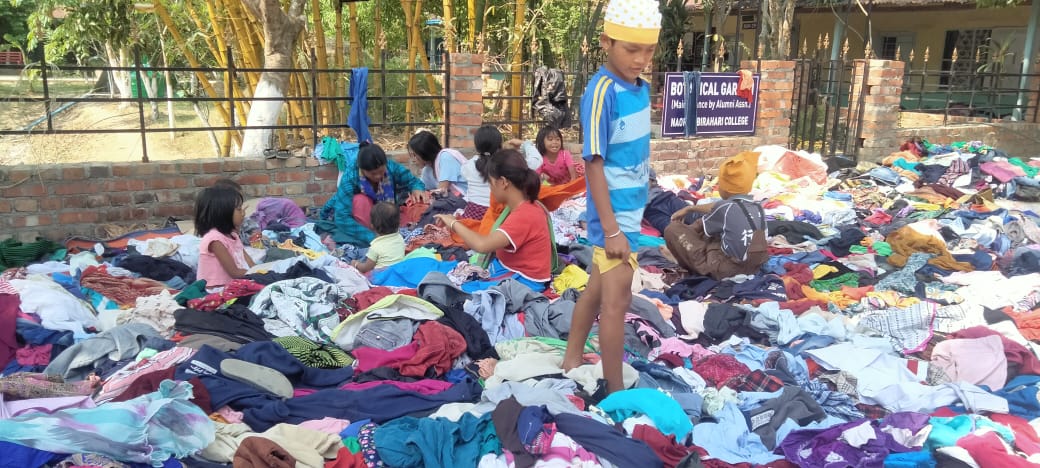
For more than 28 months now, the conflict that erupted on the unfaithful day of 3rd May, 2023 remains unresolved to this day. A staggering population of more than 60,000 have remained languishing in makeshift structures that have now come to constitute what is commonly known as relief camps. Reportedly more than 260 lives have been killed, whilst many remained maimed or untraceable and a increasing surge of incidence of suicide.
In this context, the right to life, as guaranteed by the constitution of the world’s largest democracy, becomes highly questionable, raising a critical question: what does right to life mean for the people of Manipur and specifically in relief camps? Can it be reduced to mere biological survival, or are the displaced persons residing in relief camps merely surviving rather than genuinely living? In Maneka Gandhi v. Union of India (1978), the Supreme Court affirmed that the right to life encompasses dignity, security, and the ability to live meaningfully.
The IDPs in Manipur are living in an extremely precarious condition, with survival dependent on minimal rations such as rice (cheng) and dal (hawai), along with a meagre eighty rupees per person. They are confined to overcrowded rooms that lack basic privacy or security, inadequate medical facilities and non hygienic sanitation, compromising both physical safety and mental well-being. Reports from Northeast Live reveals that the total number of IDPs who have died due to lack of medical facilities from Moreh alone has reached thirty-three; most of whom were suffering from serious conditions such as kidney failure requiring dialysis or cancer.
The question then arises, can this be called life or is it merely existence? This is not life; it is survivability, a condition which Giorgio Agamben refers to as ‘bare life’—a state of living stripped of dignity and security, without the full exercise of rights as citizens. In these circumstances, individuals exist in a bare, precarious state, unable to live with autonomy, recognition, or the protections afforded by their citizenship.
The state’s failure to address the rehabilitation of displaced persons has produced a condition in which hopelessness is not merely an individual burden but also a collective reality. A study titled “Psychological Effects of Manipur Violence among the Internally Displaced Persons Residing in Relief Camps across Imphal Valley of Manipur – A Cross-Sectional Study,” published in November 2024, found that 65.8% of respondents suffered from PTSD, while 15.2% reported severe anxiety. The despair arising from prolonged uncertainty is symptomatic of a broader legitimacy crisis within the state. The absence of a sustainable resettlement framework reveals a fundamental structural failure, rendering displacement a prolonged, if not permanent, feature of life for these populations. This persistent uncertainty has fostered profound despair among displaced persons, which has ultimately manifested in rising suicidal ideation, attempts, and deaths. The sudden collapse of social structures and norms among displaced persons, brought about by the conflict, has left them disoriented and unable to adapt to shifting conditions and circumstances, thereby producing what can be described as ‘anomie suicide.’
The rising incidence of suicides among IDPs must not be trivialized as private troubles or personal weaknesses. The suicides among the IDPs must be recognised as socially induced outcomes of displacement, dispossession, institutional neglect and ignorance. To individualize these deaths as the cause of suicide would be to commit against what C W Mills called ‘Sociological Imagination’ where personal sorrows are severed from broader public issues that generate them. Personal interviews and interactions with IDPs across different relief camps reveal overwhelming feelings of hopelessness and recurring suicidal tendencies. Although the government and NGOs like Matai Society have organized periodic mental health camps to address these issues, the lack of sustained counseling, the inability of IDPs to afford long-term medication, and the failure to tackle the structural root causes of displacement have rendered these interventions largely ineffective.
What the IDPs require is not merely mental health camps or sporadic check-ups, but sustained interventions that address the underlying causes of their psychological distress. The inaccessibility of healthcare facilities has transformed an already precarious existence into one marked by silent suffering. Doctors reportedly visit the camps twice a week; however, the absence of emergency care renders these visits largely symbolic rather than life-saving. For individuals living with chronic conditions such as diabetes or cardiovascular disease, the responsibility of procuring medicines falls entirely on them—an impossible demand in circumstances of economic destitution. Periodic free health camps and occasional mental health check-ups provide only temporary relief and fail to establish continuity of care. Without reliable access to essential medicines and sustained medical support, such interventions risk appearing performative rather than substantive, offering the illusion of support without material substance.
In cases of serious illness, IDPs are often forced to turn to private hospitals, where treatment comes at exorbitant costs. For families stripped of their livelihoods, such care is not only inaccessible but also a stark reminder of their social and economic exclusion. The tragic suicide of Konsam Bonet in Sajiwa jail further underscores the entanglement of health, livelihood, and despair. A fellow inmate noted, the absence of economic means weighed most heavily on his sense of hopelessness. This tragedy reflects the accounts of IDPs in relief camps, who repeatedly emphasize that securing livelihoods is their most pressing concern—a necessity that ties together the struggle for physical survival and the maintenance of fragile psychosocial well-being.
In an effort to sustain their livelihoods and meet basic needs, many displaced families resort to small-scale roadside sales of items such as candles, incense sticks, or detergents. Yet these attempts, rather than restoring dignity, often intensify feelings of precarity and social marginalization. Accounts from families who previously enjoyed relatively stable living conditions reveal the profound shame and humiliation they experience while selling on the roadside. One respondent recalled being regularly scolded for “blocking the road” or accused of “selling at high prices.” What might appear to outsiders as opportunistic profiteering is, in reality, a desperate strategy to secure the bare minimum required for subsistence. Even so, displaced persons frequently find it extremely difficult to sustain themselves in these unfamiliar and often hostile market environments, and the experience strips them of dignity, leaving them profoundly vulnerable despite the small earnings they manage to secure.
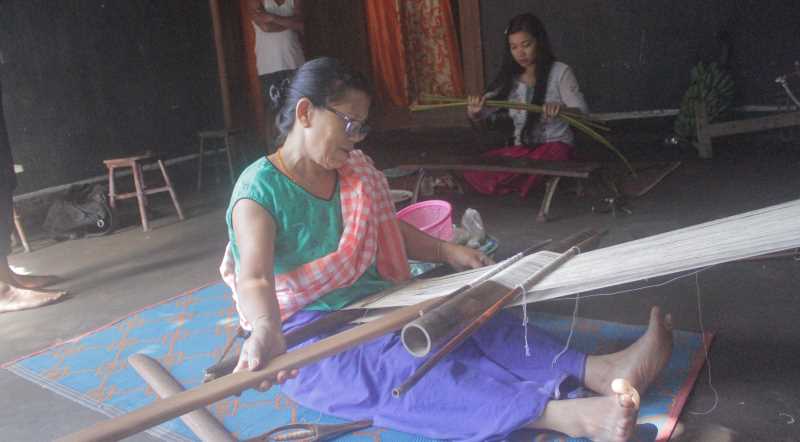
Government programs and NGO interventions have sought to mitigate the livelihood crisis among IDPs by providing vocational training in trades such as kouna handicrafts, pickle-making, and the production of bedsheets and pillow covers. While these initiatives are often presented as mechanisms of empowerment, their impact on economic self-sufficiency has been minimal. Even when displaced persons successfully produced goods, the absence of sustainable market linkages rendered their efforts largely futile. Several respondents reported that NGOs, despite earlier commitments, failed to collect the finished products, leaving labor uncompensated and expectations unfulfilled. Such interventions, rather than addressing structural vulnerabilities, risk reproducing the very precarity and marginalization imposed by displacement, eroding trust in institutional support and perpetuating a cycle of invisibility and socio-economic exclusion.
The conflict-induced large-scale displacement in Manipur has thus generated a new form of poverty. It is not only about income, as Amartya Sen’s capability approach argues, but about the denial of basic capabilities—the substantive freedom to choose, to act, and to fully exercise one’s potential for development. In Manipur, the structural system shaped by conflict has foreclosed these freedoms, leaving displaced persons unable to flourish. What is at stake is not simply livelihood in a narrow economic sense but the broader capacity to live with dignity, to rebuild social belonging, and to exercise agency over one’s future. In Manipur, however, the structural system shaped by conflict has actively obstructed these freedoms, preventing displaced persons from reconstructing their lives or reclaiming their agency. For the displaced, the inability to earn a livelihood with dignity, coupled with the erosion of belonging and recognition, has produced a condition of profound disempowerment. Their predicament reveals not only material impoverishment but also the systematic denial of fundamental human freedoms. This is not a contingent or accidental outcome but one sustained by entrenched structures that normalize deprivation. In this sense, prolonged displacement in Manipur is not merely a humanitarian crisis but an enduring form of structural violence—one that transforms life itself into a condition of bare survival, stripped of dignity and autonomy.
However, the plight of IDPs cannot be reduced to the language of displacement alone; it embodies a condition of abandonment, where political recognition and social protection are systematically withdrawn. Existence in relief camps thus is reduced in mere terms of ‘management’ thereby stripping the question of dignity, livelihood and justice. Such abandonment produces lives that remain exposed to violence, insecurity, and neglect—lives that are, in Judith Butler’s terms, ‘precarious.’ Precariousness here signifies more than vulnerability; it marks a form of existence that is unrecognized, ungrievable and sustained only at the margins of political concern. In this light, suicide and despair among the displaced cannot be understood as private tragedies.
The present crisis compels a fundamental reconsideration of justice. Justice cannot be reduced to the management of bare survival in relief camps; rather it demands the restoration of dignity, security, and political recognition. To give meaningful effect to Article 21, the state must move beyond the tokenism of ration distribution and temporary shelter toward substantive rehabilitation, rebuilding livelihoods, repairing ruptured community networks, and enabling the displaced to live as full citizens. The recent announcement by the Governor and Chief Secretary—that camps would be closed by December, with displaced families returning in three phases beginning in June and receiving ₹1.3 lakh for reconstruction—highlights the limits of state intervention. In the face of inflation and structural dislocation, such compensation amounts to little more than symbolic relief, incapable of addressing the scale of dispossession. Moreover, the conflict has ruptured the economic interdependence amongst communities. With these interdependencies fractured, the mere physical act of return cannot restore viable livelihoods.
Displacement in Manipur represents not merely a humanitarian emergency but a profound critique of systemic and institutional failure. Resettlement policies that disregard the lived experiences and voices of the displaced risk reproducing forms of exclusion and precarity rather than addressing them. The values and ideals enshrined in the Constitution are rendered hollow if they fail to manifest in practice, exposing a persistent gap between legal guarantees and social realities. Resettlement policies will thus remain inadequate until and unless it encompasses a just rehabilitation– one that ensures sustainable livelihoods, dignity, physical and mental safety.

The writer is a Research Scholar, Department of Sociology, Dhanamanjuri University, Manipur


1 thought on “Survivability, Dignity, and the Silent Crisis of Internally Displaced Persons in Manipur”
Well said👏🏻 proud of you pinky
Comments are closed.