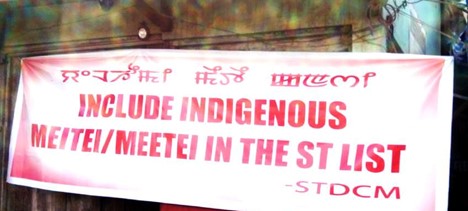
Of the many thorny issues raised by the Manipur ethnic crisis is the question of who is a tribal and qualify to be Scheduled Tribe. A demand by a section of the largely Hindu Meitei community for this status was the trigger behind the outbreak of the ever complicating, multi-dimensional conflict in the state.
A May 3, 2023, rally by Nagas and Kukis in the hill districts against a Manipur High Court order directing the state government to not hinder official scrutiny of this Meitei demand had seemed just another manifestation of the state’s endemic hill-valley divide. By afternoon however this presumption proved false.
The rally turned violent in Kuki-Zo dominated Churachandpur district and began spreading. What should not have missed any keen observer, although sadly it mostly did, was that at this point Nagas stepped back. Quite obviously, although the ST demand by Meiteis was the trigger, there were other drier cinders to catch flame.
By February this year, this oversight became glaring. Even as the feud between Meiteis and Kukis showed signs of respite, a new deadly conflict front opened up between Nagas and Kukis, which since has seen some gruesome massacres. The issue on this front is more primordial too, therefore more challenging. It involves primal notions of indigenous land and its control.
Nagas claim they are the original owners of the hills and Kukis settled here later with Naga permission, therefore Naga customary laws are binding on all in these hills. Customary laws however differ from community to community, and often are at cross purposes.
If in the hills the clash is of customary laws, in the hills-valley divide, the fault line is between spheres under modern land laws and those in the realm of customary laws.
Colonial administrators in Assam/Northeast took the easy way out, drawing an Inner Line by the Bengal Eastern Frontier Regulation, 1873, to divide hills from plains. In Bodhisattva Kar’s words in When was the Postcolonial, this was not only a dividing line in territorial terms but also in time, for it divided “pre-capital and capital, …no law and law”.
The territories beyond this Inner Line hence were kept either as ‘backward tracts’, ‘unadministered areas’, ‘excluded areas’ or ‘partially-excluded areas’. Hills administration was generally left to the devices of local communities, though with the Governor’s gaze, while the plains were directly administered under existing laws. Although not formally as in Assam, this pattern of administration was replicated in erstwhile Princely State of Manipur.
Independent India inherited this legacy. In the 80 years of independence, this administrative gulf between hills and plains became institutionalised, buttressed by a liberal reservation policy. Curiously, this is a factor in the current crisis in Manipur. Similar crisis can however explode anywhere in the region. Meghalaya recently demonstrated how fragile this balance is, though thankfully sanity prevailed early this time.
The truth is, social conditions do not remain stagnant and societies grow and transition out of past traps. When this is presumed not to be, there are consequences. There is now a growing number who also want to enjoy the benefits of this asymmetric policy architecture as it has come to be seen not as a lift for the weak, but a privilege.
If Meiteis are demanding ST status in Manipur, in Assam there are seven previously non-tribal communities who also want to be in ST category. It is anybody’s guess there would be more joining this chorus in later years.
If those who now want to be in this category do so for the preferential benefits, those already in it opposing others entering it, do so for the same reason. They want to prevent others sharing their reserved pie. Otherwise, growth in size of any fraternity should have been a matter of rejoicing for everybody in the fraternity.
The trouble also is, in the name of political correctness and self-presumed generosity, there are many who still think the idea of tribe is permanently frozen as in a museum, not realising this can be an undeclared patronising arrogance, worse still, an organic, therefore invisible, racism.
Asymmetric policies are probably still necessary to address inequalities but the evolutionary reality of social mobility cannot be ignored in drawing this equation.
This article was first published in The Telegraph. The original can be read HERE

Editor, Imphal Review of Arts and Politics and author