

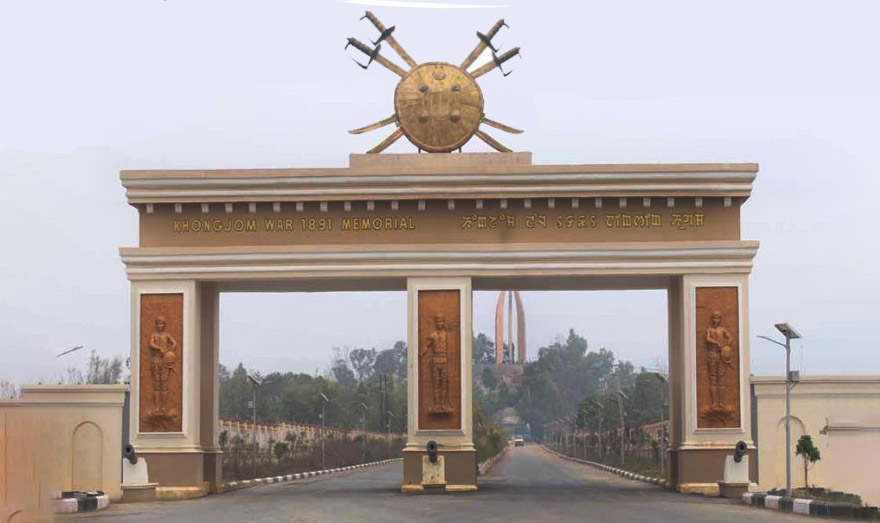
Every year, on the 23rd of April, the people of Manipur solemnly observe Khongjom Day to commemorate the valiant sacrifice of Manipuri warriors who laid down their lives during the Anglo-Manipur War. The day marks the historic Battle of Khongjom, where heroes like Paona Brajabasi stood with unwavering courage against a powerful colonial force. Over time, this observance has become institutionalized—a state holiday, a ceremonial gathering, and a ritual of remembrance; yet beneath its solemnity lies a pressing question: has the essence of patriotism endured, or has the observance gradually turned into a mere formal exercise performed without inner conviction?
Khongjom Day has endured across generations not merely because of its historical relevance but because it embodies a moral inheritance. It is a symbol of resistance, dignity, and sacrifice deeply rooted in the collective consciousness of the people. The memory of Khongjom lives not only in official records but in stories told by elders, in songs of bravery, and in the silent reverence with which the day is observed. However, continuity of observance does not guarantee continuity of meaning. Traditions, when repeated without reflection, risk becoming mechanical. Therefore, the true challenge before society today is not merely to observe Khongjom Day, but to understand, internalize, and live its spirit.
The significance of commemorating such events lies in their ability to shape identity and guide conduct. Khongjom Day is not just about remembering a battle; it is about reaffirming values—honor, unity, courage, and selflessness. The warriors who fought during the Anglo-Manipur War did not fight for recognition or ceremonial remembrance; they fought for dignity and the preservation of their land and identity. Their sacrifice demands not only remembrance but responsibility. When we observe Khongjom Day, we are called to ask ourselves: are we living in a way that reflects the values for which they sacrificed their lives?
At this juncture, a deeply uncomfortable yet unavoidable question arises: Do we truly deserve to call ourselves the proud sons and daughters of those martyrs who sacrificed their lives for the motherland, when our society continues to be marked by hatred, disunity, corruption, poor governance, power hunger, and a crisis of leadership? This question strikes at the heart of our collective conscience. While we gather in large numbers, offer floral tributes, and speak eloquently of patriotism, our everyday actions often reveal a different reality. Divisions among communities, mistrust among individuals, and the prioritization of personal gain over collective welfare stand in stark contrast to the unity and selflessness demonstrated by the martyrs of Khongjom.
The warriors of Khongjom did not act as individuals driven by narrow interests; they stood united by a common purpose. Their strength lay in their unity and their unwavering commitment to their land. In contrast, when society today is fragmented by internal conflicts, it weakens the very foundation of patriotism. Hatred and division erode the sense of collective identity that is essential for a nation or society to thrive. Similarly, corruption reflects not just a failure of systems but a failure of values. It signifies a departure from integrity and a disregard for the common good. Poor governance further widens the gap between ideals and reality, while leadership driven by power rather than service leads to disillusionment and stagnation.
Patriotism, therefore, cannot be confined to ceremonial expressions or occasional observances. It must be reflected in everyday actions—in honesty, in responsibility, and in a commitment to the welfare of society. To claim the legacy of the martyrs is not a matter of pride alone; it is a responsibility that demands ethical living and collective accountability.
It is within this context of inner conflict and moral questioning that the following poetic reflection finds its place, capturing the tension between outward observance and inward truth:
WHEN KHONGJOM DAY ARRIVES
When the day called today arrives,
When Khongjom Day comes again,
In my heart—filled with love for the motherland—
A restless thought rises, mingled with hesitation:
“Let me go to the battlefield of Khongjom,
Stand quietly on the riverbank of the Khongjom stream,
And offer a few humble flowers there.”
But then my own conscience rises and questions me sharply:
“Do you dare to say you love the motherland
When your thoughts have remained so scattered?
When you have done nothing—
Neither brave deeds for the people,
Nor any meaningful service born of sacrifice?
You neither spoke when words were needed,
Nor acted when action was demanded.
Are such wandering thoughts even worthy?”
Thus reproached again and again,
I lower my eyes in silent shame.
Yet, dressed neatly, with shawl and turban,
I step out onto the dusty road of the land,
Watching the familiar paths of my birthplace,
And when I reach the place where my feet hesitate,
My beloved companion whispers softly, pulling my sleeve:
“Who will offer flowers today,
When hunger burns fiercely in our homes?”
Hearing those words, my steps falter;
The flame of love for the motherland dims within me.
Like a sudden thunderclap of truth,
My father’s voice echoes in my ears,
His old words ringing clearly in my heart:
“This glory earned by others—
Do not dare to claim it as your own.
O my child, do not pretend to be brave;
You have not yet learned to walk your mother’s path.”
This poem is not merely a literary expression; it is a mirror held up to society. It exposes the uncomfortable truth that outward expressions of patriotism often mask inner emptiness. The act of offering flowers becomes meaningless when it is not accompanied by genuine commitment and self-reflection. The poem challenges us to confront our own inadequacies and to question the authenticity of our actions.
The impact of Khongjom Day on the younger generation is both significant and uncertain. Young people inherit the legacy of Khongjom, but their understanding of it depends on how it is presented to them. If the observance is meaningful and engaging, it can inspire them to adopt values of courage, integrity, and unity. However, if it is reduced to routine ceremonies and obligatory participation, it risks fostering indifference or even cynicism. Young minds are perceptive; they can distinguish between sincerity and performance. When they see a disconnect between words and actions, they may lose faith in the very ideals being promoted.
Education plays a crucial role in bridging this gap. It is not enough to teach the historical facts of Khongjom; it is essential to convey its moral significance. Students must be encouraged to reflect on the values associated with the event and to consider how these values can be applied in their own lives. Only then can the legacy of Khongjom become a living influence rather than a distant memory.
The designation of Khongjom Day as a state holiday underscores its importance, but it also presents a challenge. A holiday can either serve as an opportunity for reflection or become a mere break from routine. For some, it is a day to participate in ceremonies and remember the sacrifices of the past. For others, it is simply a day of rest, disconnected from its historical significance. This duality highlights the need for conscious effort to preserve the spirit of the observance.
One of the most pressing concerns is the tendency toward superficial observance. Ceremonies are organized, speeches are delivered, and tributes are offered, but often without deeper reflection. Such observance becomes mechanical rather than meaningful, symbolic rather than sincere. It preserves the appearance of respect but fails to inspire genuine understanding or commitment. Observance for the sake of the event is inherently ineffective. It reduces a profound historical legacy to a routine exercise, devoid of emotional and moral depth.
The symbolism associated with Khongjom Day, including the wearing of traditional attire such as dhoti and kurta while offering floral tributes, holds cultural significance. However, symbols alone are not sufficient. True tribute lies not in outward appearance but in inner conviction. Wearing traditional attire while harboring insincerity creates a contradiction that undermines the very purpose of the observance. A simple act performed with genuine respect carries far greater meaning than elaborate displays devoid of authenticity.
Reclaiming the true spirit of Khongjom Day requires a fundamental shift in perspective. It requires moving beyond ritualistic observance to value-based living. This involves fostering unity, rejecting corruption, embracing integrity, and redefining leadership as a form of service rather than a pursuit of power. It also requires creating opportunities for meaningful engagement, where individuals can reflect on their responsibilities and take concrete steps to contribute to society.
Furthermore, the lessons of Khongjom must be connected to contemporary realities. Patriotism today is not about fighting battles on the battlefield; it is about addressing the challenges faced by society—poverty, inequality, injustice, and division. It is about standing up for what is right, even when it is difficult. It is about working collectively to build a society that reflects the values for which the martyrs sacrificed their lives.
In conclusion, Khongjom Day is not merely a day of remembrance; it is a call to conscience. It challenges us to examine our actions, our values, and our commitment to the ideals of unity, integrity, and service. The martyrs of Khongjom did not sacrifice their lives for ceremonial recognition; they did so for principles that demand to be lived and upheld. Let us not reduce their legacy to ritualistic observance. Let us strive to embody the values they represent in our daily lives.
A great appeal to the people: Let us awaken—not just for a day, but for a lifetime. Let us carry the spirit of Khongjom in our thoughts, actions, and commitments. Let us build a society where patriotism is not performed but lived, where unity is not merely spoken of but practiced, and where the sacrifices of our martyrs serve as a guiding light for a just, honest, and united future. Only then can we truly honour their legacy and ensure that their sacrifice was not in vain.

The writer is an educationist, presently serving as an Assistant Teacher at Don Bosco High School, Langjing. He is actively engaged in literary writing and social commentary, and has nurtured many young minds who are growing to become future pillars of society. His work is driven by a commitment to ethical values, civic awareness and dignity across all professional spaces.