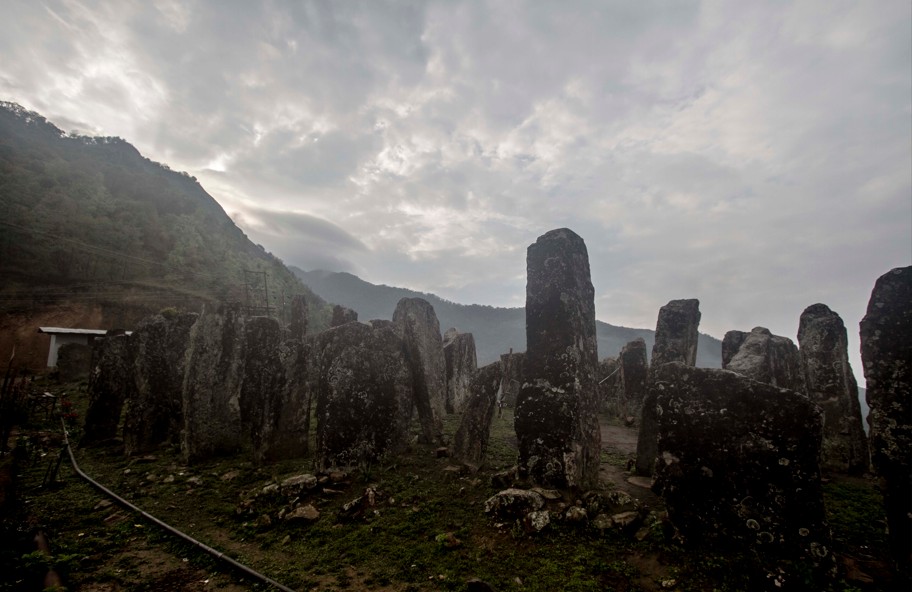
Drive north from Imphal into the folded green hills of Senapati district and, past a certain point, the roadside stops being ordinary. Grey stone slabs, some no taller than a man, some rearing seven metres into the sky, rise out of paddy terraces and footpaths as if they had grown there. Villagers walk past them every day. Most were put up by someone’s great-great-grandfather, at a feast that emptied his granary and made his name.
This is Manipur’s megalithic country, and it is one of the least-known ancient landscapes in India.
The most dramatic cluster sits at Willong Khullen, a Maram Naga village reached by a winding 37-kilometre detour off National Highway 39. Around 150 standing stones crowd the hillside there, several of them over 6.1 m. tall. Visitors and journalists have taken to calling it “the Stonehenge of Manipur,” and the comparison, while a stretch, is not absurd: nobody can say for certain how the largest stones were quarried, moved, or raised, or exactly when. Village elders say their ancestors erected them to mark victories in war. Beyond that, the site has barely been studied.
A short distance away, in the village of Makhel, the stakes are different. Here, one particular monolith is not just old — it is foundational. Oral history recorded as far back as 1911, by the British administrator T. C. Hodson, holds that the earliest Naga ancestors settled at Makhel before dispersing across what is now Manipur and Nagaland to found the Angami, Maram, Poumai, and other Naga communities. Before they parted, they are said to have held a farewell feast and raised a stone — locally called the “dispersal stone” — to mark the moment their shared story split into many. That stone still stands. For a large swathe of Naga society today, it is treated as proof of common ancestry, and it carries real political weight in an era when Naga identity and self-determination remain live, contested questions.
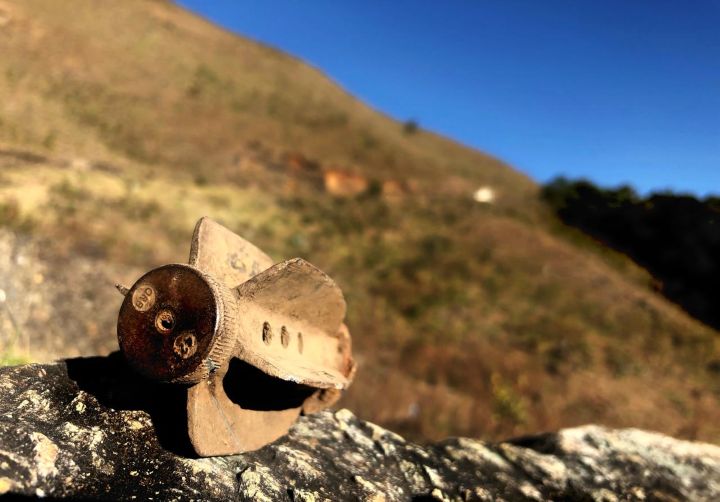
Recent survey work has shown that Makhel’s monolith is not alone. A 2023 archaeological and ethnographic study documented twelve named sacred stones in and around the village — a “charmed stone” once believed to double a family’s rice harvest, a slab said to conceal a mythical self-guiding weapon buried by an ancestor, a platform where the village chief once made his announcements and which women were forbidden to stand on, a cairn credited with the power to summon rain. Each stone comes with its own story, passed down not in writing — the Naga had no indigenous script — but strictly by word of mouth, elder to child, for as long as anyone can trace.
That, researchers say, is precisely the problem. A wider survey around the neighbouring village of Pudunamei has since mapped 217 separate megaliths and related features across roughly 25 square kilometres of hillside. But documenting a stone is not the same as documenting what it means, and the number of people who still hold the full stories is shrinking fast. Nearly the entire Naga population of the area converted to Christianity over the twentieth century; in Makhel today, researchers found only a single household still practising the older, animist faith the stones belonged to. Many younger residents can point to a monument and repeat a fragment of its story, but only the oldest generation can tell it whole.
The stones themselves are also under quieter, more physical threat. Road-widening and construction have already chipped into monuments at Makhel — one sacred dolmen was struck and partly damaged by a truck a few years ago, an incident villagers still talk about (a freak storm blew in immediately afterward, and many took it as the stone’s own protest). Village authorities have since fenced off several monuments and now fine anyone, in cash or livestock, caught damaging them — a folk heritage law enforced without any help from the state.
It would be a mistake to read all this as a culture in retreat, however. The tradition that produced these stones — raising a monolith to mark a feast, a victory, a chief’s accession, or a family’s status — was never a single ancient event. It was, and in places still is, an ongoing social currency. In the Poumai Naga village of Oinam, modified versions of the old “feast of merit,” in which a sponsor earns rank and privilege by distributing wealth in a lavish public feast, still lead to new stones going up. And at Makhel itself, a new commemorative monolith explicitly honouring the Naga origin story was unveiled only a few years ago — proof that, even stripped of its original religious framework, the act of raising a stone to say something enduring still means something to the people who live among them.
What the region badly needs, researchers argue, is what has never really been attempted at scale: systematic mapping of sites beyond Makhel, serious archaeological dating (almost nothing has been scientifically dated, so a stone could be eight hundred years old or eighty), and above all, urgent recording of the oral histories still held by a dwindling number of elders. Northeast India’s megaliths are unusual among the world’s ancient stone monuments in one crucial respect — this is not a dead tradition to be reconstructed from ruins, but a living one that can still, for now, speak for itself.
The window for listening, though, is closing.

The writer is a former Member of Parliament and a former Union Minister of State External Affairs and Education, Government of India.