

Since the eruption of large-scale violence in Manipur on May 3, 2023, the phrase “buffer zone” has ceased to be a mere descriptive term used by security planners or journalists in between nations and international borders. It has become a lived and contested reality in Manipur that now structures everyday movement, citizenship, political imagination, and the very meaning of territorial belonging in the state. For vast sections of the population, buffer zones are not theoretical constructs but physical and psychological barriers that determine where one can travel, whom one can meet, what markets one can access, and which parts of one’s own state are effectively out of bounds.
It is against this backdrop that the recent categorical statement by the Governor of Manipur, Ajay Kumar Bhalla, that “there is no buffer zone in Manipur,” assumes profound political and constitutional significance. Far from reassuring an already traumatised population, the statement has sharpened public unease, because it stands in stark contrast to extensive ground-level evidence, security force practices, judicial interventions, civil society testimonies, and even parliamentary scrutiny. The denial does not merely contradict facts; it exposes a deeper governance crisis in which the state appears unwilling to name, regulate, or dismantle arrangements that are actively reshaping Manipur’s political geography.
This article critically examines that denial in relation to three interconnected dimensions: first, the emergence of buffer zones as de facto instruments of separation since May 2023; second, the constitutional implications of prolonged movement restrictions and the erosion of Fundamental Rights; and third, the dangerous process by which repeated denial, coupled with selective enforcement, risks legitimising de facto territorial control claimed by Kuki-Zomi groups, even as the state insists that no such zones exist. The intervention of Member of Parliament (MP) from Inner Manipur Parliamentary Constituency, Dr Angomcha Bimol Akoijam, after he was stopped again by Central Security Forces from proceeding further while visiting Saiton village in Bishnupur district bordering Churachandpur district on January 6, 2026, through the Right to Information (RTI) Act further underscores that this is no longer a matter of perception or rhetoric, but of accountability, legality, and the future of the Indian constitutional order in Manipur.
The Emergence of Buffer Zones as Lived Reality
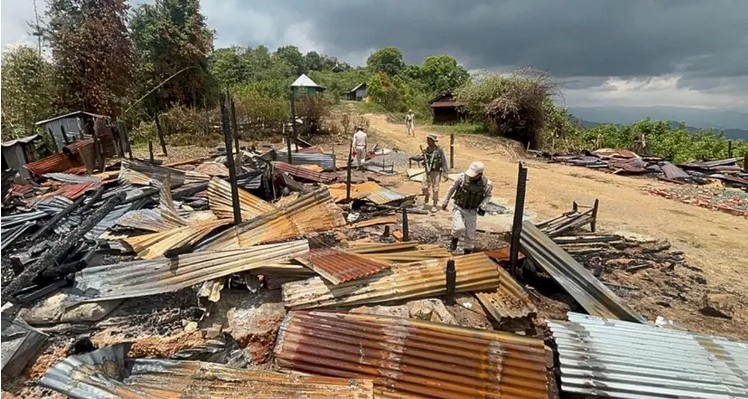
The violence that erupted on May 3, 2023, marked a qualitative rupture in Manipur’s social fabric. While ethnic tensions between Meiteis and Kuki-Zomi communities have no long histories, the scale, intensity, and spatial reorganisation produced by the 2023 violent conflict were unprecedented. Kuki-Zomi militants had driven out Meiteis from the Kuki-Zomi dominated Churachandpur district, Kangpokpi district and international border town of Moreh; and the Kuki-Zomis fled from Imphal Valley due to the retaliatory actions from Meitei mobs. As armed clashes spread across districts bordering the Imphal Valley and the surrounding hills dominated by Kuki-Zomi tribes, security forces responded by attempting to physically separate hostile populations to prevent further bloodshed. What began as an emergency measure soon evolved into a more enduring spatial arrangement.
Along strategic corridors – most notably the interfaces between valley and hill districts and along key stretches of National Highways 2 and 37 – security forces established checkpoints, enforced movement restrictions, and effectively prevented civilians from crossing into areas dominated by the “other” community. Over time, these measures crystallised into what people on the ground are made to understand, without ambiguity, as buffer zones. These were not confirmed as formally notified demilitarised areas, but zones of regulated access where identity often determined mobility.
The consequences were immediate and far-reaching. National Highways, constitutionally envisaged as arteries of free movement and economic integration, became segmented routes where passage depended on security assessments and ethnic profiling. Villages that had once been connected through trade, education, and social ties found themselves abruptly severed. For many citizens, especially Meiteis in the Imphal Valley, travel to large parts of the hill districts became practically impossible without security escort, if at all. The buffer zones thus ceased to be temporary security arrangements and instead became everyday structures shaping civilian life.
Official Denial and the Politics of Language
Despite this widely acknowledged reality, official discourse has consistently denied the existence of buffer zones. The Governor’s January 2026 statement is only the most recent articulation of a position that has been reiterated by the Chief Minister, senior police officials, and government spokespersons since 2023. The standard formulation is that there are “no buffer zones,” only “sensitive areas” or “hotspots” where security forces are deployed to maintain law and order.
This insistence on semantic distinction is not politically neutral. By refusing to name buffer zones, the state avoids acknowledging that extraordinary restrictions on movement have become normalised. Denial allows the government to bypass uncomfortable questions – Under what legal authority are these restrictions imposed? How long will they last? Who decides where citizens may or may not travel within their own state? Most importantly, what safeguards exist to ensure that emergency measures do not become permanent instruments of separation?
The contrast between official language and lived experience has created a widening credibility gap. Citizens who are physically stopped at checkpoints, turned back from National Highways or prevented from returning to their homes are told that what they are experiencing does not exist. This dissonance does not inspire confidence; it breeds cynicism and resentment. In democratic governance, language is not merely descriptive – it is constitutive. What the state refuses to name, it also refuses to regulate, review, or dismantle.
Fundamental Rights and the Architecture of Restriction
At the heart of the buffer zone controversy lies a profound constitutional question. The Indian Constitution guarantees every citizen the right to move freely throughout the territory of India under Article 19(1)(d) and the right to reside and settle in any part of India under Article 19(1)(e). These rights are not ornamental; they are foundational to the idea of a single political community. Any restriction on them must meet the strict tests of reasonableness, proportionality, necessity, and legality.
In Manipur, movement restrictions imposed through buffer zones – or whatever nomenclature is used – have persisted for nearly three years. They are not time-bound, are unevenly enforced, and disproportionately affect specific communities. This raises serious concerns under Article 14, which guarantees equality before the law. When access to highways, markets, and districts is effectively mediated by ethnic identity, the state risks institutionalising discriminatory practices, even if unintentionally.
Article 21 further deepens the constitutional stakes. The right to life has been expansively interpreted by Indian courts to include the right to live with dignity, access healthcare, pursue livelihoods, and maintain social relationships. For displaced persons unable to return home, students cut off from educational institutions, patients denied timely medical care due to travel restrictions, and traders belonging to particular community facing economic ruin because highways are inaccessible, more than 4000 drivers belonging to Meiteis became jobless as they are not allowed to drive on the National Highways, buffer zones translate directly into violations of Article 21.
Additionally, Article 301, which guarantees freedom of trade, commerce, and intercourse throughout the territory of India, is rendered hollow when National Highways function as segmented corridors rather than unified routes. When economic life is fractured along ethnic lines, the constitutional promise of an integrated national market collapses at the periphery.
What makes the situation particularly alarming is that these restrictions operate without formal notification, legislative sanction, or publicly articulated legal frameworks. The Indian State denies the existence of buffer zones, yet enforces their effects. This creates a constitutional anomaly in which rights are curtailed by arrangements that officially do not exist, thereby escaping meaningful judicial scrutiny.
Judicial Intervention and the Limits of Denial
The filing of a Public Interest Litigation (PIL) in the Manipur High Court in late 2025 challenging buffer zone restrictions marks a critical turning point. By naming not only state authorities but also the Union of India and senior security officials as respondents, the petition acknowledges what official discourse denies – that movement restrictions are being materially enforced by the apparatus of the state. The PIL contends that citizens have been effectively confined to ethnically defined spaces since May 2023, in violation of their Fundamental Rights.
Judicial engagement exposes the limits of denial. Courts cannot assess the proportionality or legality of measures that the executive refuses to acknowledge. Yet the very fact that security forces routinely “rescue” individuals attempting to cross so-called sensitive areas implicitly confirms the existence of regulated zones as Buffer Zones. The contradiction between denial in public statements and acknowledgment in operational practice undermines the credibility of governance and weakens the rule of law.
De Facto Territorial Control and the Risk of Silent Legitimation
Perhaps the most politically dangerous consequence of the buffer zone regime lies not merely in rights violations, but in its territorial implications. While the government denies buffer zones, Kuki-Zomi civil bodies and armed militant groups have consistently insisted on their existence and necessity. In doing so, they have effectively asserted de facto control over certain territories, treating buffer zones as recognised boundaries separating ethnic homelands.
This asymmetry is deeply consequential. On one side, the state verbally denies buffer zones but fails to dismantle them. On the other, Kuki-Zomi actors insist on their permanence and organise political narratives around them. Over time this dynamic risks transforming emergency security arrangements into tacitly accepted territorial facts. When certain areas become inaccessible to one community for years, control is no longer merely military; it becomes political and psychological.
History offers ample warning. Buffer zones that are denied but maintained often harden into proto-borders. They acquire symbolic meaning, legitimise claims of exclusive belonging, and normalise separation. In Manipur, this process intersects dangerously with demands for separate administration and narratives of exclusive ethnic homelands. Even without formal recognition, the continued existence of buffer zones lends credibility to these claims by altering realities on the ground.
Denial, in this context, does not preserve territorial integrity; it erodes it silently. By refusing to clearly assert constitutional sovereignty over all parts of the state through equal access and uniform rights, the government inadvertently allows alternative sovereignties to take root.
Parliamentary Oversight and the RTI Intervention
The intervention of Inner Manipur Parliamentary MP Dr Angomcha Bimol Akoijam, who sought information on buffer zones through the Right to Information Act, underscores the gravity of the issue. When an elected Member of Parliament must resort to RTI queries to ascertain whether buffer zones exist, it signals a breakdown of transparency and accountability. Parliamentary oversight is rendered ineffective when basic facts about security governance are obscured.
The RTI intervention raises a fundamental democratic question – If buffer zones do not exist, what exactly are security forces enforcing, and under whose authority? If they do exist in practice, why are they denied in principle? The inability – or unwillingness – of the executive to provide clear answers not only undermines public trust but weakens the constitutional chain of accountability linking citizens, Parliament, and the executive.
Social and Psychological Consequences
Beyond law and politics, buffer zones have inflicted deep psychological wounds. Communities feel caged within their own state, alienated from ancestral lands, and stripped of the sense of equal citizenship. Children and youth grow up internalising segregation as normal, associating identity with restricted geographies rather than shared civic space. Such conditions are corrosive to any future reconciliation.
Denial exacerbates this trauma. When lived suffering is dismissed as illusion, it deepens alienation and fuels radical narratives. Trust, once eroded, is difficult to rebuild, especially in societies emerging from violence.
Why Acknowledgement Is a Prerequisite for Peace
Peace cannot be built on denial. Acknowledging the existence of buffer zones does not mean endorsing them as permanent or legitimate. It means recognising reality in order to regulate, review, and ultimately dismantle it. Honest acknowledgement would allow the state to subject movement restrictions to constitutional tests, establish time-bound frameworks, and articulate a roadmap for restoring free movement.
Such an approach would also send a clear signal that de facto territorial control will not be legitimised through silence. It would reaffirm that Manipur’s geography remains constitutionally indivisible and that no community gains exclusive rights through force or prolonged separation.
Conclusion: The Cost of Dissonance
The contradiction between official denial and lived reality in Manipur is no longer a semantic issue. It is a constitutional crisis with far-reaching implications for citizenship, territorial integrity, and democratic trust. By denying buffer zones while enforcing their effects, the state undermines Fundamental Rights, weakens accountability, and risks normalising silent partition.
If Manipur is to move beyond violence and fragmentation, governance must align words with realities. Honest acknowledgement is not an admission of failure; it is the first step toward restoration of rights, trust, and a shared political future within the constitutional framework of India.

Senior Editor: Imphal Review of Arts and Politics


1 thought on “How Government Dissonance of Buffer Zones Deepens Crisis, Normalises Territorial Fragmentation, and Erodes Constitutional Trust”
Very clearly put: “extraordinary restrictions on movement have become normalised”and the implications of the official denials mentioned very clearly – Raj Bhavan must be very happy
Comments are closed.