On September 4, 2025, New Delhi announced the renewal of the Suspension of Operations (SoO) agreement with two umbrella bodies of armed Kuki-Zo militant groups – the Kuki National Organisation (KNO) and the United People’s Front (UPF). The Ministry of Home Affairs (MHA), through a Press Information Bureau (PIB) statement, framed it as a straightforward breakthrough. The release declared that the Kuki-Zo Council (KZC) had “decided to open” National Highway-2 (NH-2) for the free movement of commuters and essential goods, while also affirming the SoO signatories’ commitment to “the territorial integrity of Manipur” and to “a negotiated solution to bring lasting peace and stability to the State of Manipur.”
The headlines that followed suggested a neat policy win: a truce extended, a vital artery unlocked, and talks ahead. But within hours, the façade cracked. The KZC issued clarifications that narrowed the scope of the “opening,” the Village Volunteers Coordinating Committee (VVCC) in the Kuki-Zomi dominated areas flatly rejected the deal as “null and void,” and SoO signatories themselves reminded Delhi that their end goal remained nothing less than a Union Territory with a legislature for Kuki-Zo areas “under the Constitution of India.”
The contrasting statements left many in the Imphal valley, especially Meiteis who have been effectively hemmed in by “buffer zones” since the violence erupted on May 3, 2023, wondering what had really changed. Was the National Highway open? Who had the authority to decide? And more urgently – would their lives become any less constrained?
This article attempts to read the signals, the silences and the subtext behind the September SoO renewal. What looks like a technical extension of a ceasefire is, in fact, a layered political bargain in which National Highways become bargaining chips, “buffer zones” risk ossifying into de facto borders, and both the Centre, State Government and Kuki-Zomi actors are manoeuvring for leverage – often at the expense of ordinary Manipuris.
A Quick Primer: SoO, National Highways and “Buffer Zones”
The Suspension of Operations mechanism, first signed on 1 August 2005 between the KNO-UPF and Indian Army, was never born of direct hostilities between the Indian Army and Kuki-Zo militants. As several analysts have pointed out, Kuki-Zo armed militant groups and the Indian Army had never been in open combat before the SoO. Instead, the agreement functioned as a ceasefire-plus: a means of freezing the status quo while creating institutional channels for dialogue for certain agendas. Due to frequent clashes between the State Security Forces and Kuki-Zo militants, the Government of India brought in the Government of Manipur into the SoO as a tripartite agreement on August 22, 2008 with a preamble – KNO-UPF to abide by the “territorial integrity of Manipur”. Renewed periodically, the SoO has allowed the Centre to engage the KNO and UPF without committing to a final political arrangement.
However, the September 2025 renewal once again extended that logic, with the PIB noting that “the SoO extension and revised ground rules underline the need for a negotiated solution to bring lasting peace.”
The battleground today, however, is not only about armed encounters. It is about roads, the connectors.
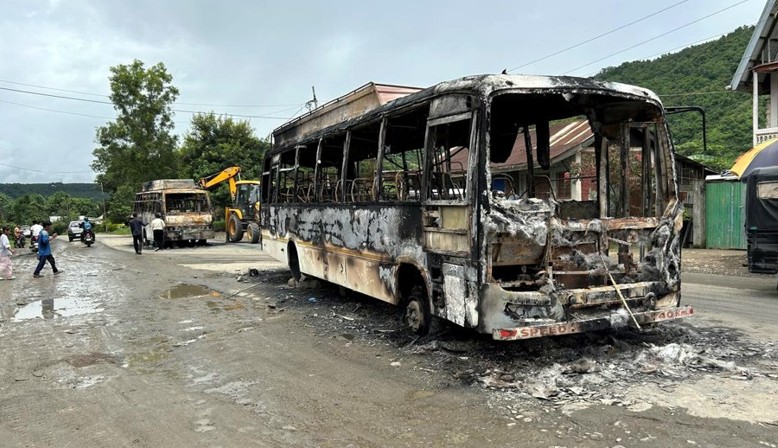
NH-2, connecting Imphal to Dimapur, is not just asphalt but a lifeline. It carries supplies, medicines, fuel and food to the valley and distribute to all parts of the State. Since May 3, 2023 the route has been fractured by a patchwork of “buffer zones” policed by Central Security Forces, state police, and informally, by Kuki-Zomi armed village volunteers. For valley residents especially Meiteis, these checkpoints have made routine mobility – to work, business, hospitals, schools, markets and transportations owned and run by Meiteis in other districts and beyond – a failed affair. For many, the only reliable way out of Manipur now is by air, where tickets have skyrocketed in price and some routes are discontinued.
Even after the PIB claimed the highway would be reopened, reports emerged that armed men stopped a bus in other highways at Molnom village along the Sanakeithel-Imphal route in Ukhrul district on 8 September, 2025 checking for Meitei passengers while hurling slurs. Such incidents underline the gap between paper announcements and lived reality intimidating the Meiteis.
What the PIB Said and Why the Wording Matters
The PIB release on September 4, 2025 was clear in its framing: the KZC had “decided to open” NH-2 and had “given commitment to cooperate with Security Forces deployed by GOI to maintain peace” along the stretch. It stressed that the renewed and revised agreement reaffirmed the “territorial integrity of Manipur” and the constitutional framework for talks.
At first glance, this was simple cause-and-effect storytelling: extend the truce, open the road, restart commerce, move towards talks.
But the phrasing raises questions. The release positioned the National Highway opening as a KZC decision following meetings in Delhi, effectively shifting responsibility to a community body rather than the government itself. And crucially, it left unqualified the scope of the opening. Only later did clarifications emerge that the “opening” was confined to NH-2 stretches within Kangpokpi district – not an all-access pass for valley residents especially Meiteis to travel through contested zones, instead respect “Buffer Zones”.
That gap between the PIB’s spin and the fine print would become the first faultline in the days ahead.
The Responses: Rebuttal, Clarification and Outright Rejection
By the next morning, the neat story had unravelled.
The KZC issued its own statement, insisting that the highway had “never really been blocked in the blanket way implied by some reports.” Instead, it argued, traffic was already flowing for all except the Meiteis, but security was the concern. The KZC demanded neutral Central Security Forces be deployed within the stretch of Kangpokpi, while making clear that the “opening” applied to all except the Meiteis under their cooperation with security agencies.
That ambiguity – neither outright denial nor full endorsement of the PIB’s framing – created space for rival voices.
The sharpest came from the VVCC, a grassroots coordinating body of village volunteers in Kuki-Zomi dominated areas. In a September 5 release, it blasted the deal as “unilateral” and declared it “null and void.” The statement warned that “no free movement for Meiteis” would be permitted into Kuki-Zo territories until a separate administrative arrangement was secured. It also announced a boycott of the KZC for “acting without mandate.”
Meanwhile, the umbrella SoO signatories themselves stressed that the renewal reaffirmed their political project. The KNO and UPF reiterated that their demand remains a Union Territory with its own legislature, adding that any eventual settlement would be “within the Constitution of India.” In other words: they were not signing away their long-term agenda for a temporary traffic concession.
Three parallel messages had thus crystallised: the government’s triumphalism, the KZC’s hedged cooperation, and the VVCC’s outright rejection. Each told a different truth.
Who Is Telling The Truth? Reading Competing Narratives
Which version should Manipuris believe? There are three ways to read the contradiction.
Spin and message control. Government press notes are designed for optics. The PIB’s line that “KZC has decided to open NH-2” may have been less a literal description of mobility and more a symbolic communication of progress. Independent commentators have already accused the PIB of “putting a spin” by omitting the limiting clauses contained in the SoO text.
A genuine but limited opening. The KZC’s clarifications suggest that limited stretches in Kangpokpi along the NH-2 be made safe, provided central forces guarantee security, and the “Buffer Zones” be respected limiting the Meiteis to access the National Highway.
Transactional bargaining with vetoes. The VVCC’s rejection demonstrates that elite deals in Delhi do not automatically command compliance on the ground. Village committees, defence groups and rival formations retain the capacity to veto, often through blockades, boycotts or threats. Thus the National Highway can be “open” for all on paper while closed in practice.
In reality, all three are true at once: a central government keen on optics, umbrella groups negotiating leverage, and grassroots actors exercising veto power.
Why the National Highway Matters As A Bargaining Chip
It is tempting to dismiss the entire flap as overblown. But roads in Manipur are not only infrastructure; they are symbols of sovereignty and instruments of survival and extortions to sustain militancy.
Access to NH-2 governs whether food reaches Imphal markets, whether patients make it to hospitals within Manipur and outside, whether students travel for exams, whether transportations owned and run by Meiteis function, whether trade and commerce continue. To concede the road – even partially – is to decide who mediates valley life: Delhi, Kuki-Zomi armed militant groups, or Kuki-Zomi volunteer militias or Naga insurgents or Naga civil bodies.
For the Centre, securing even a partial opening underlines its writ through Central Security Forces and relieves humanitarian pressure ahead of Prime Minister Narendra Modi’s planned visit on 13 September. For Kuki-Zo leaders, the deal signals recognition of their negotiating authority while keeping their political demands intact. For valley Meiteis, however, the bargain looks one-sided: concessions for others’ mobility while their own freedom of movement remains denied.
Buffer Zones: Temporary Security or De Facto Partition?
Perhaps the most dangerous feature of the current conflict is the way buffer zones, first erected in May 2023 by the Central Security Forces in the name of preventing clashes, have hardened into invisible borders.
Checkpoints on NH-37 mean Meiteis cannot move beyond Keithelmanbi toward Jiribam along Imphal-Silchar Road to connect with Assam on the western border of Manipur. Along the Imphal-Moreh road of Asian Highway, AH-1, their movement stops at Pallel. In practice, these restrictions have carved the state into segregated zones of control. Imphal-Churachandpur is blocked at Phoubakchao Ikhai.
If such zones persist, they risk crystallising into permanent partitions. Other critics also warn that the SoO’s careful language about “territorial integrity” may mask a reality in which the State is being re-mapped along ethnic lines – creating the very conditions for a separate Union Territory demand to appear as the logical endgame.
The Fragmentation of “Kuki-Zo” and The Politics of Representation
Another key to reading the SoO drama is recognising that “Kuki-Zo” is not a monolith. The KZC, UPF, KNO, VVCC, ITLF, COTU, Zomi organisations and smaller village committees often pull in different directions, besides Thadou Inpi Manipur (TIM) and its groups.
The VVCC’s boycott of the KZC illustrates this clearly: not all Kuki-Zomi bodies recognise the KZC’s authority. Zomi groups, for instance, continue to emphasise their distinct political imagination of “Zoland” or “Zogam,” separate from a Kuki-centric framework denouncing “Kuki-Zo” nomenclature.
That diversity complicates Delhi’s desire for neat tripartite negotiations. Without broader buy-in at the grassroots, elite bargains risk crumbling on contact with reality.
The Centre’s Incentives – Stability, Optics and Control
Why, then, did Delhi go ahead with the PIB fanfare? Three reasons stand out.
First, optics. After 28 months of turmoil, the Centre needs visible normalisation before high-profile visits and electoral campaigns. Announcing that “NH-2 is open” sounds like progress.
Second, relief. Even limited openings reduce humanitarian stress in the valley and demonstrate that Central Security deployments matter.
Third, leverage. By engaging SoO signatories in Delhi, the Centre pulls militant groups into a managed framework of talks, reducing immediate security burdens and buying time to shape long-term outcomes.
But these gains are fragile if they are not matched by grassroots legitimacy.
Human Consequences: Who Remains Constrained?
For Meiteis in the valley, the lived reality has not shifted. Checkpoints still confine them, routes remain blocked, and flight tickets out of Imphal are becoming more and more unaffordable.
For Kuki-Zomi villagers in the hills, meanwhile, the prospect of unrestricted Meitei entry is itself a red line – rooted in their perceived grievances of occupying lands and fears of domination.
These daily constraints – not the wording of PIB notes – will ultimately decide whether Manipuris feel peace or partition in the year ahead.
Risks Ahead
Several dangers loom.
Legitimacy deficit. Deals struck with umbrella SoO groups without local consent invite non-compliance and splintering.
Administrative entrenchment. Temporary “buffer zones” risk becoming permanent borders.
Weaponisation of National Highways and relief. If access National Highways and to goods is tied to political concessions, National Highways and humanitarian needs become bargaining chips.
Persistent ambiguity. Alternating claims of “opening” and “limited access” deepen mistrust.
What Would A Wiser Approach Look Like?
If the SoO extension is to create space for real peace, three steps are essential.
First, transparency: spell out in writing which stretches of NH-2 are open, under what protection, for how long, and for whom.
Second, neutral enforcement: Central Security Forces must secure routes with clear rules of engagement and independent oversight.
Third, inclusive dialogue: tripartite talks should be supplemented with consultations in both Kuki-Zomi dominated areas and Imphal Valley, where dissenting groups like the VVCC are heard.
Above all, essential goods, medical access and education must be insulated from political bargaining and treated as rights.
Conclusion: A Brittle Peace In Need of Durable Legitimacy
The September SoO renewal has not unlocked a road so much as it has revealed the layers of bargaining that structure Manipur’s conflict. Delhi trumpeted a highway opening; the KZC hedged its cooperation; the VVCC rejected the move outright; and the SoO signatories reiterated their demand for a Union Territory.
The outcome is a muddled spectacle: a “road open” on paper, still closed for Meiteis on the ground.
If peace is to be more than a press release, the Centre, State government and SoO groups’ leaders along with local actors must move beyond symbolism to transparent, inclusive and rights-based implementation. Otherwise, “buffer zones” will harden into borders, humanitarian needs will be politicised, National Highways will further be weaponised, and Manipuris especially Meiteis will remain trapped in a brittle cycle of tactical truces and everyday constraints.
At stake is not only the movement of trucks along NH-2, but whether Manipur can be held together as a shared space, or whether invisible partitions will be etched into its future.

Senior Editor: Imphal Review of Arts and Politics