
When the Constitution of India was framed, federalism was never intended to mean complete autonomy of the States. Equally, it was never intended that the Union Government would routinely administer the internal affairs of a State without invoking constitutionally recognised emergency provisions. Between these two constitutional poles lies the ongoing crisis in Manipur, where since May 2023 an unusual model of governance appears to have emerged – one in which the elected State Government continues to exist, yet critical decisions concerning security, administration, negotiations and even the movement of people increasingly appear to originate from New Delhi.
The constitutional question is therefore larger than the conflict itself.
Has Manipur, while formally remaining under an elected government for much of the crisis and later under President’s Rule before the installation of a new government, actually been administered through a system of Union direction under Articles 355 and 371C of the Constitution?
The question deserves careful examination because what has unfolded in Manipur may represent one of the most significant yet least discussed transformations of Indian federalism.
An Extraordinary Administrative Rearrangement
Within days of the violence that erupted on 3 May 2023, the Union Government initiated an administrative restructuring rarely witnessed in any State not under President’s Rule.
A Security Adviser was appointed specifically for Manipur. A new Director General of Police was brought in. A new Chief Secretary assumed charge.
Most significantly, the Security Adviser became Chairman of the Unified Command Headquarters.
Conventionally, the Unified Command in insurgency-affected States functions under the political authority of the Chief Minister. In Manipur, however, operational authority effectively shifted towards a centrally appointed security architecture. This change was not merely administrative. It symbolised a redistribution of power.
While the elected government continued to exist, the principal instrument through which security policy was implemented no longer appeared to remain under the direct political leadership of the Chief Minister. Besides, the home affairs of the State lie with another cabinet minister – not in the hands of the Chief Minister in the new elected government.
This restructuring coincided with an unprecedented expansion of the operational role of Central Armed Police Forces, the Army, Assam Rifles and the Ministry of Home Affairs.
From that point onward, major security decisions increasingly appeared to require approval from New Delhi.
The Chief Minister’s Remark That Raised Constitutional Questions
One statement made by then Chief Minister Nongthombam Biren Singh deserves closer constitutional attention.
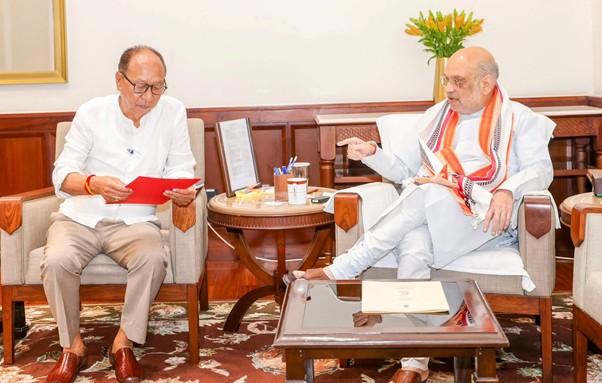
When the Manipur crisis was nearly two months, after the summon by the Union Home Minister Amit Shah in New Delhi on June 25, 2023, N Biren Singh stated upon arriving late night at the Imphal Airport that he would be responsible for the law and order in Imphal Valley, while the Union Home Minister Amit Shah would look after the hill areas.
The remark attracted public discussion at the time but was never constitutionally examined seriously deeper.
No constitutional provision permits a Union Home Minister to become the administrator of a portion of a State.
Yet the statement appeared to describe precisely how governance was functioning in practice.
Whether intended literally or politically, the remark reflected a widespread perception that different parts of Manipur were effectively being governed through different centres of authority.
That perception has only deepened over time.
The Shadow of Article 355
Although no formal notification has been issued, many constitutional observers have argued that Article 355 has effectively operated in Manipur since May 4, 2023.
Article 355 imposes a constitutional duty upon the Union:
“It shall be the duty of the Union to protect every State against external aggression and internal disturbance and to ensure that the government of every State is carried on in accordance with the provisions of this Constitution.”
Unlike Articles 356 or 352, Article 355 does not itself establish an emergency.
Instead, it provides the constitutional foundation upon which the Union may intervene to assist – or direct – a State in restoring constitutional governance.
Several former constitutional authorities have described Article 355 as the “constitutional gateway” to Union intervention before President’s Rule is imposed.
If Article 355 has indeed guided the Union’s actions in Manipur, then the extensive deployment of Central forces, restructuring of security command, and assumption of operational control become constitutionally intelligible.
But Article 355 alone does not explain the administration of the hill areas. For that, one must turn to Article 371C.
The Unique Constitutional Provision
Article 371C occupies a unique place in India’s constitutional architecture.
Unlike many special provisions for Northeastern States that primarily concern development or customary laws, Article 371C specifically addresses the administration of Manipur’s hill areas.
Clause (2) provides:
“The Governor shall annually, or whenever so required by the President, make a report to the President regarding the administration of the Hill Areas in the State of Manipur, and the executive power of the Union shall extend to the giving of directions to the State as to the administration of the said areas.”
Few constitutional provisions are more explicit.
The Union possesses executive authority to direct the State Government regarding the administration of the hill areas. “Hill Areas” means such areas as the President may, by order, declare to be Hill Areas.
This authority exists independently of Article 356.
It exists even when an elected government continues to function.
In other words, the Constitution itself contemplates circumstances in which the Union may direct the administration of Manipur’s hill areas without formally taking over the State.
The provision is unique.
It creates a constitutionally recognised exception to ordinary federal autonomy.
Was Article 371C Functionally Activated?
No public record suggests that the President formally required reports under Article 371C after the violence.
Nor has the Union publicly disclosed whether directions were issued under this provision.
However, constitutional practice need not always be accompanied by public notification.
The relevant question is whether the observable pattern of governance corresponds to the constitutional mechanism envisaged by Article 371C.
Several developments suggest that it may.
Negotiations with Kuki-Zomi organisations have been conducted almost entirely by the Ministry of Home Affairs rather than the State Government.
Buffer zones separating communities have been maintained principally by Central Forces.
Major decisions concerning highways, security deployments and peace initiatives have consistently emerged from New Delhi.
Repeated meetings between Kuki-Zomi representatives and Union officials have often occurred without substantive participation by the elected State Government.
Even issues involving district administration increasingly appeared linked to Union security priorities.
Whether described formally or not, the Union has exercised decisive influence over the administration of substantial portions of the hill areas.
The constitutional question is therefore not whether Article 371C has been declared.
The question is whether its logic has effectively structured governance.
A State Government with Limited Autonomy?
This raises another uncomfortable question.
How much authority has the Government of Manipur actually retained?
The State Government has frequently appeared unable to implement decisions independently regarding:
- reopening highways,
- removing buffer zones,
- conducting policing operations in sensitive areas,
- negotiating with armed organisations,
- taking actions against those who breach the ground rules of Suspension of Operations (SoO) agreement,
- deployment and transferring security personnel,
- restoring free movement across the State.
Each major initiative appeared to have depended upon approval or coordination with the Ministry of Home Affairs.
In ordinary federal practice, law and order remains a State subject under the Seventh Schedule.
Yet during the Manipur conflict, the practical distinction between State powers and Union powers has become increasingly blurred.
The State Government often appeared less as an autonomous constitutional authority than as an implementing agency within a centrally coordinated security framework.
The Double Engine Question
This reality also challenges the political slogan of the “double engine government.”
The phrase ordinarily implies cooperation between governments led by the same political party.
In Manipur, however, the relationship has often appeared markedly asymmetrical.
Rather than two engines working together, governance increasingly resembled one engine directing another.
The State Government repeatedly deferred to decisions emerging from New Delhi. Key political negotiations occurred under Union leadership. Strategic security decisions were centrally coordinated.
Public confidence gradually shifted away from Imphal towards New Delhi because citizens increasingly believed that ultimate authority rested there.
This was perhaps the clearest indication of where effective executive power had migrated.
President’s Rule Did Not Fundamentally Alter the Pattern
When President’s Rule was eventually imposed on February 13, 2025, many expected a dramatic transformation.
Instead, the administrative pattern changed surprisingly little. The same security architecture remained. The same central coordination continued. The same operational priorities persisted.
Even after a new elected government with mini-sized ministry of five including Chief Minister Yumnam Khemchand assumed office on February 4, 2026; the Union retained dominant influence over security and political negotiations.
This continuity suggests that the underlying model of governance had already evolved long before formal President’s Rule.
Democratic Accountability
This constitutional arrangement creates a democratic dilemma.
If major decisions originate in New Delhi while implementation occurs in Imphal, accountability becomes fragmented.
When highways remain closed, who is responsible? When buffer zones continue indefinitely, who answers? When negotiations fail, who bears constitutional responsibility?
Citizens cannot effectively hold governments accountable if authority itself becomes opaque.
One of the cardinal principles of constitutional democracy is that executive responsibility must be identifiable.
The Manipur experience has often obscured precisely that principle.
The Need for Constitutional Transparency
If the Union has indeed exercised powers under Article 371C, the public deserves to know.
Has the Governor submitted special reports to the President? Were directions issued under Article 371C(2)? What was their scope? Are they still operative?
If Article 355 informed the Union’s intervention, what legal framework governed the extent of that intervention?
None of these questions seeks to undermine national security. Rather, they seek constitutional transparency. The Constitution authorises exceptional measures. It does not authorise invisible governance.
Conclusion
The Manipur crisis may ultimately be remembered not only as one of independent India’s gravest internal conflicts but also as a constitutional turning point.
It has exposed an under-examined feature of the Indian Constitution – the possibility that the Union may exercise substantial control over the administration of a State’s territory without invoking the dramatic machinery of Articles 356 or 352.
Whether this occurred through the formal exercise of Article 371C, through the broader duty imposed by Article 355, or through political arrangements outside explicit constitutional language remains unclear because the Union Government has never publicly explained the legal basis of its actions.
That silence matters.
Federalism depends not only upon the distribution of power but also upon clarity regarding who exercises that power, under what authority, and subject to which constitutional limits.
Manipur’s experience demonstrates that constitutional powers can reshape governance even without formal proclamations. If the Union has effectively directed the administration of the hill areas under the authority contemplated by Article 371C(2), then India deserves an open constitutional conversation about the scope, limits and accountability of that power. Such a conversation is essential not merely for Manipur, but for the integrity of India’s federal structures itself.

Senior Editor: Imphal Review of Arts and Politics




1 thought on “Has Manipur been Governed from New Delhi? The Quiet Centralisation of Power During the Manipur Crisis”
First, Constitution has never been treated as an instrument of administration with sanctity.
Second, the State Units have never been treated with the federalism principles.
This is Bharat has been duing the last 12 years.The underlying dynamics in the case of Manipur is well spelt oit
Comments are closed.