
Since February 13, 2025, Manipur has lived under direct Central Rule that is the President’s Rule. Chief Minister Nongthombam Biren Singh’s resignation ended the turbulent BJP-led government that had lost both legitimacy and control after nearly two years of violence. The Centre promised that direct rule would “restore normalcy” and “rebuild trust.” Prime Minister Narendra Modi reinforced this narrative when he visited Churachandpur and Imphal on September 13, 2025, declaring that “peace and progress have returned to Manipur.”
Yet for those living in the state, “peace” is a mirage. Guns may have fallen silent, but the state remains trapped in paralysis. Over 61,000 internally displaced persons (IDPs) still languish in makeshift/relief camps. Meiteis cannot travel freely or security escorted on the two national highways – NH-2 (Imphal–Dimapur) and NH-37 (Imphal–Silchar) – that connect Manipur to the rest of India. And buffer zones, enforced by central forces, have hardened into de facto borders between the valley and the Kuki-Zomi dominated areas of the Manipur Hills.
What prevails is not reconciliation, but a frozen conflict – a condition in which violence stops, but the underlying divisions remain unaddressed and institutionalised. Delhi’s “normalcy” is built not on peace, but on the maintenance of silence.
The Frozen Conflict Framework
The phrase “frozen conflict” is often used for post-war zones in Eastern Europe or the Caucasus – Transnistria, Abkhazia, Nagorno-Karabakh – where the absence of open warfare masks an unresolved struggle for control, legitimacy, and identity. Manipur today fits this framework with alarming precision.
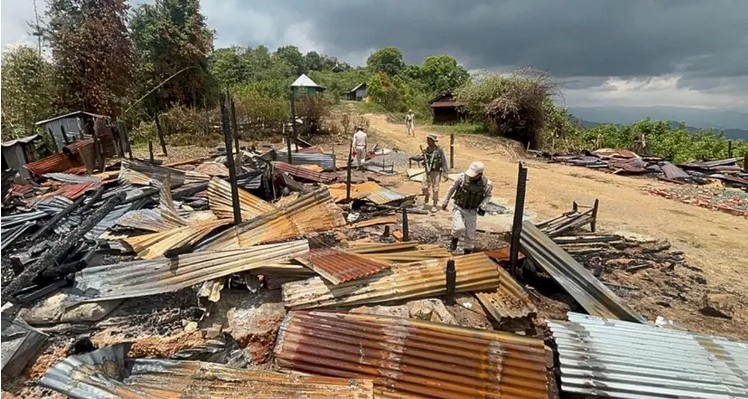
The violent conflict that erupted on May 3, 2023, began with coordinated Kuki-Zomi militant assaults on Meitei settlements in Churachandpur and its bordering areas of Bishnupur district, Kangpokpi and its bordering areas of Imphal East district and international border town of Moreh in Tengnoupal district. What followed was the worst communal bloodletting with counter attacks from Meiteis in the state’s modern history. Entire Meitei villages were razed and bulldozed. More than 270 people died, more than 34 missing, and tens of thousands were uprooted.
Two years later, the guns have largely fallen silent – but not because peace was made. Rather, the conflict has been frozen through militarised separation, with the state itself acting as the custodian of division.
The buffer zones, which were initially conceived as temporary safety corridors, have now ossified into invisible frontiers – lines that mark not only territory but also access, identity, and rights. Meiteis and Kuki-Zomis live under separate regimes of control, security, and narrative.
Buffer Zones as De Facto Borders
Along the faultlines between Bishnupur and Churachandpur, between Imphal West and Kangpokpi, and between Imphal East and Kangpokpi, the Indian state through Central Forces has erected what it calls “buffer zones.” These are manned by Central Forces such as the Assam Rifles, CRPF, and BSF. The official logic is simple – prevent clashes by maintaining a physical separation between the communities.
But this “temporary” arrangement has, over time, become almost permanent. Villages like Torbung, Phoubakchao, Pallel, Keithelmanbi, Kangchup, Kanglatongbi, Pukhao, and Gwaltabi now exist on opposite sides of what residents describe as an invisible border. Security posts, sandbag bunkers, and iron barriers mark the edges.
For thousands of displaced Meiteis whose homes lay beyond the line, return is prohibited. Even attempting to visit their lands is not allowed and risks confrontation with armed groups or interception by the security forces themselves. The state’s presence, instead of guaranteeing rights, enforces exclusion.
By allowing these zones to persist indefinitely, the government has effectively allowed a partition of control – a partition that, while not declared, is deeply entrenched. Most of the Manipur Hills in between the Meitei and the Naga settlements are dominated by Kuki-Zomi groups, many of whom remain under the Suspension of Operations (SoO) agreement, while the valley remains the administrative hub being the state capital. The result is a fractured sovereignty managed by soldiers, not citizens.
Roads Blocked, Rights Denied
If Manipur’s geography mirrors division, its national highways reveal the collapse of constitutional rights.
The state’s two arteries – NH-2 and NH-37 – connect Imphal to Dimapur and Silchar respectively, serving as lifelines for all economic, educational, health and social activity. Yet since May 2023, these roads have been inaccessible for Meitei travellers.
The irony is glaring – the Indian Constitution guarantees freedom of movement under Article 19(1)(d). But in today’s Manipur, Meiteis cannot traverse national highways that run through their own state.
Vehicles with Manipur state registration numbers are turned back at security checkpoints. Meiteis reaching buffer lines are turned back by the security forces. Those who venture beyond buffer lines risk abduction or attack. The highways, rather than being roads of connectivity and integration, have become corridors of exclusion.
In practice, this means that an entire community has been cut off from the Indian mainland, dependent on air transport or circuitous internal routes for goods, fuel, and medicine. The Centre and its President’s Rule in the state call this peace; for those living it, it feels like siege.
The IDP Paradox: Peace without Return
More than 61,000 people displaced by the violence remain in relief camps till now since the May 3 violent conflict broke out. The majority are Meiteis driven out from Churachandpur, Moreh, Kangpokpi and other mixed areas. Most are not allowed to return home.
Some of their villages – once thriving mixed communities – have been burned and bulldozed to the ground. Others have been occupied or renamed by new Kuki-Zomi settlers. In many cases, the government and local security forces have told IDPs that “security conditions are not yet conducive” for their return when they attempted to visit.
This phrase, repeated in official press briefings, is revealing. It admits that the conditions of conflict persist, even as Delhi proclaims peace. A government cannot both claim normalcy and simultaneously deny citizens the right to go home.
For the displaced, the delay feels like betrayal. Many believe the state has frozen the displacement – allowing the ethnic cleansing of May 2023 to stand as a fait accompli. Their lives remain on hold, their lands beyond reach, and their citizenship effectively suspended.
President’s Rule: Order without Accountability
The imposition of President’s Rule seems intended as a corrective – a way to stabilise Manipur by removing partisan control and restoring administrative neutrality. In practice, it has produced the opposite effect – order without accountability.
Under Governor-led administration of the President’s Rule, the machinery of governance is now fully centralised and opaque. Bureaucrats answer upward to Delhi, not outward to citizens. Independent verification of security operations is rare, and information about incidents near buffer zones is tightly controlled.
Field reports from journalists and local organisations indicate selective enforcement – Meitei village volunteers are routinely arrested, while SoO camps in the hills remain operational despite multiple violations.
This imbalance reinforces the perception that the Centre’s peacekeeping is not neutral, but tilted toward preserving Kuki-Zomi territorial control in the name of stability.
Law and order, in this model, becomes a means of containment, not reconciliation.
Delhi’s Narrative Management
In Delhi’s political lexicon, “normalcy” is both a slogan and a shield. It allows the Centre to project control while avoiding uncomfortable questions about justice and accountability.
Official briefings emphasise “return to routine,” “peaceful observance of festivals,” and “improved law and order.” Mainstream media amplify the message by showing soldiers distributing relief or flagging of army conducted tours for children or children returning to school.
But behind this optics lies a deliberate narrative management strategy. The absence of fresh violence is treated as proof of peace – not a positive peace but a negative peace, while the enduring structural violence of displacement, division, and restriction is rendered invisible.
When Prime Minister Modi stood in Imphal and spoke of “a new era of hope,” he did not mention the 61,000 people still in makeshift/relief camps, or the fact that Meitei traders cannot travel to Moreh – the state’s main trade gateway with Myanmar. In this official imagination, peace is a press release, not a lived condition.
Economic and Humanitarian Stagnation
The illusion of normalcy is also belied by Manipur’s economy.
With the two national highways blocked for normal movement, transportation costs have skyrocketed. Fuel and essential goods are 30–50% more expensive in Imphal than in Guwahati or Dimapur or Silchar. Small businesses have collapsed. Private construction works remain stalled. The informal economy, once powered by cross-border trade through Moreh, now depends on Pangals or on clandestine smuggling – often controlled by armed Kuki-Zomi groups.
For the displaced, life in makeshift/relief camps is a humanitarian purgatory. Conditions remain harsh – cramped shelters, inadequate sanitation, and irregular rations. Children have lost years of joyful home environment. Families live on donations from the valley’s shrinking middle class and NGOs with dwindling funds.
Yet, when questioned, officials insist that “rehabilitation efforts are ongoing.” They point to token measures – new prefabricated shelters or job-training workshops – as evidence of progress.
The contrast between bureaucratic language and lived experience could not be starker. For those who have lost everything, “normalcy” sounds like mockery.
Security Forces and the Double Standard
Manipur today is one of the most heavily militarised states in India. Nearly every major highway, border, and buffer line is patrolled by central paramilitary forces. Their mandate is to keep peace; their methods have made them arbiters of geography.
In the valley, many Meiteis accuse the Central Security Forces particularly Assam Rifles of bias – claiming they restrict Meitei village volunteers while allowing armed Kuki-Zomi presence on the national highways, in the hills and foothills. In the hills, Kuki-Zomi groups view the same forces as insufficiently protective. This dual perception of partiality underscores the deeper truth – militarised peace cannot substitute for positive peace.
By enforcing separation rather than restoring coexistence, the security apparatus has become an instrument of division. It keeps the conflict contained, not cured. The Indian tricolour still flies over both valley and hills – but between them lies a landscape of checkpoints and mistrust.
The Constitutional Question
At its core, Manipur’s frozen conflict poses a constitutional paradox. Article 355 obliges the Union to protect every state against internal disturbance and ensure that governance is carried on according to the Constitution. But what happens when “protection” itself violates constitutional guarantees?
Under Article 19, every citizen has the right to move freely throughout India. Under Article 21, every citizen has the right to life and dignity. Both rights are effectively suspended in Manipur – not by formal proclamation, but by the tacit acceptance of exceptional conditions.
If citizens must rely on ethnic identity and military escort to move within their own state, and selective ethnic groups are not allowed to move beyond buffer lines, constitutional equality has been hollowed out. The buffer zones may not be officially sanctioned borders, but they operate as such.
Delhi’s silence on this erosion reveals a larger discomfort – to admit the reality of partition within a state of the Union would be to acknowledge the failure of its own policy.
Ground Realities Ignored
Independent journalists and local human rights groups continue to document what the government prefers to overlook:
Armed presence: SoO camps remain active; reports indicate night patrols and occasional firing from hill peripheries.
Encroachment: Burned Meitei villages like Pukhao and Phayeng have seen new illegal settlements.
Differential policing: Meitei civilians attempting to retrieve property across buffer lines are often stopped by security forces; Kuki-Zomi civilians are not and they escorted by security can access Imphal airport.
Economic exclusion: Valley transporters face extortion at checkpoints run by hill-based armed groups, and Meitei transporters are not allowed on the national highways.
Psychological trauma: IDPS report rising depression, addiction, and suicides.
These realities puncture the government’s curated image of peace. They suggest not reconciliation, but an uneasy equilibrium – a quiet that exists only because communities no longer share space.
What Real Normalcy Requires
Real peace in Manipur cannot be decreed by Delhi; it must be rebuilt from the ground up with Delhi’s sincerity and transparency. That process requires five fundamental shifts:
Freedom of Movement: Unrestricted access to NH-2 and NH-37 for all communities. Security forces must guarantee safe passage, not conditional access.
Return and Rehabilitation: Immediate, secure repatriation of IDPs to original villages, with reconstruction aid and transitional policing.
Accountability: Transparent review of SoO violations and prosecution of those responsible for ethnic cleansing or arson.
Demilitarisation of the Buffer Zones: Replace armed separation with mixed civil administration and local policing drawn from both communities.
Dialogue and Political Reconciliation: Establish an inclusive peace process involving the representatives of all the ethnic groups of Manipur under neutral facilitation.
Without these, “normalcy” remains an empty word – an administrative label for a divided land.
The Peril of Freezing the Future
History teaches that frozen conflicts rarely stay frozen forever. They either thaw into renewed violence or calcify into permanent separation.
Every day that buffer zones remain; every month that displaced families stay in makeshift camps; Manipur inches closer to a psychological partition. Children on either side grow up knowing only fear of the other.
A generation from now, the buffer may no longer need soldiers – it will be sustained by memory. That is the tragedy of freezing a conflict – it preserves hostility under ice.
Conclusion: Between Silence and Settlement
The Indian government’s claim of “normalcy” in Manipur is not a measure of peace but a method of postponement. The absence of gunfire is not the same as the presence of justice.
Negative peace is not equal to positive peace. President’s Rule has brought administrative calm but no reconciliation, security without dignity, and governance without equality.
Delhi has mistaken the stillness of fear for the serenity of peace. But for the tens of thousands still exiled from their homes, and for a community that cannot move freely within its own state, normalcy remains a distant promise.
President’s Rule has silenced the guns but not restored justice. Behind the rhetoric of peace, Manipur remains carved by buffer zones, blocked highways, and broken rights.
Manipur today is not at peace; it is suspended between conflict and resolution – a state frozen in time, managed by soldiers, narrated by politicians, and endured by its people.
Until freedom of movement, the right to return, and the equality of citizens are restored, every official claim of normalcy will ring hollow.
What Manipur needs is not the silence of a frozen conflict, but the courage of a political settlement. Only then can peace thaw into justice.

Senior Editor: Imphal Review of Arts and Politics