
The book tells of the saga of Rashtriya Swayamsevak Sangh, RSS, in the Northeast, starting from the time it first set foot in Assam, inaugurating a Shakha at the Shukreshwar Temple near Brahmaputra River on 28 October 1946.
By 1952, the Sangh spread its wings to Manipur and Tripura, then to the hill regions of the then Assam, all of which have now bifurcated to become Nagaland, Mizoram, Arunachal Pradesh and Meghalaya.
Other than the opening two chapters which scan the history of Northeast citing from books and articles, much of the rest of the book is dependent on field interviews of surviving Sangh pioneers who worked in the region as well as their associates. The book explains this is because of paucity of secondary sources. Identities of many of those interviewed are however kept anonymous.
The Sangh’s mission in the Northeast is unambiguous. It was about winning the hearts and minds of the people to the Hindu way of life, and to make this synonymous with the idea of India. It briefly mentions that this idea of India is not confined by political boundaries and wherever people affiliated to this idea live is part of a larger nationhood – Akhand Bharat.
The Sangh’s strategies are also clear. The first is to consolidate the Hindu population in the region. The second is to win over and absorb followers of indigenous faiths, which it sees as part of an open-ended Sanatan Hinduism.
The Sangh’s third concern is a possible demographic overturn of Assam because of migration of Muslims, during the pre-Partition days when the Muslim League was trying to have Assam awarded to Pakistan, as well as post-Partition when continued migration led to the six year Assam Agitation, led by the All Assam Students Union, AASU, and in its wake the formation of the militant secessionist, United Liberation Front of Assam, ULFA.
This concern resonated with the Assamese, and the Sangh found undeclared partners in AASU and ULFA but not for long with the latter. The two turned competitors trying to win the same constituency, and ULFA began targeting it. This story finds echoes in Manipur and Tripura too.
The Sangh’s other concern was proselytization in the hills. As a resort, it supported revival of indigenous faiths. Haipu Jadonang and Rani Gaidinliu’s Heraka movement amongst the Zeliangrong tribes in Nagaland and Manipur, Rangfrah and Donyi-Poly in Arunachal Pradesh, Seng Khasi in Meghalaya and more. Under its Shanti Kali ashrams, it also set up schools and hostels to counter works of Christian missionaries.
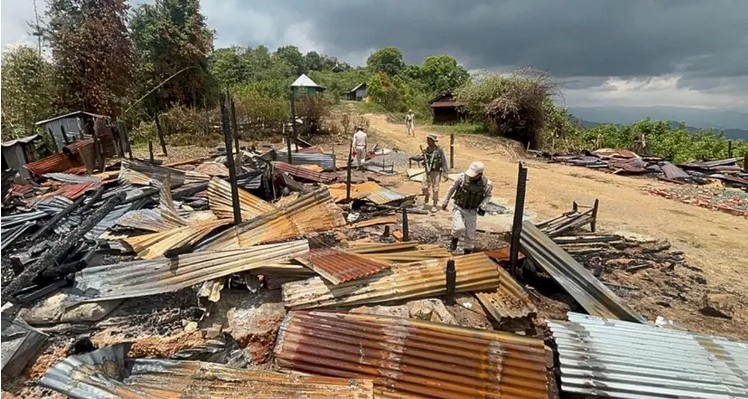
The book also talks about other social engineering missions of the Sangh including in conflict mediation. Hence the Sangh intervened in its own capacity in ethnic conflicts such as Mizoram’s Bru problem, Assam’s Bodo-Muslim, Kuki-Dimasa and Kuki-Karbi conflicts, and the and even the current Kuki-Meitei conflict in Manipur.
The book credits the ascendency of the Bhartiya Janata Party, BJP, winning power in Northeast states directly or else in alliance, to the continuing grassroot campaigns of the Sangh.
This review was first published in The Telegraph. The original can be read HERE

Editor, Imphal Review of Arts and Politics and author