The political landscape of Tamil Nadu has once again witnessed the emergence of a new political movement led by an actor-turned-politician. In Tamil Nadu, cinema and politics have long shared a deep and influential relationship. Legendary film personalities such as M. G. Ramachandran, J. Jayalalithaa, and M. Karunanidhi successfully transformed their popularity in cinema into powerful political careers. Continuing this tradition, several contemporary actors have stepped into politics with promises of change, transparency, and development.
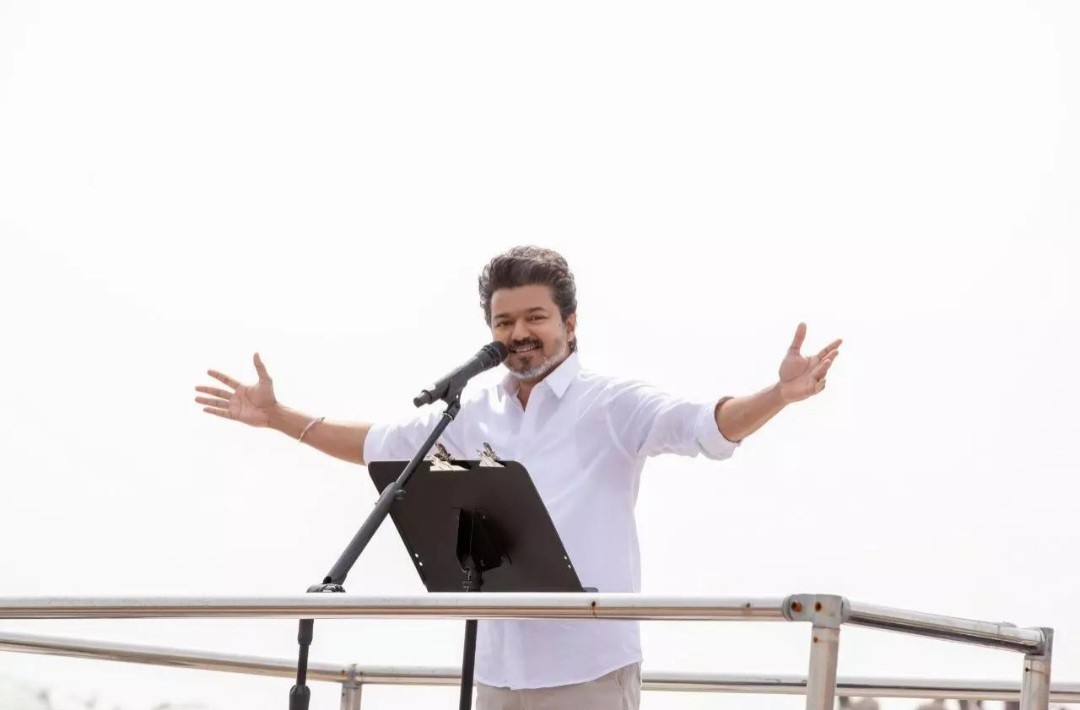
Recently, prominent actor Vijay, whose full name is Joseph Vijay Chandrasekhar, launched a political movement that has attracted significant public attention, especially among the youth. His entry into politics reflects the growing desire among people for alternative leadership and fresh political ideas. Supporters believe that his popularity, communication skills, and mass appeal can mobilize large sections of society, particularly first-time voters.
Cinema in Tamil society has historically shaped public opinion, social awareness, and political ideology. Film stars often enjoy emotional connections with the masses, enabling them to communicate political messages effectively. Through movies, speeches, and social service activities, actors build a strong public image that later becomes a foundation for political support.
Today, Vijay stands at a historic turning point in his life. Having conquered the world of cinema with immense popularity, he now faces the challenge of proving whether he can transform his reel-life heroism into real-life leadership. This is not merely the trust of the people of Tamil Nadu alone, but also the hope and curiosity of the entire nation.
In his films, Vijay is often portrayed as a fearless hero who fights corruption, protects the poor, and stands against injustice. Such roles have deeply connected him with millions of fans who now expect him to reflect the same courage, honesty, and commitment in public life. The emotional bond between Vijay and his supporters has become the foundation of his political movement. Many young people especially believe that he can bring a fresh approach to governance and inspire a new generation of leadership.
However, politics is far more demanding than cinema. In films, problems are solved within a few hours through dramatic action and powerful dialogues. In real life, governance requires patience, wisdom, administrative ability, and practical solutions to complex issues such as unemployment, poverty, education, healthcare, corruption, and economic development. The real test for Vijay will not be his popularity, but his ability to convert promises into meaningful action.
If Vijay succeeds in proving himself as an efficient and sincere leader, he may create a new chapter in Indian politics. His success could encourage educated, socially conscious, and service-minded personalities from various fields to enter public life with genuine intentions. He may emerge not just as a political leader, but as a symbol of hope for millions seeking change.
The impact of Vijay’s political rise may not remain confined to Tamil Nadu alone. Its influence may also reach states like Manipur, where cinema and public life often intersect emotionally. In Manipur too, several film personalities had once entered politics with hopes of serving society, but many could not achieve electoral success despite their popularity.

One such notable personality is Rajkumar Kaiku, popularly known as Kaiku, one of the most recognized stars of Manipuri cinema. Despite his immense fan following and contribution to the film industry, his electoral journey did not lead to victory. Similarly, personalities like Maheshwar Thounaojam, popularly known as Mahesh, who also gained public recognition through films and social activism, stepped into politics and became influential public voices, especially among the youth. Though electoral success remained limited, their political participation reflected the desire of artistes to contribute to society beyond the world of entertainment.

Now, Vijay’s emergence as a serious political force may freshly inspire such personalities in Manipur. Those who once contested elections and faced defeat may begin to believe again that perseverance, sincerity, and long-term public connection can eventually earn people’s trust. Vijay’s journey may remind them that political defeat is not necessarily the end, but sometimes only the beginning of a greater struggle.
Yet, an important question arises: Can such a dramatic political transformation really happen in Manipur as it has happened in Tamil Nadu? Many observers may honestly feel that the answer, at least for now, is “No.”
The political culture of Manipur differs greatly from that of Tamil Nadu. In many parts of Manipur, money power often dominates electoral politics. Elections are frequently influenced not merely by ideology, vision, or leadership qualities, but by financial strength, local influence, and the distribution of money during campaigns. Poverty and economic hardship among ordinary people make society more vulnerable to such practices. For many struggling families, immediate financial assistance during elections appears more meaningful than long-term political promises.
In an economically backward environment, money sometimes becomes more powerful than political philosophy, public service, honesty, or even emotional popularity. A candidate with strong ideals but limited financial resources may find it extremely difficult to compete against wealthy political rivals. As a result, talented and sincere individuals, including socially conscious artistes and intellectuals, often fail to survive in the harsh realities of electoral politics.
Moreover, political instability, social divisions, ethnic tensions, and insecurity have deeply affected the democratic environment in Manipur. Many voters are compelled to think not only about development but also about survival, community interests, and immediate needs. Under such conditions, emotional popularity alone cannot easily transform into electoral victory.
This is why the political success of film personalities in Tamil Nadu cannot be directly compared with Manipur. Tamil Nadu possesses a long-established culture where cinema and politics have historically merged over decades. The people there have repeatedly witnessed actors becoming successful administrators and chief ministers. In contrast, Manipur has not yet developed such political traditions on a large scale.
Nevertheless, Vijay’s rise may still carry symbolic importance for Manipur. It may encourage future leaders, artistes, intellectuals, and youth activists not to lose faith in democratic participation. Even if immediate success appears difficult, social change often begins slowly through awareness, education, political maturity, and the gradual rejection of money-driven politics.
Therefore, the larger challenge before Manipur is not merely whether an actor can become a successful politician. The deeper question is whether society itself can rise above poverty, dependency, corruption, and money power to choose leadership based on vision, honesty, and capability. Only then can real political transformation become possible in Manipur, just as dramatic political movements have reshaped Tamil Nadu in different periods of history.

The writer is an educationist, presently serving as an Assistant Teacher at Don Bosco High School, Langjing. He is actively engaged in literary writing and social commentary, and has nurtured many young minds who are growing to become future pillars of society. His work is driven by a commitment to ethical values, civic awareness and dignity across all professional spaces.