
Understanding EEC Development
Before discussing crab mentality and its effects on society, it is important to understand the concept of EEC Development. EEC stands for Educational, Economic, and Community Development, three interrelated pillars that determine the overall progress and well-being of a society. Educational development seeks to improve knowledge, skills, values, and access to quality learning opportunities for all citizens. Economic development focuses on generating employment, increasing productivity, reducing poverty, improving infrastructure, and enhancing the standard of living. Community development aims at strengthening social unity, civic participation, cooperation, and collective responsibility for the common good. Together, these three dimensions create a holistic framework for sustainable development. A society that invests in education, promotes economic opportunities, and fosters strong community relationships is better equipped to achieve long-term prosperity and social harmony. Therefore, EEC Development may be understood as the integrated advancement of education, economy, and community life, working together to build a progressive, inclusive, and resilient society.
However, the successful realization of EEC Development depends not only on resources, institutions, and policies but also on the attitudes and mindset of the people. Even communities blessed with talented individuals, educational opportunities, and economic potential may fail to progress if negative social attitudes prevail. Among the most damaging of these attitudes is what is commonly known as Crab Mentality or Crab Culture, a behaviour that discourages achievement, undermines cooperation, and obstructs collective advancement. To better understand this phenomenon and its consequences, let us begin with a simple yet powerful lesson from nature.
The Basket of Crabs: A Lesson from Nature
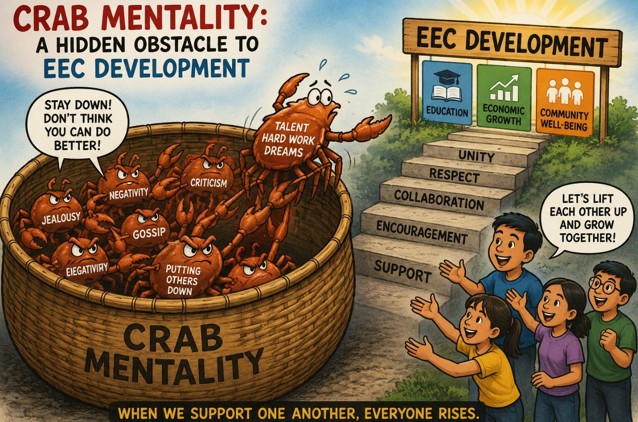
One of the most striking illustrations of human behaviour comes from an unlikely source—a basket of crabs. When a crab attempts to climb out of the basket, the others instinctively pull it back down. As a result, none of them escapes. This phenomenon has become a metaphor for a destructive social attitude known as “Crab Mentality” or “Crab Culture.” It refers to the tendency of individuals or groups to resent, oppose, or sabotage the success of others instead of celebrating and supporting it. In many societies, this mentality manifests through jealousy, envy, gossip, criticism, and deliberate obstruction of progress. While such behaviour may appear insignificant at first, its long-term consequences can be devastating for educational advancement, economic growth, and community development.
The Difference Between a Growing Society and a Stagnant Society
History shows that successful societies are not built merely by talented individuals but by communities that encourage talent. A society grows when people are willing to support one another’s dreams and achievements. It stagnates when individuals become threatened by the success of others. Communities that nurture cooperation often produce remarkable advancements in education, science, technology, and economic prosperity. In contrast, communities plagued by jealousy and division frequently remain trapped in cycles of underdevelopment. Development is therefore not only an economic or educational issue; it is also a matter of mindset.
Education: The Foundation of Human Progress
Education is the cornerstone upon which every civilized society is built. It equips individuals with knowledge, skills, values, and critical thinking abilities necessary for personal and collective growth. Through education, people learn to understand the world, solve problems, and contribute meaningfully to society. It empowers citizens to make informed decisions and helps nations build strong institutions. Without education, progress becomes accidental; with education, progress becomes systematic and sustainable.
Schools: The Nursery Bed of Future Leaders
Every classroom contains the seeds of tomorrow’s society. Within today’s schools sit future administrators, scientists, doctors, engineers, entrepreneurs, lawmakers, judges, teachers, and political leaders. Just as a nursery nurtures young plants before they are transplanted into fields, educational institutions cultivate young minds before they assume positions of responsibility in society. The quality of a nation’s future leadership largely depends on the quality of its educational system today. Therefore, investment in education is not merely spending for the present but an investment in the future of an entire society.
The Teacher: The Architect Behind Every Profession
Behind every successful professional stands a teacher who once guided, encouraged, and inspired. Teachers are among the most influential figures in society because they shape the minds and character of future generations. Their responsibilities extend beyond teaching academic subjects. They cultivate discipline, honesty, perseverance, creativity, and social responsibility. In many ways, teachers are the architects who design the foundation upon which every profession is built. A society that respects and supports its teachers strengthens its own future.
The Need for Professional Ethics Among Teachers
The teaching profession demands more than competence; it requires integrity. Teachers serve as role models whose actions often speak louder than their lessons. Professional ethics require teachers to demonstrate fairness, commitment, respect, accountability, and dedication to the welfare of students. Students observe not only what teachers teach but how they behave. Ethical teachers inspire confidence and trust, while unethical conduct undermines the credibility of educational institutions and damages the learning environment.
When Crab Mentality Enters the Staff Room
Unfortunately, educational institutions are not immune to crab mentality. In some schools and colleges, teachers may become jealous of the achievements of their colleagues. Instead of appreciating innovation and excellence, they may engage in criticism, gossip, factionalism, or deliberate non-cooperation. A talented teacher may be viewed as a threat rather than an asset. Creative ideas may be rejected simply because they originate from someone else. Such attitudes create an unhealthy atmosphere where personal rivalries overshadow the common mission of educating students.
The Silent Victims: Students
Whenever teachers become divided by jealousy and personal conflicts, students suffer the most. Educational institutions thrive on collaboration, shared vision, and collective responsibility. When these qualities disappear, the learning environment deteriorates. Students may receive mixed messages, experience reduced academic support, and witness negative examples of professional behaviour. Instead of learning cooperation and mutual respect, they are exposed to division and hostility. Thus, the effects of crab mentality extend far beyond the individuals involved; they shape the attitudes of future generations.
Community Development Begins with Individual Responsibility
The progress of a community depends upon the willingness of its members to contribute positively to collective goals. Every individual has a role to play in promoting educational and economic development. Parents can encourage learning at home. Community leaders can support educational initiatives. Citizens can participate in developmental projects and promote a culture of excellence. Development is not solely the responsibility of governments; it is a shared responsibility that requires active participation from all members of society.
Educational Development as a Community Mission
Education flourishes when entire communities value learning. Communities that encourage literacy, support schools, reward academic excellence, and respect educators create an environment where students can succeed. Such societies understand that education is not merely a personal achievement but a public good. Every educated citizen contributes to the collective advancement of the community. Therefore, educational development should be viewed as a mission that involves families, schools, civil society, and government institutions working together.
Economic Development: Beyond Wealth Creation
Economic development is often misunderstood as the accumulation of wealth. In reality, it involves improving the overall quality of life of people. It includes reducing poverty, creating employment opportunities, enhancing healthcare, improving infrastructure, and ensuring social welfare. True economic development enables individuals to live with dignity and security. It creates opportunities for future generations and strengthens social stability.
The Connection Between Education and Economic Progress
No society can achieve sustainable economic development without a strong educational foundation. Education produces skilled workers, innovative thinkers, competent managers, and visionary entrepreneurs. It enhances productivity and promotes technological advancement. Countries that invest heavily in education often experience higher levels of economic growth because educated citizens are better equipped to solve problems, create businesses, and adapt to changing economic conditions. Education transforms human potential into economic productivity.
How Crab Mentality Sabotages Economic Development
Crab mentality not only harms educational institutions but also weakens economic progress. Entrepreneurs may face criticism rather than encouragement. Innovative ideas may be ridiculed rather than supported. Successful individuals may become targets of envy instead of sources of inspiration. As a result, talented people often become discouraged or leave their communities in search of more supportive environments. This loss of talent and initiative significantly hinders economic development and reduces opportunities for collective prosperity.
Why Some Communities Fail to Develop
Many communities possess abundant resources, talented individuals, and promising opportunities, yet remain underdeveloped. The problem often lies not in a lack of resources but in a lack of unity. Internal divisions, jealousy, mistrust, and resistance to progress can prevent communities from realizing their full potential. When individuals focus more on pulling others down than on lifting the community up, development becomes impossible. The greatest obstacles are often not external challenges but internal attitudes.
The Tragic Consequences of a Failing Education System
When an educational system fails, society eventually pays the price. Unemployment rises because young people lack the skills required in the workforce. Crime and social instability increase as opportunities diminish. Corruption becomes more widespread when ethical education is neglected. Innovation declines, productivity falls, and economic growth slows. The consequences extend across generations, creating cycles of poverty and underdevelopment that become increasingly difficult to break.
A Society Without Educational Vision
A society that neglects education resembles a ship sailing without a compass. It may continue moving, but it lacks direction. Without educational vision, leadership becomes weak, institutions become ineffective, and citizens become vulnerable to manipulation. The absence of quality education deprives society of the intellectual resources necessary for solving complex challenges. Consequently, social and economic progress becomes increasingly difficult to achieve.
Replacing Crab Mentality with Growth Mentality
The solution to crab mentality lies in cultivating a growth mentality. Instead of viewing another person’s success as a threat, we should view it as evidence of what is possible. Success should inspire rather than intimidate. Communities must foster cultures of appreciation, encouragement, mentorship, and collaboration. Individuals should learn to celebrate achievements, share knowledge, and support one another’s growth. When people rise together, the entire community benefits.
The Transformative Power of Collective Success
No great society was built by isolated individuals. Progress occurs when people combine their strengths and work toward common goals. Teachers, parents, entrepreneurs, administrators, and citizens all contribute to the advancement of society. The success of one individual should not diminish the opportunities of others. Instead, it should create pathways for collective advancement. Communities that embrace this philosophy become centres of innovation, prosperity, and social harmony.
A Call to Teachers, Leaders, and Citizens
The battle against crab mentality must begin within each individual. Teachers must inspire cooperation rather than competition. Leaders must encourage unity rather than division. Parents must teach children to appreciate the achievements of others. Citizens must recognize that the prosperity of the community depends on collective effort. Every act of encouragement contributes to development, while every act of jealousy hinders it.
Conclusion: Lift Others and Rise Together
The future of any society depends not only on its resources but also on its attitudes. Crab mentality may offer temporary satisfaction to those who pull others down, but it ultimately harms everyone involved. Educational development, economic progress, and community advancement flourish where people support one another’s success. The true measure of a progressive society is not how many individuals reach the top alone but how many people rise together. Let us therefore reject the culture of envy and embrace a culture of encouragement, for when we lift others, we elevate ourselves and secure a brighter future for generations to come.

The writer is an educationist, presently serving as an Assistant Teacher at Don Bosco High School, Langjing. He is actively engaged in literary writing and social commentary, and has nurtured many young minds who are growing to become future pillars of society. His work is driven by a commitment to ethical values, civic awareness and dignity across all professional spaces.