
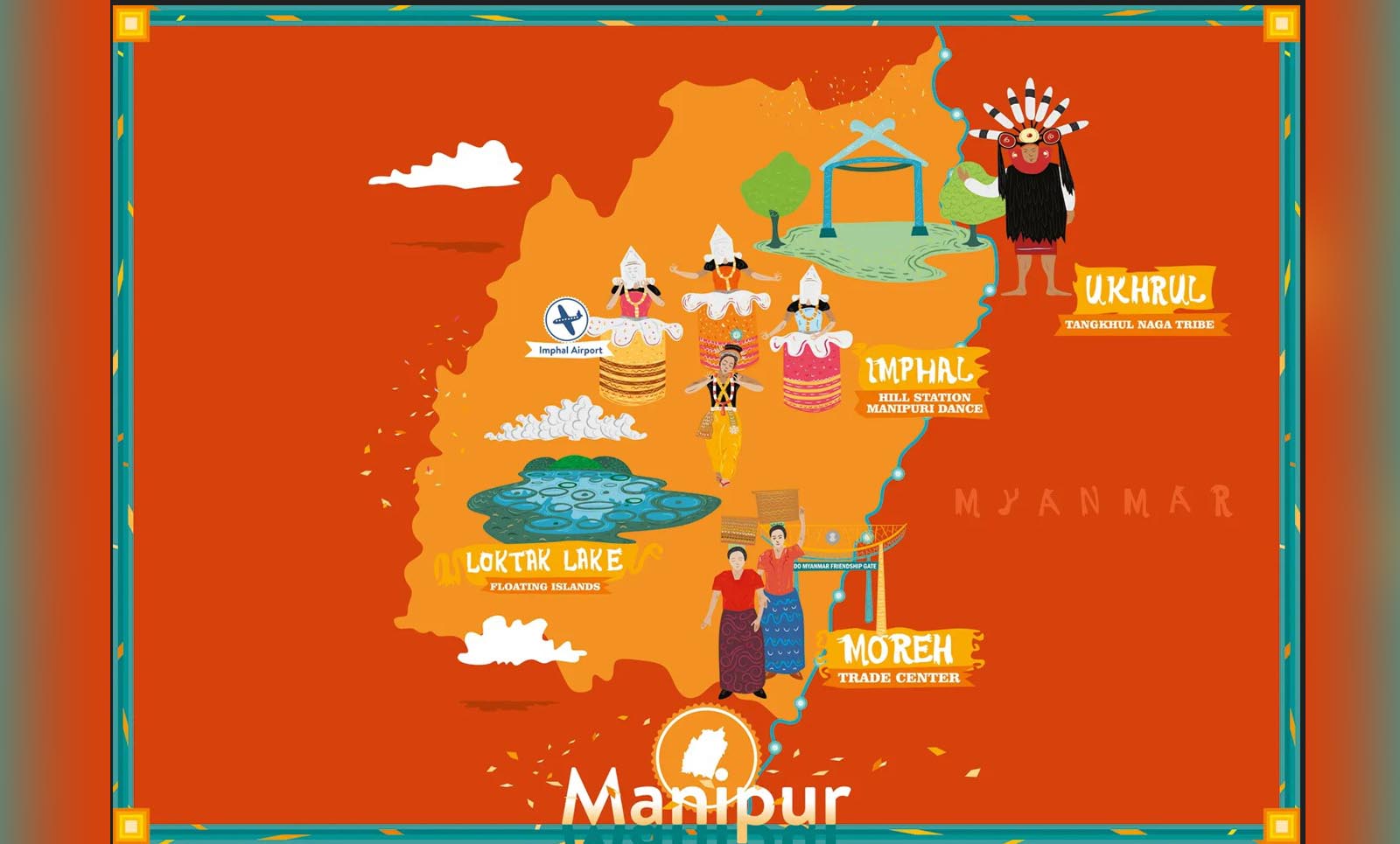
The crisis that has engulfed Manipur since May 3, 2023 is often presented as a communal binary conflict between Kuki-Zomis and Meiteis, between Hindus and Christians, between majority and minority, between non-tribal and tribal and later an ethnic conflict between communities competing for territory, political power, and security. Yet such a rhetoric and superficial description, while partially true, fails to capture the deeper historical, geopolitical and national security realities that shape the present situation. The conflict is not merely a struggle between ethnic groups. It is also a contest over the future of Manipur as a historical political entity and over the survival of all indigenous peoples who inhabit this strategically important region.
For thousands of years, Manipur existed as a distinct political and civilisational entity long before its controversial merger with India in 1949. Manipur had its own constitution embracing all the ethnic groups who can exercise their democratic rights and held elections based on adult franchise for “State Assembly” for the first time in South and Southeast Asia before the merger with India. Manipur was a constitutional monarchy after the British left. Throughout its history, Manipur developed institutions of governance, diplomatic relations, military traditions, and a shared territorial consciousness. Although political power was often exercised by Meitei rulers, the state itself evolved as a multi-ethnic society composed of numerous communities inhabiting both the hills and the valley. The political survival of Manipur was never solely the achievement of one community. Rather, it depended upon the collective contribution of diverse peoples whose destinies became intertwined through geography, ecology, economics, culture, and security.
The present territorial boundaries of Manipur are themselves the result of historical processes. In earlier periods and even in 19th century, the kingdom’s sphere of influence extended in all directions beyond present-day borders. Various external powers attempted to dominate, partition, or absorb the region. Yet despite periods of invasion and political instability, the territorial idea of Manipur survived. This historical experience created a strong attachment among many inhabitants to the concept of an integrated and united Manipur.
In the post-independence era, however, new political movements emerged that challenged this territorial framework. One of the most significant developments was the rise of Naga nationalism. Following the split of the National Socialist Council of Nagaland (NSCN) in 1988, the faction led by Isak Chishi Swu and Thuingaleng Muivah, known as NSCN (IM), continued advocating the integration of Naga-inhabited areas across state boundaries into a proposed Nagalim. Since large swathe of Manipur are claimed under this vision, many people in Manipur have viewed the movement as a challenge to the state’s territorial integrity.
The Government of India entered into a ceasefire with NSCN (IM) in 1997, beginning one of the longest peace negotiations in South Asia. While these talks were intended to resolve a decades-long insurgency, they also generated anxieties in Manipur regarding possible territorial concessions. Massive public protests in June 2001 demonstrated the depth of these concerns and reflected the widespread belief that Manipur’s territorial integrity should not be compromised during any settlement process.
A different but related challenge emerged from the rise of Kuki-Zomi armed groups. All these organisations grew out of the violent Naga-Kuki conflict of the 1990s and later confrontations involving various communities. Over time, twenty-five armed groups came under the umbrella organisations known as the Kuki National Organisation (KNO) and the United People’s Front (UPF). The KNO and the UPF first signed an initial ceasefire arrangement with the Indian Army on September 22, 2005. Later, the ceasefire arrangements formalised signing a tripartite Suspension of Operations (SoO) agreements with the Government of India and the Government of Manipur on August 5, 2008.
A notable feature of these agreements was the explicit commitment to respect the territorial integrity of Manipur. For many observers, this provision signified that political dialogue would take place within the framework of the existing state rather than through territorial separation.
However, over time, a widespread perception emerged among large sections of Meitei and Naga society that the Government of India’s security and political approach towards the Kuki-Zomi armed groups differed significantly from its approach towards Meitei and Naga insurgent organisations. According to this perception, the Kuki-Zomi militant groups, many of which remained under the Suspension of Operations framework, were increasingly viewed as strategic proxies of the Ministry of Home Affairs and sections of the security establishment for containing and counterbalancing both Meitei and Naga insurgent movements. Even if this perception is yet to establish fully, it has become an important political factor shaping public opinion in Manipur.
The persistence of this belief has had profound consequences. Many Meiteis and Nagas argue that the political and security space provided to Kuki-Zomi armed groups enabled them to consolidate territorial influence and strengthen demands that go beyond the original framework of the SoO agreements. The demand for a Separate Administration after May 2023 reinforced these suspicions, particularly because the proposed territorial arrangements are perceived by many communities as encompassing not only areas inhabited by Kuki-Zomi groups but also territories historically inhabited by Meiteis, Nagas and other indigenous communities. Consequently, what may be viewed by supporters as a quest for security and self-governance is viewed by many opponents as a project of ethno-territorial expansion that threatens the territorial integrity of Manipur and undermines the possibility of long-term coexistence among its diverse peoples.
The growing distrust generated by these perceptions has further complicated peace-building efforts. Instead of seeing the conflict merely as a dispute between two communities, many residents increasingly interpret it through the lens of competing geopolitical and security strategies involving state institutions, insurgent movements, and trans-border armed militant groups. As a result, confidence in political negotiations has weakened, and fears have intensified that the continued legitimisation of ethno-exclusive territorial projects may eventually lead to the fragmentation of Manipur itself.
The violent conflict that erupted on May 3, 2023 fundamentally altered the political landscape. What portrayed in the beginning as a communal confrontation rapidly escalated into one of the most serious crises in Manipur’s modern history. Entire populations were displaced, villages destroyed and erased, and communities physically segregated. Areas that had once witnessed daily interaction between different ethnic groups became divided by fear, mistrust, and violence. More than 61,000 displaced of which more than 51,000 are still languishing in relief camps, more than 270 deaths and 32 still reported as missing.
The hasty demand on May 12, 2023 by ten Kuki-Zomi legislators for a Separate Administration represented a significant political turning point. The proposal later became the main demand of all the Kuki-Zomi organisations, including the KNO-UPF leadership and the Kuki-Zo Council. To supporters, the demand emerged from concerns about security and political representation. To opponents, however, it constituted a direct challenge to the territorial integrity of Manipur and contradicted earlier commitments made under the Suspension of Operations framework.
As the conflict continued, territorial control increasingly became a central issue. Population movements created new realities on the ground. Areas that had historically been shared spaces became ethnically segregated. Security arrangements established buffer zones that further reinforced physical separation. The result has been the gradual emergence of de facto divisions within the state.
The conflict has also extended beyond the Meitei-Kuki divide. Tensions involving Naga communities have introduced an additional layer of complexity. Violent incidents in areas inhabited by Liangmai, Inpui, Tangkhul, Chiru, Rongmei, and other Naga groups have deepened concerns about wider instability. The tragic cycle of killings, abductions, retaliation, and counter-allegations has expanded the conflict into a broader contest involving multiple ethnic actors.
Amid these developments, competing narratives have become increasingly entrenched. Different communities interpret the origins of the conflict, the legitimacy of territorial claims, and the role of armed groups in fundamentally different ways. These narratives often reinforce mutual suspicion and make reconciliation more difficult.
Yet beneath these competing claims lies a reality that no community can escape –geography.
The hills and valleys of Manipur are not separate worlds. They are components of a single ecological and economic system. The valley depends on the hills for water resources, forest cover, biodiversity, and environmental stability. The hills depend on the valley for agricultural products, markets, transportation networks, advanced educational institutions, advanced healthcare facilities, and economic opportunities. Attempts to politically separate these interconnected spaces cannot alter their geographical interdependence.
This interdependence has shaped centuries of coexistence. Trade routes connected hill and valley settlements. Agricultural production, forest resources, and local markets including foothills markets traditionally known as Keithelmanbi generated economic relationships that transcended ethnic boundaries. Cultural exchanges, inter-ethnic marriages, despite periods of conflict, created layers of shared experience that continue to influence contemporary society.
The fragmentation of Manipur would therefore create challenges for all communities rather than providing lasting solutions. Territorial division may appear attractive during periods of intense conflict because it promises security through separation. History, however, suggests that such arrangements often create new disputes rather than resolving existing ones.
No proposed boundary can perfectly correspond to ethnic realities. Every district contains multiple communities. Every region contains overlapping histories, settlements, and claims. Any attempt to redraw boundaries along ethnic lines would inevitably generate new minorities, new grievances, and new conflicts.
The geopolitical dimension makes the situation even more serious. Manipur occupies a strategically vital position between South Asia and Southeast Asia. It borders Myanmar and lies within India’s broader connectivity vision linking the Indian mainland with Southeast Asian markets. The state is therefore not merely an internal administrative unit but an important geopolitical corridor.
Major Powers increasingly view the Indo-Pacific and adjoining regions as arenas of strategic competition. Infrastructure projects, trade routes, resource access, migration flows, and security considerations are becoming more significant than ever before. Small indigenous populations confronting these forces are vulnerable to marginalisation if they remain divided.
This reality applies equally to Tangkhul, Mao, Maram, Poumai, Rongmei/Kabui, Inpui, Liangmai, Zeme, Thangal, Aimol, Anal, Chiru, Chothe, Kharam, Khoibu, Koirao, Kom, Lamgang, Maring, Monsang, Moyon, Purum, Tarao, Thadou, Paite, Gangte, Simte, Suhte, Vaiphei, Zou, Mate, Ralte, Lushai/Mizo, Hmar, Pangal, Meitei, and other communities. None of these groups possesses the demographic or economic strength to independently shape the larger geopolitical environment. Their long-term survival depends less on defeating one another and more on preserving conditions that allow indigenous societies to endure.
The greatest threat to the future of Manipur may therefore not be any single community except illegal immigrants but the collective failure of all communities to recognise their shared interests. Ethno-exclusive political projects, regardless of who advocates them, tend to reduce complex societies into competing territorial blocs. Such approaches overlook centuries of coexistence and underestimate the consequences of fragmentation.
A sustainable future requires a different vision. That vision must begin with the recognition that Manipur is a multi-ethnic state whose history cannot be monopolised by any one community. The Meiteis have played a central role in defending and governing the state, but the state’s identity has also been shaped by the contributions of numerous ethnic communities. Likewise, the aspirations and security concerns of all the communities must be acknowledged without accepting the inevitability of territorial fragmentation.
Political arrangements should therefore focus on strengthening inclusive governance rather than partition. Greater decentralisation, democratisation, equitable development, constitutional safeguards, fair representation, a house of all the ethnic groups, and meaningful dialogue between communities can address legitimate grievances while preserving territorial integrity.
Equally important is the need to reject violence as a means of political negotiation. Armed confrontation may create temporary advantages, but it cannot establish lasting peace. Every cycle of violence deepens mistrust and pushes reconciliation further away.
The future of Manipur ultimately depends on whether its people choose coexistence over separation. The state has survived wars, invasions, colonial interventions, and political upheavals because successive generations understood that their destinies were interconnected. That lesson remains relevant today.
The question facing Manipur is not whether different communities can live separately. Geography and history have already answered that question. The real question is whether they can develop a political framework that allows them to live together with dignity, security, and mutual respect.
If they fail, all communities risk becoming weaker and more vulnerable in a rapidly changing geopolitical environment. If they succeed, Manipur can remain what it has long been – a shared homeland where diversity is not a threat to survival but the foundation of it.

Senior Editor: Imphal Review of Arts and Politics

1 thought on “Coexistence is the only Answer: Any Dismemberment of Manipur Would Imperil all Its Indigenous Peoples”
This article is restoriing hope against hopless situation especially when geography, ecological and composite cultural heritage and contiguities with diverse peoples and cultures in its full integrity are brought up in the focus. It is also foward looking perspective building. However, the onus of demonstrating the full integrity of Manipur lies in the valley. It is here full attentions and actions are required in reconstructing 21st century Manipur. Thanks Bobichand
Comments are closed.