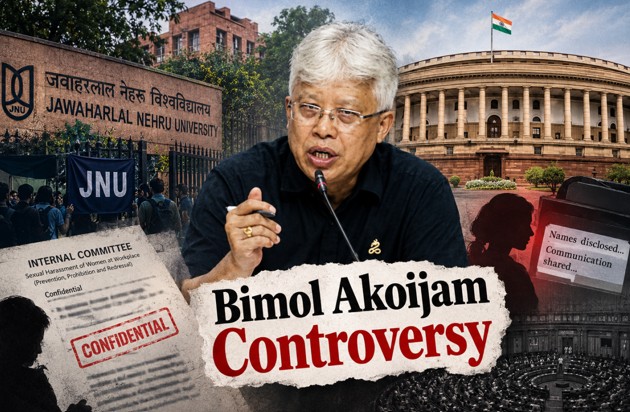
The dismissal of a Manipur MP from Jawaharlal Nehru University raises troubling questions about the POSH Act, institutional accountability, confidentiality and the danger of turning allegations into instruments of partisan politics.
The dismissal of Professor Angomcha Bimol Akoijam from Jawaharlal Nehru University (JNU) following an internal inquiry into allegations of sexual harassment has developed into a controversy extending well beyond the university campus. Bimol Akoijam, the Congress MP representing Inner Manipur, has challenged the university administration’s account of the proceedings and described the action as a witch-hunt. The Jawaharlal Nehru University Teachers’ Association (JNUTA) has expressed deep shock over alleged procedural violations, the reported breach of confidentiality and questions concerning the Vice-Chancellor’s authority to impose the penalty. Meanwhile, BJP leaders and MPs have demanded action against Bimol Akoijam, including his removal from Parliament.
The central question is not whether allegations of sexual harassment should be taken seriously. They must be. Nor should a complainant’s allegations be dismissed because the respondent is a professor, an opposition MP or a prominent critic of the ruling establishment. The equally important question is whether the institution responsible for investigating such allegations has complied with the law, respected confidentiality, observed its own statutes and protected the procedural rights of everyone involved.
A democratic society cannot choose between the dignity and safety of complainants and the right of an accused person to a fair process. Both are essential. If an institution fails in either responsibility, it undermines the credibility of its inquiry and public confidence in the mechanisms established to address sexual harassment.
In Bimol Akoijam’s case, the allegations must be examined on their evidence, while the university’s actions must be subjected to equally rigorous scrutiny. Neither political allegiance nor public outrage can substitute for due process. So also media trial cannot overshadow due process.
The POSH Act and JNU’s Obligation to Maintain Confidentiality
The Sexual Harassment of Women at Workplace (Prevention, Prohibition and Redressal) Act, 2013, commonly known as the POSH Act, establishes a framework for receiving complaints, conducting inquiries and recommending appropriate action. Its purpose is to provide women with a safe working environment and an effective mechanism for redress. It requires institutions to handle complaints through prescribed procedures rather than through arbitrary administrative discretion.
Section 16 of the Act prohibits the publication or communication to the public, press or media of the contents of a complaint, the identities and addresses of the complainant, respondent and witnesses, information relating to inquiry proceedings, the committee’s recommendations and the action taken by the employer, subject to the statutory exception for appropriately anonymised information about justice secured to a victim.
This provision raises a particularly serious question about JNU’s handling of the case. According to the reported television appearances, Vice-Chancellor Santishree Dhulipudi Pandit disclosed the respondent’s identity and details of communications between the Internal Committee and the respondent to national television channels while the inquiry was still in progress. If these disclosures occurred as described, the issue cannot be reduced to an unexplained leak of confidential information. It raises a direct question about the university administration’s own compliance with the statutory duty of confidentiality.
The Vice-Chancellor’s position as the university’s chief executive does not, in itself, exempt her from the restrictions imposed by Section 16. Indeed, the responsibility to uphold the law should be particularly exacting for the head of a central university. If the reported disclosures are confirmed, JNU must explain their legal basis and establish whether they were consistent with the Act.
The distinction between defending an institution’s actions and disclosing protected information is important. A university may need to respond to public questions, correct misinformation and explain the broad procedural status of a disciplinary matter. That does not automatically authorise it to identify the respondent or disclose communications connected with an ongoing inquiry.
Such disclosures could compromise confidentiality, influence public perceptions before the proceedings have been completed and undermine confidence in the impartiality of the process. The concern is not to shield a respondent from accountability. It is to ensure that a mechanism designed to protect complainants and secure fair proceedings is not compromised by the institution responsible for administering it.
Confidentiality protects complainants and witnesses from exposure, intimidation and social stigma. It also prevents the person who is the respondent of the complaint from being publicly condemned through selective disclosures before the applicable process has run its course. Where a case becomes a national political controversy, these safeguards become more important, not less.
The university should therefore clarify precisely what was disclosed, by whom and under what legal authority. Any alleged breach must be examined independently, without disclosing further protected information or compromising the complainant’s or respondent’s privacy.
Did JNU Follow Its Own Statutes?
A second question concerns the authority to dismiss a university professor. JNUTA has challenged the legality of the decision, arguing that Statute 30 of the Jawaharlal Nehru University Act places the relevant power of removal with the Executive Council and questioning whether the Vice-Chancellor could unilaterally impose dismissal.
Statute 30 distinguishes between the Vice-Chancellor’s powers concerning suspension and the Executive Council’s authority to remove a teacher on grounds of misconduct. Its applicable provisions also require procedural safeguards, including a reasonable opportunity for the teacher to show cause before removal. The precise legal position must be determined from the statute, applicable service rules and any valid delegation of authority.
These are not inconsequential technicalities. Statutory authority is fundamental to the legitimacy of disciplinary action. Even where an inquiry establishes misconduct, the resulting punishment must be imposed by the authority empowered to do so and in accordance with the prescribed procedure.
JNU’s reported position is that the dismissal followed the Internal Committee’s findings and the applicable rules. Bimol Akoijam and JNUTA have questioned the process. The public cannot responsibly determine the legal validity of the dismissal without examining the complete order, the committee’s recommendations, the relevant statutory provisions and any Executive Council decision.
Nevertheless, the university owes the academic community a clear explanation. If Executive Council approval was required but not obtained, why did the administration proceed? If the Vice-Chancellor possessed the necessary authority under another applicable provision, what was its legal basis?
The rule of law cannot mean that institutional statutes bind ordinary employees but become dispensable when an allegation attracts intense public attention. Nor should an accused professor be permitted to evade a lawful disciplinary process merely by challenging the authority of those conducting it. The same principle applies to both sides – the prescribed rules must be followed.
Was The Dismissal Hasty? The Allegation of a Witch-Hunt
The sequence of events has intensified the controversy. Bimol Akoijam has disputed the administration’s account of his cooperation with the inquiry, stating that he submitted a written response on May 31, provided his deposition on July 16 and produced witnesses whose depositions were recorded on August 14. He has also challenged the university’s reported account of the communications exchanged during the proceedings.
These claims require verification against the documentary record. A lengthy inquiry is not necessarily a fair inquiry, just as a short inquiry is not automatically unlawful. The decisive questions are whether the allegations were clearly communicated, whether Bimol Akoijam received a meaningful opportunity to respond, whether his evidence and witnesses were considered, whether the committee followed the applicable rules and whether the findings adequately supported the recommended punishment.
The administration must also explain the urgency of imposing dismissal with immediate effect. Was the inquiry completed? Had the prescribed decision-making process been exhausted? Was the penalty authorised by the competent body? Were all mandatory procedural safeguards observed?
The reported disclosures by the Vice-Chancellor raise an additional question of institutional fairness. While the university was responsible for maintaining a confidential and impartial process, its chief executive was reportedly discussing the respondent’s identity and communications relating to the inquiry with television channels. Whether every disclosure violated Section 16 must be assessed against the precise material communicated and the statutory text. But the circumstances warrant an explanation independent of the merits of the underlying complaint.
Bimol Akoijam has described the proceedings as a witch-hunt. His political position and the speed of the dismissal may not, by themselves, prove that allegation. However, it should not be dismissed without examining the evidence. If statutory authority was bypassed, confidentiality was compromised, relevant evidence was disregarded or the disciplinary process was manipulated, those circumstances would warrant serious investigation into the fairness and possible motivation of the decision.
An institution cannot demand unquestioning confidence in its disciplinary action while leaving legitimate questions about its own compliance with the law unanswered. Equally, procedural objections cannot be used to trivialise the allegations or deny complainants a fair hearing.
Why Are BJP Leaders Demanding Parliamentary Action?
The controversy has moved from university discipline into national party politics. BJP leaders and women MPs have demanded action against Bimol Akoijam, including calls for his suspension from the Lok Sabha. They have framed the issue in terms of women’s dignity and accountability. Those principles are important. Sexual harassment allegations must be taken seriously, irrespective of the political affiliation, public standing or institutional position of the respondent. Congress cannot legitimately defend misconduct merely because Bimol Akoijam is one of its MPs. But there is a fundamental distinction between demanding an impartial investigation and seeking to remove an elected representative from public life before the legal consequences of the allegations have been established.
Bimol Akoijam’s political significance cannot be separated from the circumstances in which he entered Parliament. As the Congress MP from Inner Manipur, he has been a vocal critic of the handling of the continuing conflict in Manipur that erupted on May 3, 2023. His interventions have drawn national attention to displacement, the fragmentation of communities, the erosion of public confidence in state institutions and the responsibilities of the Union government. He has challenged official narratives of peace and normalcy and questioned the Centre’s response to a crisis that has profoundly affected the lives, security and political future of the people of Manipur.
His wider political interventions have also challenged aspects of the ruling establishment’s approach to national affairs, including the ideological assumptions associated with the BJP’s Hindu nationalist politics. For a state that has often struggled to command sustained attention in national political debates, the ability of an elected representative to articulate its grievances in Parliament is particularly important. Bimol Akoijam’s significance lies not simply in his opposition to the BJP, but in his willingness to question the relationship between the Union and a politically marginalised state whose people have experienced prolonged violence and uncertainty.
This context makes the possibility of political exploitation worth examining. It does not, however, automatically establish that the allegations against him were fabricated or that the JNU administration acted on instructions from the BJP. Such conclusions would require evidence of political interference, selective treatment, improper communications or manipulation of the disciplinary process. The fact that the respondent is a vocal opposition MP cannot invalidate a complaint; equally, the existence of a complaint cannot justify treating every demand for procedural scrutiny as an attempt to protect political misconduct.
The more defensible question is whether the institutions and political actors involved are allowing the case to be decided by evidence and law, or whether the controversy is being converted into a partisan weapon. There is a troubling asymmetry when allegations against an opposition MP rapidly become a demand for his removal from public life, while substantial questions raised by a teachers’ association about statutory authority, due process and confidentiality receive comparatively less attention. If BJP leaders are invoking the principle of accountability, that principle must extend to the university administration as well. The reported disclosure by the Vice-Chancellor of the respondent’s identity and communications relating to an ongoing inquiry deserves scrutiny under Section 16 of the POSH Act, just as the underlying allegations deserve a fair and impartial investigation.
Accountability must not be selective. If the allegations are substantiated through a lawful process, appropriate action must follow. If JNU violated mandatory procedures or acted beyond the authority conferred by its statutes, those responsible must also be held accountable. Both propositions can be true at the same time. The defence of women’s rights and the defence of due process are not opposing political positions; they are complementary requirements of justice.
The question of parliamentary action must also be separated from the university’s disciplinary proceedings and any criminal investigation. A dismissal from a university post does not automatically terminate an MP’s membership of Parliament. Nor does an allegation or the registration of a police case, by itself, establish that the constitutional and statutory conditions for disqualification have been met. Any demand for suspension or removal must therefore be examined under the applicable parliamentary and legal framework rather than treated as an automatic consequence of the controversy.
The timing inevitably invites further questions. With the parliamentary winter session approaching and Manipur’s 2027 Assembly election on the horizon, the political consequences of removing or discrediting a vocal opposition MP could be substantial. His absence from parliamentary debates, whether through formal action or the cumulative effect of a sustained political campaign, could weaken the representation of people who continue to suffer from the consequences of the conflict. Yet timing alone cannot establish political intent. The more pertinent question is whether the university proceedings or the campaign for parliamentary action are being used to secure a political outcome.
Is Bimol Akoijam becoming a soft target for the ruling BJP because his interventions challenge its handling of Manipur and its broader political agenda? That possibility warrants scrutiny, but it must be established through evidence rather than assumed from political differences. Equally, it would be naïve to disregard the potential political value of discrediting an opposition representative whose interventions have challenged the government’s account of a crisis with serious national implications. The appropriate response is to examine whether comparable standards are being applied across party lines, whether procedural objections are receiving fair consideration and whether political demands are being allowed to prejudge the outcome of an unresolved case.
Ultimately, the test of democratic accountability is not whether an opposition MP is protected from scrutiny, but whether he is subjected to the same law and fair procedures as everyone else. The legitimate cause of protecting women from sexual harassment must not become an instrument for eliminating political opponents. Nor should political considerations be used to diminish the seriousness of a complaint. Only an impartial process, conducted without political interference and in accordance with the law, can establish the facts and justify the consequences.
Congress’s Silence and The Marginalisation of Manipur’s Voice
Congress also faces difficult questions. Why has the party not articulated a clearer position that simultaneously respects the complainant, insists on a fair inquiry and demands compliance with JNU’s statutes?
An unconditional defence of Bimol Akoijam could be interpreted as indifference to women’s rights. Silence, however, risks creating the impression that Congress is unwilling to defend one of its MPs against potentially unfair institutional action.
The appropriate response is neither blind loyalty nor political abandonment. Congress should call for an impartial inquiry, insist on the protection of complainants, respondent, and witnesses, and demand that JNU explain the legal basis of its disciplinary decision without compromising confidentiality. It should also make clear that accountability and procedural fairness are complementary obligations.
The issue carries particular significance for Manipur. Since May 2023, the state has endured prolonged violence, extensive displacement and a profound crisis of political trust. Its people need representatives capable of making their suffering intelligible to the rest of India and holding the Union government accountable.
Bimol Akoijam’s interventions have challenged prevailing narratives about peace and normalcy and questioned the Centre’s handling of the conflict. His political significance lies partly in his willingness to bring Manipur’s grievances into national debates that have too often marginalised the Northeast.
It would be unjustified to claim that mainland India or national political parties uniformly oppose the rise of politicians from smaller states. Nevertheless, the structural marginalisation of peripheral regions especially small states of the Northeast in national political discourse is a legitimate concern. Representatives from these regions frequently struggle to secure sustained attention for issues that might otherwise command greater political urgency.
The question is whether the political system can allow a representative from Manipur to challenge the government without his criticism being overshadowed by partisan battles. Can allegations of procedural unfairness be examined on their merits without dismissing the complainant or presuming the respondent’s guilt?
These are questions of democratic equality, not special treatment.
Justice Must Not Become An Instrument of Political Expediency
The controversy surrounding Professor Angomcha Bimol Akoijam demands scrutiny on three distinct fronts – the allegations of sexual harassment, the legality and fairness of JNU’s disciplinary proceedings, and the political campaign for action against him as an MP.
The first requires a sensitive, impartial and evidence-based inquiry that protects complainants, respondent and witnesses. The second requires JNU to demonstrate that its Internal Committee, Vice-Chancellor and competent statutory authorities acted within the POSH Act, the JNU Act, applicable statutes and service rules. The third requires political parties to distinguish legitimate demands for accountability from efforts to secure consequences that the law does not automatically prescribe.
JNUTA’s objections make it particularly important that the university address the questions concerning Executive Council authority and confidentiality. The Vice-Chancellor’s reported disclosure of the respondent’s identity and communications relating to an ongoing inquiry warrants a specific explanation under Section 16. Bimol Akoijam’s claims of procedural irregularity must be tested against the record, while the complainant’s allegations must receive equal seriousness.
Neither side should be prejudged through media narratives or political declarations.
The fundamental principle is straightforward – the seriousness of an allegation cannot justify abandoning due process, just as the demand for due process cannot justify dismissing an allegation of sexual harassment.
If misconduct is established through a lawful inquiry, accountability must follow. If the university violated mandatory procedures, those violations must be addressed and responsibility assigned. If political actors have attempted to exploit the controversy to silence an opposition representative, that possibility deserves investigation on the strength of evidence.
Manipur has already endured a prolonged crisis in which institutional credibility and the ability of its people to make their voices heard have suffered profoundly. The answer cannot be to weaken those principles further. Justice must protect women, uphold the rule of law and preserve the democratic right to political representation. Anything less risks turning a case demanding impartial accountability into another contest in which institutional power and partisan advantage overshadow justice itself.

Senior Editor: Imphal Review of Arts and Politics