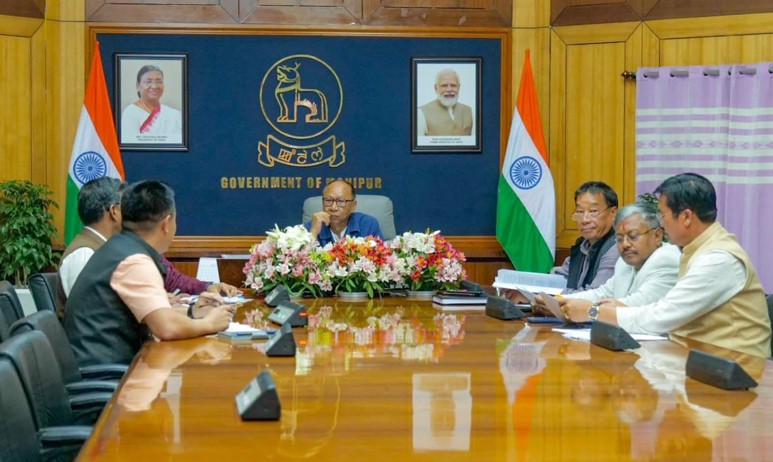
The formation of the government led by Yumnam Khemchand on February 4, 2026 was expected to signal the restoration of elected governance in a State that had spent nearly a year under President’s Rule in Manipur. Instead, the early weeks of the new administration have produced a political situation that raises fundamental questions about the nature of executive authority in Manipur today. Nearly a month elapsed before portfolios were allocated among the five members of the council of ministers, and even now the ministry remains strikingly small – only five ministers including the Chief Minister himself.
In constitutional terms, this situation is highly unusual. Under Article 164 of the Constitution of India, read with the provisions inserted by the Ninety-first Amendment to the Constitution of India, the size of a State’s council of ministers cannot exceed fifteen per cent of the strength of the legislative assembly, provided that the number of Ministers including the Chief Minister, in a State shall not be less than twelve. In other words, States with assemblies with not less than forty members must maintain a minimum of twelve ministers. With sixty members in the Manipur Legislative Assembly, a full ministry in Manipur would normally consist of around twelve to fifteen ministers. But, since the Ninety-first Amendment to the Constitution of India, Manipur has been maintaining a 12-member council of ministers including the Chief Minister.
The persistence of a five-member council therefore raises more than procedural questions. It raises deeper political concerns about whether the government has the autonomy and stability necessary to function as a genuine executive authority. Two critical questions have increasingly begun to surface in political discussions within the State. First, is Chief Minister Khemchand actually exercising independent authority in choosing his ministerial team, or is the composition of the government being determined largely by the national leadership of the Bharatiya Janata Party (BJP) and the Central Government? Second, does the prolonged delay in expanding the cabinet indicate that the federal power of the State government itself has been severely compromised?
These questions are not merely speculative political gossip. They arise from the extraordinary circumstances under which the present government came into existence. The restoration of an elected executive followed nearly a year of direct central rule, during which the State’s political institutions had effectively been placed in suspension. The imposition of President’s Rule was justified as a necessary response to the deep governance crisis triggered by the violent conflict that erupted on May 3, 2023. Yet the central intervention, while stabilizing certain administrative functions, did not resolve the underlying structural breakdown that had engulfed the State.
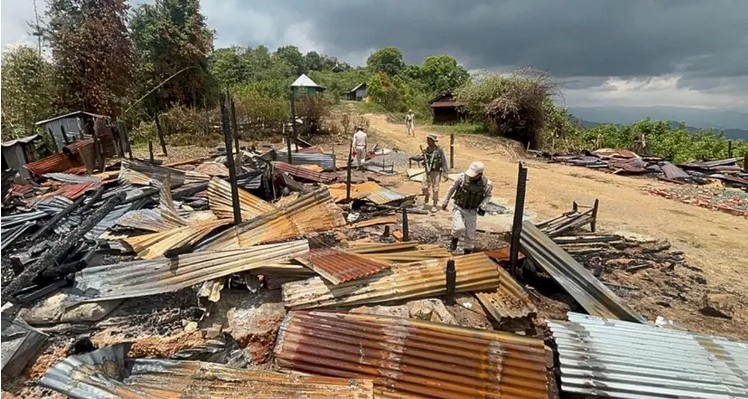
The violence of 2023 fundamentally altered Manipur’s political landscape. It produced massive displacement, hardened ethnic territorial divisions, and weakened the authority of the State government across large parts of the State. In many areas, local civil society groups, armed volunteers, and community organizations emerged as dominant actors in maintaining security and governance. The State’s institutions – its legislature, police, and administrative apparatus – were widely perceived as either ineffective or partisan.
When President’s Rule was imposed, it was expected that the direct involvement of the Union government would restore administrative neutrality and pave the way for political reconciliation. However, the period of central rule did not significantly transform the underlying political dynamics. Internally displaced persons continued to live in camps, mobility between communities remained restricted, free and safe movement of the Meiteis on the National Highways remained blocked, and the territorial segmentation of the State persisted.
Against this backdrop, the restoration of an elected government in February 2026 was politically necessary but structurally complicated. The swearing-in of Khemchand was intended to signal a return to democratic normalcy, yet the conditions under which the government was formed suggest that this restoration may have been driven as much by constitutional obligation as by genuine political consolidation.
The delay in portfolio allocation within such a small council of ministers illustrates the fragility of the new arrangement. Ordinarily, distributing portfolios among five ministers would be a simple administrative matter. In the current context, however, each portfolio carries immense political implications. Control over departments such as home, finance, tribal affairs, hills, forests, climate, rural development, public health, and public works can significantly influence how the post-violent conflict recovery process unfolds.
The allocation of these portfolios therefore becomes a delicate exercise in balancing competing political factions. Within the ruling party itself, multiple legislators are reportedly pressing for ministerial positions. The pressure is not surprising. In India’s political system, ministerial office represents both status and access to the administrative machinery through which political influence is exercised.
The problem for the Chief Minister is that the number of available positions is limited, while the number of aspirants is substantial. If the ministry were expanded immediately to the expected size of twelve ministers, the distribution of these positions would inevitably generate winners and losers within the BJP and ruling coalition. Those excluded might express dissatisfaction, potentially destabilizing the government at an early stage when the next State assembly elections due in early 2027.
Yet the continued existence of a minimal council is equally problematic. A government with only five ministers is administratively stretched, especially in a State confronting the enormous challenges of post-violent conflict reconstruction. Moreover, the absence of cabinet expansion creates the impression that the government itself is uncertain about its political footing.
This perception is reinforced by the widely discussed possibility that key decisions about the composition of the ministry are being shaped not in Imphal but in New Delhi. The BJP’s centralized decision-making structure means that State-level leadership often operates within parameters defined by the party’s national leadership. In politically sensitive States, especially those experiencing instability, the influence of the central leadership tends to become even more pronounced.
If the Chief Minister’s choices are indeed subject to approval – or even direct determination – by the national leadership of the party and the Central Government, the implications for federal governance are significant. The Indian Constitution formally establishes a federal structure in which State governments possess autonomous executive authority within their jurisdictions. However, in practice the balance between the Union and the States has often fluctuated depending on political circumstances.
Manipur’s current situation illustrates how fragile that balance can become during periods of crisis. The year-long period of President’s Rule effectively transferred executive authority from the State government to the Union government. The restoration of an elected government was expected to reverse that process. Yet if the new government’s composition and decisions remain heavily influenced by central political actors, the restoration of federal autonomy may be more symbolic than substantive.
This raises the uncomfortable possibility that Manipur is currently experiencing a form of “managed federalism,” in which the formal institutions of State governance exist but operate under the shadow of central political authority. Such an arrangement may provide short-term stability, but it also risks undermining the long-term legitimacy of democratic institutions within the State.
Another factor complicating cabinet expansion is the ethnic polarization that has shaped Manipur’s politics since 2023. Ministerial appointments are now interpreted not merely as political decisions but as signals of ethnic representation and territorial influence. The inclusion or exclusion of particular legislators can easily trigger perceptions of community bias.
In a State where political trust has already eroded, the formation of the cabinet becomes an intensely scrutinized process. The Chief Minister is compelled to balance the demands of party factions, coalition partners, and ethnic constituencies, all while maintaining the confidence of the central leadership. The result is a political environment in which even routine administrative decisions become highly sensitive.
The broader question, however, is whether the current executive arrangement can effectively address the structural challenges facing the State. The violence of 2023 did not merely create a temporary security crisis; it exposed deeper institutional weaknesses in Manipur’s governance framework. Rebuilding trust in the State requires a functioning political executive capable of taking decisive action.
A truncated ministry struggling to allocate portfolios does not project that image of authority. Instead, it reinforces the perception that the State government remains politically constrained. For citizens who have endured years of instability and displacement, this perception can further erode confidence in democratic institutions.
The situation also highlights a deeper dilemma within India’s federal political system. When a State experiences prolonged internal conflict, the Union government inevitably becomes more involved in governance. While such intervention may be necessary to restore order, it also creates the risk that the State’s political autonomy will be weakened.
Manipur now appears to be navigating precisely this dilemma. The restoration of an elected government was meant to reaffirm the principles of democratic federalism. Yet the slow formation of the ministry and the continuing uncertainty surrounding its expansion suggest that the State’s political institutions have not fully regained their independence.
Ultimately, the question is not merely whether Yumnam Khemchand will expand his cabinet to twelve ministers. The more fundamental issue is whether the government can exercise genuine executive authority in a State where the political landscape remains deeply fragmented and where the influence of the central leadership looms large.
If the Chief Minister is able to assert greater autonomy in shaping his government and articulating a coherent political strategy, the current difficulties may prove to be temporary. Cabinet expansion could then become a step toward restoring normal governance and rebuilding public confidence.
However, if the ministry continues to function as a limited executive whose decisions are shaped primarily by external political calculations, the implications for Manipur’s democratic future are troubling. In such a scenario, the restoration of elected government may remain largely procedural – a formal return to constitutional rule without the substantive revival of federal political authority.
Manipur today therefore stands at an uncertain political juncture. The State has technically emerged from the period of direct central rule, yet the structures of democratic governance remain fragile. The delayed formation or expansion of the council of ministers is not merely a bureaucratic irregularity; it is a window into the deeper political tensions shaping the State’s future.
Whether those tensions can be resolved will determine not only the fate of Manipur Chief Minister Yumnam Khemchand’s government but also the credibility of India’s federal democratic system in one of its most politically sensitive regions. Until the ministry expands, asserts its authority, and begins addressing the profound challenges facing the State, the question will continue to linger – has Manipur truly returned to elected governance, or is it still operating under a shadow of suspended federal power?

Senior Editor: Imphal Review of Arts and Politics