Nine months into President’s Rule, Manipur’s politics remains frozen. Since February 13, 2025, the state has been administered directly by the Centre; its Legislative Assembly kept in suspended animation.
Former Chief Minister Nongthombam Biren Singh’s resignation four days earlier had ended an increasingly untenable regime. His government, once hailed as the BJP’s strongest bastion in the Northeast, had collapsed under the weight of two years of violent conflict resulting in bloodshed between the Meitei and Kuki-Zomi communities.
Now, as the months drag on, the state’s BJP MLAs shuttle between Imphal and Delhi seeking revival of an elected government. But New Delhi is unmoved. The Centre’s caution is deliberate – bringing back a political government risks reopening the wounds of May 2023, when violence erupted across Manipur and shattered the coexistence of ethnic groups of Manipur, now, a state under suspension.
May 3, 2023: The Day the State Shattered
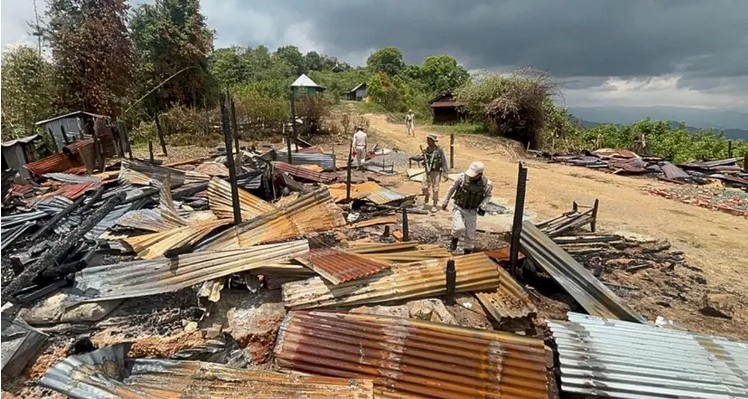
The violent conflict began on May 3, 2023, when a “Tribal Solidarity March” in Churachandpur spiralled into coordinated attacks on Meitei settlements in Churachandpur, the neighbouring Bishnupur district, Kangpokpi, Sagolmang, Pukhao, the border town of Moreh and beyond. Retaliations from Meiteis soon followed in the state capital Imphal and across the foothills. By the time the guns fell silent, more than 260 people were killed, more than 1,500 injured, and over 70,000 displaced. Villages were razed, structures were bulldozed, police armouries looted, and entire districts divided by ethnicity.
The collapse of civil administration was total. N Biren Singh’s government, seen as partisan by Kuki-Zomi groups and ineffective by many in the valley, lost its legitimacy. In the months that followed, the demand for his removal came not only from the Kuki-Zomi groups and opposition benches but also from Delhi’s own advisers.
When the Centre finally imposed President’s Rule in February 2025, it was less a constitutional intervention than an emergency brake – a way to buy time, contain violence, and reset the political board.
A Vacuum in Imphal, a Tightrope in Delhi
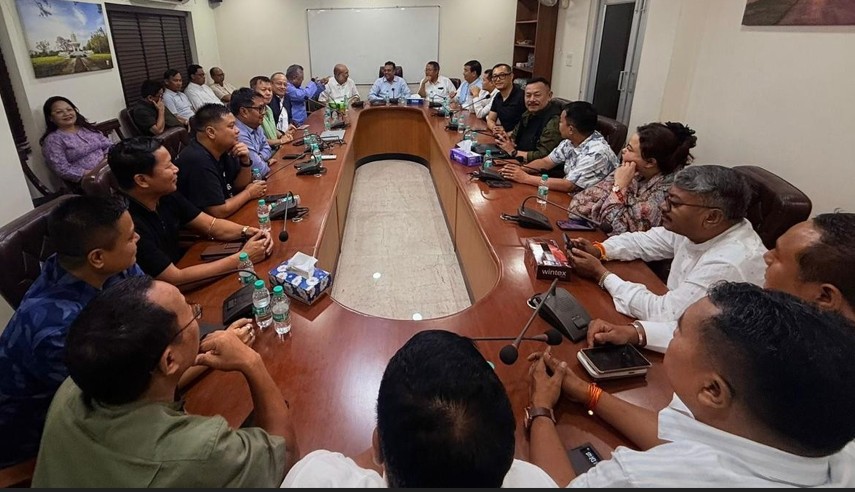
Since then, Manipur’s politics has drifted into suspended animation. In early October, former chief minister N Biren Singh was among the 25 BJP legislators flew to Delhi to press for reinstatement of a “popular government”. They sought audiences with Prime Minister Narendra Modi, Home Minister Amit Shah, and BJP national president J.P. Nadda – but none were granted.
Instead, the delegation met Sambit Patra, the BJP’s Manipur in-charge, who advised them to first build consensus among Meitei, Naga, and Kuki-Zomi MLAs before any step could be taken.
The advice was revealing. It was not a rejection but a reminder of political reality – without the participation of 10 Kuki-Zomi MLAs – seven of them from the BJP, two from Kuki People’s Alliance (KPA) and one Independent – any government would lack inclusivity, legitimacy, and stability.
Delhi’s reluctance is also strategic. Installing a government now would tether the BJP to a volatile situation it cannot control. It risks turning every incident in Manipur into a national embarrassment.
The Impossible Arithmetic
On paper, the BJP has the numbers. Of the 60 Assembly seats, it holds 37 including seven belonging to Kuki-Zomi community, comfortably past the halfway mark in the 60-member Manipur Assembly, which currently has the strength of 59 as one National People’s Party (NPP) member passed away earlier this year. The Kuki-Zo MLAs are not part of this group and did not attend Wednesday’s meeting. Six MLAs from the NPP, five MLAs are from the Naga People’s Front (NPF) and one MLA is from the Janata Dal (U) – all three being part of the NDA at national level – are BJP ruling partners in the state. But those numbers mask an ethnic void.
The seven BJP MLAs from Kuki-Zomi constituencies, along with two from the KPA and one Independent, have not returned to Imphal since the violence broke out. They remain outside the state, citing security threats and political ostracism.
Without them, any government would be a Meitei-Naga only administration, effectively governing half a state. Even if the BJP could cobble together a majority, it would lack legitimacy in the Kuki-Zomi dominated areas and inflame separatist sentiments demanding a “separate administration”.
The arithmetic is further complicated by factionalism within the BJP’s Meitei bloc. Former ministers Thongam Biswajit, Govindas Konthoujam, and Speaker Thokchom Satyabrata Singh each lead their own camps. N Biren Singh himself remains a polarising figure, simultaneously indispensable and unacceptable.
In short, the BJP has a majority in numbers, but a minority in unity.
The Centre’s Logic: Peace Before Power
Prime Minister Narendra Modi’s September 13 visit to Manipur spoke volumes without saying much. His speeches at Churachandpur and Kangla made no mention of restoring the Assembly. Instead, he emphasised empowering local bodies and rebuilding trust between communities.
That omission was intentional. It reflected the Centre’s doctrine – peace first, government later.
For Delhi, the challenge is not just restoring governance, but preventing relapse into violent conflict. The renewal of the Suspension of Operations (SoO) agreement with Kuki-Zomi armed groups in September shows that the Union Government of India’s priority remains negotiation and containment. A political government, particularly a Meitei-majority one, could unravel that fragile détente overnight.
Even among security officials, the consensus is that the situation remains too delicate for a full transfer of power. Highways may have reopened in paper, but buffer zones still divide the state on the ground, and camps for the displaced people remain full.
Sambit Patra and the Gatekeeping of Power
The most telling symbol of Delhi’s caution lies in Sambit Patra’s quiet gatekeeping. Multiple delegations of Manipur BJP MLAs have camped in Delhi since October 4, but Sambit Patra has consistently kept them at bay – hearing them out, but never granting access to the top leadership.
When 25 MLAs met him at Manipur Bhavan on October 8, he again urged “consensus” and “inclusiveness.” But behind the diplomatic phrasing lay a political decision – the central leadership is not ready to take responsibility for Manipur’s instability.
For the MLAs, Sambit Patra’s silence has been infuriating. For the Centre, it is a deliberate buffer. As one party source told The Indian Express, “The top leadership is not in a mood to end President’s Rule. The feedback from officials is not in favour.”
In effect, Sambit Patra’s role is to keep the crisis at arm’s length – far from Modi’s podiums and Shah’s political calendar.
Therefore, former CM N Biren Singh, speaker Thokchom Satyabrata Singh, former speaker and minister Yumnam Khemchand Singh, former minister Govindas Konthoujam, former minister Thongam Biswajit Singh and MLA Khongbantabam Ibomcha Singh – all being seen as chief minister probable – were given the opportunity to meet at least BJP’s national general secretary (Organisation) B L Santosh on October 10, 2025 to press the party leadership to form a new government.
A Risk Delhi Won’t Take
Forming a government in Manipur today would be like lighting a match in a room full of gas. The moment a Meitei-led government is installed, the Kuki-Zomi groups could continue categorising it as Meitei government and interpret as provocation, and withdraw from peace talks.
Even within the valley, competing ambitions could paralyse governance. The ruling coalition would spend its brief tenure negotiating survival rather than peace. And with elections due in early 2027, the central leadership sees little point in risking a premature and short-lived administration.
For the BJP, delay is strategy. By maintaining President’s Rule, the Centre governs through bureaucracy and security agencies without political liability. Any deterioration in the situation can be blamed on “local factors,” not the party.
If calm returns by 2027, Delhi can claim credit for having restored peace – and then reinstall its government with a renewed mandate. But if violence flares under an elected government now, the BJP would carry the blame into the polls.
In that calculus, patience becomes policy.
Between Control and Collapse
The irony is that the longer the Centre delays, the weaker the very institutions of democracy become. The Manipur Assembly – neither dissolved nor functioning – has become a symbol of political paralysis. The Governor, Ajay Kumar Bhalla, now wields both administrative and symbolic authority, presiding over a state where the bureaucracy runs without political oversight.
Civilian authority has eroded to the point of absurdity. The Gwaltabi incident in May 2025, when an army regiment forced a Manipur State Transport bus ferrying journalists to cover the opening of Shiroi Festival by Manipur Governor Ajay Kumar Bhalla in Ukhrul to conceal its own banner, sparked protests from journalists (All Manipur Working Journalists’ Union – AMWJU) and civil society groups such as Coordinating Committee on Manipur Integrity (COCOMI) . Yet the episode passed without accountability.
Such moments reveal the hollowness of governance under President’s Rule – a semblance of order masking institutional decay. But they also explain Delhi’s dilemma. The state machinery itself is too fractured to sustain normal government. Until civil authority, police command, and public confidence are rebuilt, even the most popular government would remain a hostage to circumstance.
The Mirage of “Inclusivity”
When Sambit Patra spoke of an “inclusive government,” he set a precondition that may be impossible to meet for the time being. For the BJP to include Kuki-Zomi MLAs in any government, those legislators must first be able to return safely to Imphal – something neither they nor the security forces can guarantee.
Equally, Meitei MLAs cannot freely travel to Kuki-Zomi-dominated areas. The buffer zones separating the two regions are not symbolic lines; they are militarised boundaries.
This geographic and psychological partition means no single government can claim to represent the entire state. Any formation without Kuki-Zomi participation would reinforce division; any formation with them would risk violence from both sides unless there is an understanding with the Union government.
Inclusivity, in other words, is the Centre’s way of saying “not yet.”
A Sacrifice in the Name of Stability
When President’s Rule was imposed, it was widely understood as Delhi sacrificing party interest for national interest. By removing N Biren Singh, the Centre pacified Kuki-Zomi groups without conceding their demand for separation. It also shielded the BJP from direct blame for the state’s disintegration.
That calculation still guides policy. The Centre sees little gain in reclaiming Imphal at the cost of reigniting unrest. Far better, in its view, to wait until a modicum of reconciliation is achieved – or at least until the optics improve.
As a senior BJP leader told News18, “The situation has improved, but not enough. The top leadership wants to ensure that once the government is formed, it stays.”
For now, that means the continuation of President’s Rule is both strategy and safety net.
Democracy Deferred
The tragedy of Manipur today is that the same measure that saved it from chaos – President’s Rule – also prevents its recovery. The state lives under what might be called a managed paralysis – violence contained, politics suspended, democracy deferred.
Every week, delegations of MLAs travel to Delhi. Every week, they return empty-handed. Their frustration is real, but Delhi’s fear is greater.
The Centre knows that the moment it hands back power, it also hands back blame. In a conflict where the line between security and survival is razor-thin, control is safer than democracy.
The Road to 2027
By now, even the BJP’s Manipur MLAs privately acknowledge that the next Assembly election in 2027 is the real horizon.
The BJP’s numerical majority means little in a state still divided by barricades, buffer zones, and fear. Delhi’s caution reflects not paralysis but calculation – restoring a government now could risk reopening the wounds of May 2023.
Therefore, the BJP’s best bet is to keep Manipur under President’s Rule while pursuing limited peace talks, rehabilitation of internally displaced people, and infrastructure reconstruction – all under the Union’s supervision.
If relative calm returns by late 2026, the party can campaign as the restorer of peace and integrity. If not, it can still argue that it prevented further bloodshed.
Either way, Delhi wins by waiting.
The Hard Truth
The demand for a “popular government” may make sense in constitutional terms, but in the reality of Manipur’s divided landscape, it risks inviting collapse.
The events since May 2023 have shown that governance without coexistence is impossible. Until Kuki-Zomi and Meitei representatives can again sit in the same chamber without fear, President’s Rule will remain not just an administrative choice but a political necessity.
Delhi’s caution, often read as indifference, stems from recognition of this grim truth – a premature government could trigger a permanent partition.
The BJP’s national leadership appears willing to bear the criticism of delay rather than the blame for disaster. It has opted for control over collapse, even if that means democracy must wait.
So long as the guns have not fallen silent and the buffer zones remain guarded, the question is not when the BJP will return to power – but whether Manipur is ready to be governed at all.

Senior Editor: Imphal Review of Arts and Politics