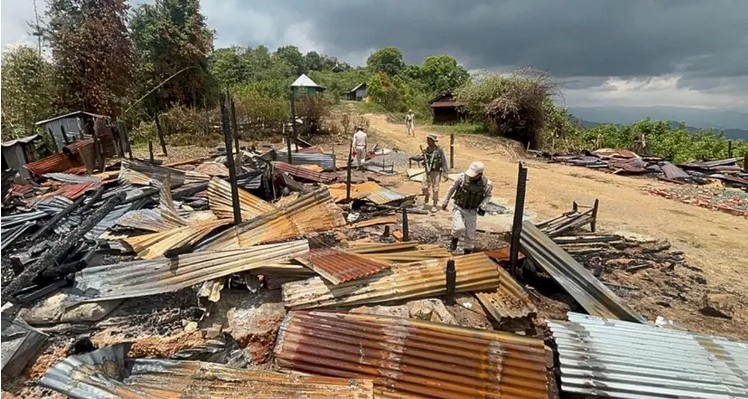

Close to three years after mindless ethnic blood-letting broke out between the Kuki-Zo group of tribes and the majority Meiteis community on May 3, 2023, overt violence has now ceased but the state remains bitterly divided physically and psychologically. Over 60,000 conflict displaced people from both sides of the divide continue to languish in several relief camps, unsure of their and their children’s future. They have also become prone to depression and even suicide cases among them are on the rise.
The trouble is, both the warring sides continue to see and push for amelioration of their side of the suffering and their understanding of what a solution should be, missing out in the process the fact that the losses and sufferings brought by the violence is shared by both sides. They also tend to forget Manipur is multi-ethnic and that a solution cannot be a bilateral matter between them only. Another major community, the Nagas, have begun asserting this, and all need to note this seriously.
Any reconciliation would have to begin with a comprehensive plan for the displaced on both sides to return to their abandoned homes and rebuild their lives. This would also mean opening up the highways for free movement either way for all. The responsibility for making this happen cannot just be of the government alone, but also by what John Paul Laderach called ‘the moral imagination’ of the people in his book by the same title. It contends that just as hostility gets hostility as response, goodwill will be reciprocated with goodwill.
If one side for instance unilaterally opens up and welcomes back displaced people, or assures free passage to those wishing to access health facilities in Imphal or outside the state, the iceberg of mutual suspicion should begin to melt, paving the way for a settlement of the crisis across the table. The side to first exercise empathy and see their own sufferings shared by the other side and take courage to reach out, is the one blessed with moral imagination, and not at all the one to blink first in this masculine contest for belligerency.
There will probably be entrenched vested interests who reap a sense of power and other benefits from the conflict therefore would want its continuance, if not as open violence, then as a ‘frozen conflict’. These are the elements, as and when they become evident, that the government must tame, even if use of the state’s coercive power becomes necessary.
Reconciliation will not be easy but not impossible. There have been atrocities by both sides and as in any conflict there are hawks and doves within, but only the hawks are heard and seen. Again, in a charged conflict atmosphere, even the doves often speak the hawk language without actually meaning them. The inference is, what are seen and heard cannot be the summary of the entirety of the mood of this conflict landscape, although many parachute journalists and NGO fact finders have ended up trying to make it seem so, complicating matters.
Once the displaced have been allowed to return and reclaim their homes, and free movement ensured across the ‘buffer zones’ established by the government after the trouble broke out, the larger issues that caused the conflict can be addressed and settled.
Among these are the questions of illegal immigration and unequal development between the valley and the hills. Both of these and more will have to be dealt with but after establishing their exact nature and extent. There would be illegal immigrants without doubt but the number may not be as overwhelming as often made out to be, for the Chin state in Myanmar where this immigration is said to be originating, is itself very sparsely populated. In the light of this however, the tradition of villages splitting and spreading amongst Kuki-Zo tribes will also have to be discontinued.
There would also be developmental disparity between the hills and valley, but here too a false binary has made this difference seem acute. The tendency has been to compare a hill district township or village with the capital Imphal city to claim this disparity. If the comparison were to be between a hill district township or village with a valley district township or village, there would be little or no disparity.
The poppy menace, another often cited cause of the present trouble, would have to be stopped unconditionally. Even the option of introducing controlled legal poppy cultivation is unlikely to work, for legal farmgate price of opium yield is between Rs.850 to Rs.3,500 per kg depending on quality, while in the illegal narcotics market the range is between Rs.60,000 and Rs.80,000.
The biggest challenge however will be in bringing in all stakeholders to a consensual participatory truth-and-reconciliation exercise. It is here that both sides can discover the traumas each carry is shared, and that in telling and hearing each other, a doorway to a peaceful resolution can become visible.
David Reiff in his book ‘In Praise of Forgetting: Historical Memory and its Ironies’ have some valuable advice. Individual memory, as psychologists vouch, is problematic, for a person can remember things that did not happen or forget things that happened. Collective memory is even more problematic for it is memory passed on by someone else or another generation. It also becomes ‘editable’ to suit present needs and historical narratives.
The trouble is, forgetting the past is often seen as betrayal, but Reiff reminds us that remembering the past can also often be toxic for the present. Trauma memory thus can become weaponised by those who benefit from perpetuating animosities of the past. Sanitising traumatic memories of this toxicity by placing them in correct context and perspective hence is vital. That Japan is able to put to rest its memories of the two atom bombs of 1945, just as the US has done of Japan’s Pearl Harbour attack of 1941, so that the two countries can become close allies today is a lesson for all seeking reconciliation.
The article was first published in The New Indian Express. The original can be read HERE

Editor, Imphal Review of Arts and Politics and author