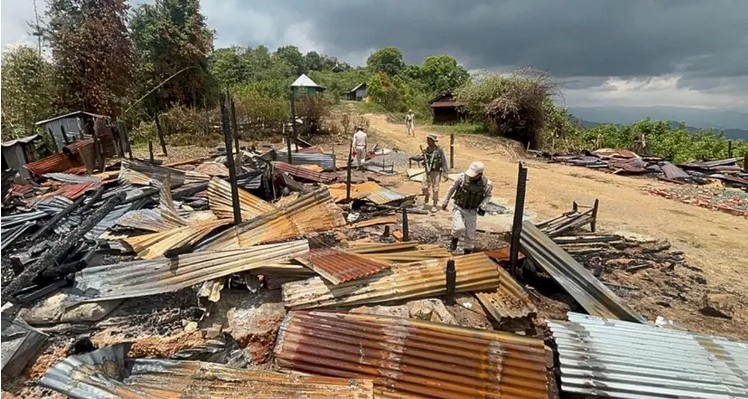

The mindless mayhem in Manipur has ceased after over two years of blood-letting between two of the state’s communities – the Meiteis and the Kuki-Zo group of tribes. This however is hardly normalcy, for the underlying causes of the inferno that ravaged the state, or the tragic consequences it left behind, remain unresolved. Nonetheless this is precious time won to reflect on a way forward.
A resolution however can be elusive given the tendency for inaccurate presumptions in popular understanding of the conflict. The first likely fallacy is treating this conflict as a bilateral matter between Meiteis and Kuki-Zos, for Manipur is multi-ethnic. The Naga tribes for instance can be predicted not to tolerate any solution deemed as infringement into their domain. This can turn ugly if a territorial settlement is envisaged, for the Nagas contend most of the land Kukis have settled belong to them but leased out to Kukis when they arrived.
The Meiteis too will object, unlike in the case of Nagas and Kukis whose claimed home-grounds almost completely overlap, this will be more out of an “imperial nostalgia” inherited from a sense of having been at the helm of the erstwhile Manipur kingdom’s pre-colonial history. This nostalgia is nothing to be trifled as Thant Myint-U explains in reference to Myanmar in “The River of Lost Footsteps”, contending that the familiar ahistorical approach which ignores archetypal memories of historical experiences of peoples, cannot ever gauge current problems comprehensively.
In Manipur’s case, colonial land laws first – as in Assam and Myanmar – segregated revenue plains from non-revenue hills. The hills were claimed as British territory but left “unadministered”, “excluded” or “partially excluded”. This colonial approach was inherited by modern India, restricting Meitei settlements largely within the Imphal valley which constitutes about 10 percent of the state’s total area. The valley is also where modern land laws were introduced by the Parliament in 1960 while Manipur was still a Union Territory, and is open to settlement by all Indians. In recent times, this has led to a sense of besiegement amongst Meiteis.
The hills on the other hand are disenchanted with what they see as lopsided development in which the valley is seen as garnering a lion’s share of developmental funds. While the developmental disparity between the hills and valley is a reality, the question is, how much of this is a result of motivated planning, and how much of it a result of topography, and not the least, the state’s poverty. The state’s annual budget is generally around Rs. 35,000 crores but 70 percent of this goes to non-plan revenue expenditures – salaries, pensions, repayment of loans and interests, constituting the bulk. What is left is then spread out thin to all the districts.
These perceptions – in the valley of a sense of besiegement and in the hills of developmental neglect – are fertile grounds for quotidian populists and righteous demagogues, in the words of Adnan Naseemullah and Pradeep Chhibber, to build or consolidate their constituencies. This populism is not necessarily restricted to politicians, for public intellectuals too are often guilty of it. In the few years prior to the outbreak of violence, the atmosphere in the state had thus become tense.
Amongst the Meiteis, a paranoic sense of an existential threat looming was building up, reinforced also by a belief that since they are not classified as Scheduled Tribes, ST, they are being left behind in the competition for state benefits. Likewise, amongst the hill communities too, a sense of being unfairly deprived of their entitlements became widespread. Propelled by populist campaigns, in 2021, there was even a demand for introducing a bill in the state Assembly to create a separate administrative arrangement for the hills. Such was the mistrust and tension on both sides of the divide that it just needed a spark to explode. That spark happened on May 3, 2023, when a rally to oppose Meitei demand for ST status turned violent at Torbung village.
Naga interest
If the original tension was between the hills and valley, why did Nagas stay away from the fight against Meiteis? Here is another evidence of the layered nature of the ethnic relations in Manipur. Nagas, like Meiteis, despite their differences, think only they are original inhabitants of Manipur and Kukis are later migrants, therefore should know their place.
It is unlikely there have been huge waves of migration of Kuki-Zos into Manipur in recent times for the Chin state in Myanmar where this migration supposedly originates, although in land area is two and half time the size of Manipur, has a population of about five lakhs only. But in a state where Assembly constituencies are small, and electoral victory margins are low, a few thousand can overturn power balances.
Evidence of this is in the records of the Manipur Assembly from the time Manipur became a full-fledged state in 1972 with a 60-member Assembly. Of the 60 seats, 20 are in the hills, and of these, 19 are reserved for STs. In the early years of statehood, of the 20, Nagas usually returned 12 seats, Kukis 7 or 8 if a Nepali did not win the Kangpokpi seat. Today, Nepalis are out of the equation, and the 20 hill seats are shared equally between Naga and Kuki candidates. The anticipation is, the balance can soon become 9 Nagas and 11 Kukis, if Kukis take the two border districts of Chandel and Tengnoupal, both of which were once Naga strongholds. If this happens, more troubles can be expected.
Other than these 20 hill seats, there are also 40 general seats. Again, populists habitually project these as reserved Meiteis seats, which false. Meiteis and Meitei Pangals (Muslims) do win these seats, but voters who give them victory margins are not all Meiteis. Especially in the seven Assembly constituencies in the cosmopolitan Imphal capital region, no aspiring candidate can afford to champion sectarian Meitei causes.
In matters of identity, the valley has been a melting pot of ethnicities. In 1606 an invading Muslim army from a Bengal Nawabi invited by a rebellious sibling prince hopeful of usurping the Manipur throne was defeated. However, considering the new fishery and horse tending skills the soldiers brought, the then king settled them in his kingdom, and their descendants are the Meitei Pangals. Similarly, Brahmins from Bengal and beyond who came to Manipur to spread Cheitanya Mahaparbhu’s Bhakti movement, received royal patronage and they too were absorbed into the Meitei fold to become today’s Meitei Bamons.
If a genome study were to be done, the Meiteis probably will be found to carry DNA traces of many groups of peoples, including all of the hill communities. Many see this syncretic character of the Meitei society as strength, serving as a confluence of cultures and civilisations, continually enriching its social fabric. A growing revivalist section however sees these as contamination needing a purge, strongly reminiscent of Sunil Khilnani’s additional introduction to the 2003 edition of his 1997 book “The Idea of India.”
Human migration is universal, and indigeneity is just a matter of who settled at a place earlier. But it must be added that the modern state is premised on a sedentary and enumerable population, therefore unregulated shifts of populations must have to end. Otherwise, even democracy’s mandate will cease to have meaning.
Legitimate identity
Sajjad Hassan’s book on building legitimacy in Northeast India makes an interesting comparison between identity legitimacy of Manipur and Mizoram. The Mizo identity is new. Before the Mizo (Mi-people and Zo-mountain) identity materialised, the Lushais were the most numerous and powerful. Amongst the Lushais, the Sailo clan formed the core of the ruling elite. All non-Lushai tribes were treated as serfs of the ruling dispensation but even within the Lushais, there was a division between commoners and chieftain clan.
Another book, “Modern Mizoram” jointly authored by P. Thriumal, Laldinpuii and C, Lalrozami, adds another perspective to the unified Mizo identity which came into being following a campaign by a civil body, the Mizo Union. The Mizo Union’s movement first spawned amongst the serf tribes and was also directed against chieftainship rule.
The arrival of the Mizo identity is dramatic. In the 1951 census there were no Mizos, but in the 1961 census, Lushais disappeared as did many smaller tribes, and Mizo, which the Mizo Union had campaigned to have listed as Scheduled Tribe, became the majority.
There were pockets of resistance, including from Chakma, Lakher (Mara), Pawi (Lai) and Hmar. Again, the smaller tribes which became Mizos, revert back to their original identities if they cross the border into Manipur. Evidently, it would be hasty to presume the Mizo identity project a complete success just as it would be hasty to label the Manipur project, which is a direct contrast, a failure.
Manipur case
Unlike the Mizo case, the Manipur project is anarchic. The state has 33 recognized tribes, besides several non-tribals like Meiteis. Each of these groups are under no pressure to leave their individual identities. Many of the tribes, such as Kharam and Koireng number no more than a thousand or two, and the smallest, Purum, has today just 352 individuals left. Yet each tribe has the space to be linguistically and culturally themselves. If the Mizo identity is akin to a curated rose garden, then Manipur’s can become a meadow where a hundred flowers blossom together.
The way forward
What then can be Manipur’s way forward? First, all must acknowledge there are more stakeholders than the two in the current conflict. All stakeholders must be taken on board to evolve a common platform they all can stand together in equality. For this, those in the conflict must overcome the tendency of “selective empathy”, which often leads to a victimhood syndrome. The empathy circle must widen to bring within it even adversaries in what John Paul Lederach termed “The Moral Imagination”. Only this can lead to a realisation that the trauma of this conflict is shared and not unique to either, and in the courage to acknowledge this, find common redemption.
The second hurdle also has to do with selective empathy, but of observers and commentators who sermonise from the vantage of the ideologies they profess and conflict templates they are familiar with. They can also suffer from an acquired victimhood syndrome aligning with the side they choose to identify with, a phenomenon Dominick LaCapra termed “surrogate victimage” in his “Writing History, Writing Trauma”. This can be dangerous, for they can end up widening the conflict chasms, making resolutions more difficult.
The third is related to the complications from ongoing secessionist insurgencies in the region. Rifts in insurgency prone societies are often outcomes of counterinsurgency strategies the state adopts. Briefly, Naga insurgency is the first born, and arguably the most committed. Its seeds germinated as early as 1929 when the then nascent Naga Club submitted a memorandum to the visiting Simon Commission saying Nagas were not Indians and want to be left alone when the British leave India. Meitei and Assamese insurgencies were born out of disenchantment of a section with the Indian Union they joined. The first took shape in 1964 and the latter in 1979. Kuki insurgency came into prominence in the 1990s in the wake of a communal conflict with Nagas.
Kukis militants were not fighting the Indian state or security forces, yet in 2005, the Army signed a Suspension of Operation, SoO, with them. This was upgraded to a trilateral agreement in 2008 bringing in the Manipur government as a signatory. The suspicion was that this was meant to undermine Naga and Meitei insurgencies. If true, in the short run the strategy may seem promising, but in the long run, the poison spilled into the society will predictably not be easy to cleanse. Meiteis now want the SoO abrogated and Nagas have sworn they will not allow any SoO camps set up in lands they consider theirs. This matter also needs to be addressed and the toxicity removed to make way for a more permanent and positive peace in the state.
This article first appeared in an e-book on the Manipur conflict brought out by The Hindu. The original is available HERE

Editor, Imphal Review of Arts and Politics and author