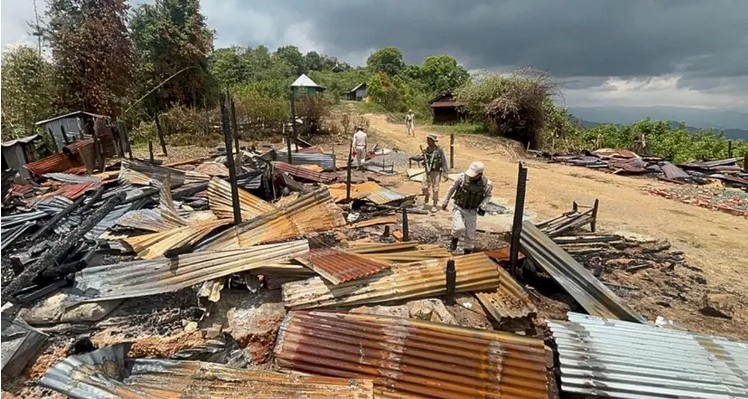

The killing of two sleeping children – one four years old boy, Oinam Tomthin and his 5 months old sister, Oinam Yaisana waiting for her Chak-umba, weaning ceremony – and injuring their mother Oinam Binita critically in Tronglaobi Awang Leikai on April 7, 2026 in a terror attack on civilians, followed by the deaths of civilians in firing by the Central Reserve Police Force (CRPF), marks not only the most tragic and shocking incident but also one of the most morally and politically consequential moments in Manipur since the outbreak of violent conflict on May 3, 2023. What makes this episode particularly significant is not only its brutality, but the layered failures it appears to reveal – failures of anticipation, protection, coordination, and calibrated response.
This is not simply another tragic and shocking incident. It is a stress test of the state’s claim that it has regained control.
At the heart of the episode lies a fundamental question – how could a rocket-propelled attack occur in a heavily militarised sensitive zone like Tronglaobi in Bishnupur district – a known hotspot of the violent conflict along the hill-valley interface and also along the Imphal-Churachandpur stretch of the National Highway, NH-2 – without detection? Since May 2023, such fringe villages have been transformed into fortified spaces, with multiple layers of deployment involving the Manipur Police, Central Security Forces including, BSF, Assam Rifles, CRPF and the Indian Army. The very logic of this security architecture is based on denial – denying armed groups the ability to move, assemble, and strike. Yet, the use of a rocket-propelled grenade, reportedly fired from close range, suggests that either surveillance failed, or the threat was not interpreted as imminent.
This raises the first axis of concern – intelligence failure. Intelligence in conflict zones is not merely about high-value militant targets; it is about granular, localised awareness. The reported involvement of “local elements” complicates this further. If indeed the launcher was improvised and the ammunition supplied externally, it points to a hybrid threat – where “local actors” act as force multipliers for organised groups. Such threats are inherently harder to detect, but not impossible – especially in a zone under sustained watch. The failure, therefore, may not be absolute ignorance, but a breakdown in actionable intelligence – signals may have existed, but were not synthesised, shared, or acted upon in time.
The second and more disturbing dimension is the apparent lapse in immediate response and site control. Reports indicate that a live shell remained in proximity for more than 10 hours after the blast. In any standard operating procedure, a site involving explosive ordnance should trigger immediate cordoning, evacuation, and bomb disposal protocols. The delay points to either confusion over jurisdiction (which force takes charge) or deliberate for reasons best known to the state home department or hesitation born out of uncertainty in a volatile civilian environment. These possibilities are deeply problematic. A crime scene in such a sensitive context is not just about evidence; it is about signalling control. The inability to secure it quickly would have amplified public anxiety and anger naturally.
And anger, in this case, was entirely foreseeable.
The killing of little children – particularly in their sleep – is among the most incendiary triggers in any conflict. In a society already traumatised by nearly three years of violence, the emotional shock was bound to translate into collective outrage. This is where the third failure becomes evident – the failure of anticipation. The gap of several hours almost 12 hours between the attack and the escalation into mass protest storming the CRPF post and burning down their vehicles was not a sudden rupture; it was a window of opportunity. Earlier in the early morning irate villagers had already burned down three trucks including oil tanker. Crowd psychology in Manipur’s conflict zones has followed a recognisable pattern since May 3, 2023 – grief, gathering, rumour, mobilisation, and confrontation. The state has seen this cycle repeatedly. That it did not proactively secure the nearby CRPF post hardly one kilometre away to the west of the attacked civilian house, establish layered crowd-control perimeters, or engage community leaders to defuse tensions suggests a serious misreading of the situation.
The question, then, is not why the mob gathered – but why the state was unprepared for it.
This leads to the most contentious aspect – the firing by the CRPF that resulted in civilian deaths and several injured. From the standpoint of force doctrine, personnel guarding a fixed installation are permitted to use lethal force if they perceive an imminent threat to life or the risk of the post being overrun. A mob attempting to storm a camp, particularly in a conflict zone where weapons proliferation is high, can be interpreted as such a threat. However, legality does not automatically confer legitimacy.
The critical issue is proportionality and sequencing. Were non-lethal measures – tear gas, stun grenades, rubber bullets – exhausted before live rounds were used? Was there adequate warning? Were the personnel trained and equipped for riot control, or were they primarily configured for counter-insurgency? These distinctions matter. The reported nature of injuries – upper body hits – raises questions about fire discipline. In crowd control situations, standard practice emphasises aiming below the waist to minimise fatality, even when live ammunition is used as a last resort. Deviations from this norm, whether due to panic, poor training, or breakdown of command, require scrutiny.
Yet, it is equally important to recognise the structural dilemma faced by forces on the ground. In Manipur’s current environment, the line between “civilian” and “combatant” might have blurred in certain contexts, with the proliferation of looted weapons and the presence of armed militias embedded within communities, which is not in this case and the protestors are unarmed people who are shocked and angry with the killing of innocent children and injuring their mother critically. This does not justify excessive force, but it does complicate real-time decision-making. The solution, therefore, lies not in post-facto blame alone, but in recalibrating protocols for such hybrid scenarios.
Beyond the immediate, the episode exposes a deeper issue – fragmentation of command and coordination. Manipur today operates under a layered security grid involving state police, central armed police forces, intelligence agencies, and, in some sectors, the army. While this provides depth, it also creates seams – points where responsibility becomes diffused. Who was in operational command in Tronglaobi that night? Which agency was responsible for perimeter surveillance? Who authorised or oversaw the crowd-control response? Where had gone the state police? Without clear answers, accountability risks becoming diluted.
The political context adds another layer of complexity. The government led by Chief Minister Yumnam Khemchand has projected the formation of a new administration as the beginning of a stabilisation phase. There have indeed been tentative outreach efforts across communities. But this incident suggests that the underlying conflict architecture remains intact – and volatile. The possibility that actors – whether terrorist, militant, political, or criminal – may seek to sabotage any emerging equilibrium cannot be dismissed. At the same time, invoking “destabilisation” cannot become a substitute for addressing internal lapses.
The decision to hand the probe to the National Investigation Agency (NIA) is, in principle, a step toward credibility. However, investigation alone is insufficient if it does not run parallel with visible administrative accountability. The absence, so far, of a judicial inquiry into the CRPF firing risks reinforcing the perception of selective scrutiny – where the initial act of terror is investigated, but the state’s own use of force is not subjected to equally transparent examination.
What happened in Tronglaobi was not inevitable. It was the product of a chain of preventable failures – a possible intelligence gap that allowed the attack, a delay in securing the aftermath, a failure to anticipate and manage public anger, and a reactive use of force that escalated casualties. Each link in this chain is an opportunity for correction.
And that is where a path forward, however difficult, remains open.
Manipur’s experience since May 2023 has shown that cycles of violence persist not only because of deep ethno-political divisions, but because of recurring breakdowns in trust between the state and its citizens. Rebuilding that trust will require more than operations and statements. It will require demonstrable changes – tighter intelligence integration at the local level, enforce unified command structures in sensitive zones, specialised riot-control training for all deployed units, and, critically, transparent accountability mechanisms that apply to all actors – including the state.
The tragedy of Tronglaobi can still become a turning point – if it forces a shift from reactive governance to anticipatory, accountable security management. Without that shift, the risk is not just further violence, but the gradual normalisation of failure. With it, there remains a real possibility of restoring both control and confidence in a region that has endured far too much of both loss and uncertainty.

Senior Editor: Imphal Review of Arts and Politics