
Rashomon, a Japanese film directed by Akira Kurosawa in 1950, centers around the conflicting testimonies of four characters on the assassination of a samurai. The accounts are provided by a bandit, the samurai’s wife, a woodcutter, and the ghost of the dead samurai. The testimonies are inconsistent with one another, and none can truly be considered false. The film resolves nothing, only asks viewers to consider whether truth is even possible when filtered through the lens of personal bias, motive, and trauma. While it was made more than seventy years ago, the film is still disturbingly relevant; you can watch it again and again hoping to find the “truth,” only to find that your own interpretations shaped from your own perspective lead you to conclusions that are neither final nor universal.
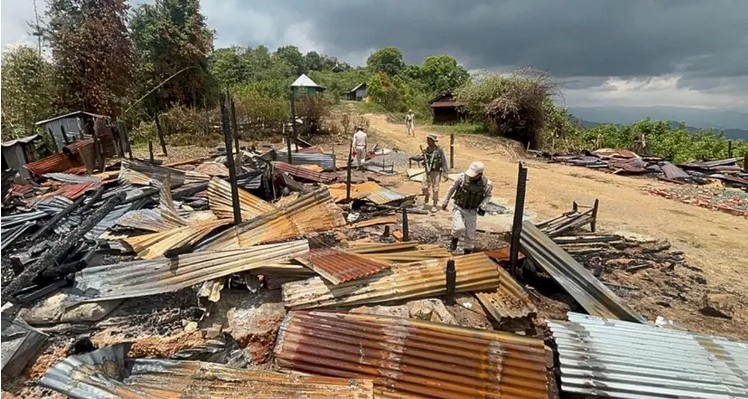
Similarly, just as the four characters in Rashomon attempt to bias us in moral terms in regards to the events narrated, so too do media organisations today attempt to bias our public opinion around contentious issues. This might all lead us to view the current situation in Manipur through a Rashomon-type lens. As an area that has been beset by chronic conflict and has faced clear governmental incompetence in preventing violence for over two years, reporting, regardless of whether national, international or local, varies in terms of tone, focus and implications to the nth degree. But which account is the “truth”? As in Rashomon, it depends on the lens through which the audience wishes to interpret. This article is bereft of any intent to present one media outlet as reliable over others. It simply seeks to make the reader aware of media narratives, in regards to which they should give credibility to or a level of scepticism in their processing of those narratives.
In this instance, it is appropriate to think of the media in the sense of the “Fourth Estate”: a watchdog that protects from harm against abuses of power. But does this ideal translate into reality? Hardly ever, with a handful of principled exceptions. Many contemporary media organizations operate less as independent referees than as byproducts of the political machinery, overtly or tacitly aligned with state interests, partisan ideologies, or corporate benefactors. The affiliations shape not only what is reported, but how it is reported, how easily it is likely to be broadcast, and who gets prominence expressed and/or omitted. In such a Rashomon-like media ecosystem that means that fact is indistinguishable from framing, that makes discerning individual agency doubly significant. This is precarious, but at the same time empowering. Every member of the public must engage actively: Who has constructed/presented this narrative? Who has the stake? Have the claims been fact-checked against credible sources? What has been omitted from consideration? Whose voice has been silenced?
Let’s now look at some media effects theories that can provide the critical citizen an analytical springboard to help them make informed decisions when choosing a news source for mass consumption. So, we’ll start with the Agenda-Setting Theory developed by Maxwell McCombs and Donald Shaw (1972). The primary tenet of agenda-setting theory is that the media does not tell us what to think, but what to think about. If we relate this to Manipur, we can see how national broadcasters, regional networks and even digital influencers shape our consciousness by bringing certain issues to prominence, ethnic violence, administrative blindness, humanitarian nightmare, while pushing other issues to obscurity. The process of setting an agenda affects public deliberation and amplifies polarization. We must also question the origins of these news sources: who owns them? Are they funded by political benefactors or party machinery or corporate machinery? Understanding the entanglements will help us understand the nuances of their messages.
The Gatekeeping Theory, formulated by Kurt Lewin and extended to journalism by David Manning White in 1950, is another relevant framework. Everybody, editors, as gatekeepers, chooses what news is shared. But who is it that decides? Is it the gatekeeper’s editor-in-chief? Their editorial board? The owners and financiers? The truth is that the reader is not given the truth and real facts, but are instead shown an edited form of events that are impacted by the gatekeeper’s viewpoints and ideological slant. In addition, the Framing Theory discusses the architecture of the media’s storytelling: what stories are being told, who are the heroes and villains of the story, and what emotional frameworks are applied to people’s understanding of the story.
For many years, Manipur has been a site of stormy conditions and remains a place where media narratives and the desires of political ambition continue to intersect. News media reports and social media posts about politicians, bureaucrats, and our power brokers are often shaped – sometimes explicitly or implicitly – even by their relationships with the media entities. Media ownership matters: a political scion-owned news channel or a publication or television show folded under a corporate partner will carry those preferences with faux neutrality. Media products – from textual headlines to passionate video portrayals or social media posts that become viral data points – can be used to sway the electorate. There is no alternative to having public consciousness when it comes to being informed and aware. Social change starts not just with slogans, but with our ability as voters, to think critically about our representatives, and the institutions that tell our stories. Elections are essentially job interviews where voters are in the position of recruiters. To recruit well, recruiters need to be qualified and be aware of nuance, be aware of propaganda, and be prepared to “read between the lines.” Truth is not straightforward, and there is no perfect truth in our message distorted, Rashomon-like, media, but we can aim for discernment. Discernment involves seeing, if not the best, at least the least bad.
This article is not about film. This article is not about Rashomon per se. While the film in discussion addresses truth and the elusive nature of truth itself, it provides a moment for the audience to reflect on their biases in their own construction of stories, the competing stories. The same can be said for Manipur as the truth may well forever be contested, but we must begin asking questions about it, how stories are constructed, who constructs them, and what agenda do they serve, however opaquely or obviously.With the electoral moment approaching, media organizations will no doubt strategically develop competing framings of the of the individuals, incidents, and contexts linked to Manipur’s unrest. They will do so ingrained in editorial frameworks and institutional interests, these stories will shape public perceptions as outlined in earlier parts of this article. If Manipur is to move on then we all must learn to separate signal from noise, and narrative from manipulation. The problem is not misinformation per se, but the lack of examination of the narratives we find most palatable. In any genuinely functioning democracy, the failure to subject institutions and events to adequate scrutiny is not a trivial aberration. It is profoundly perilous: both for the people of Manipur and for the structural integrity of a society that aspires to thrive.

The writer is a media scholar and professional