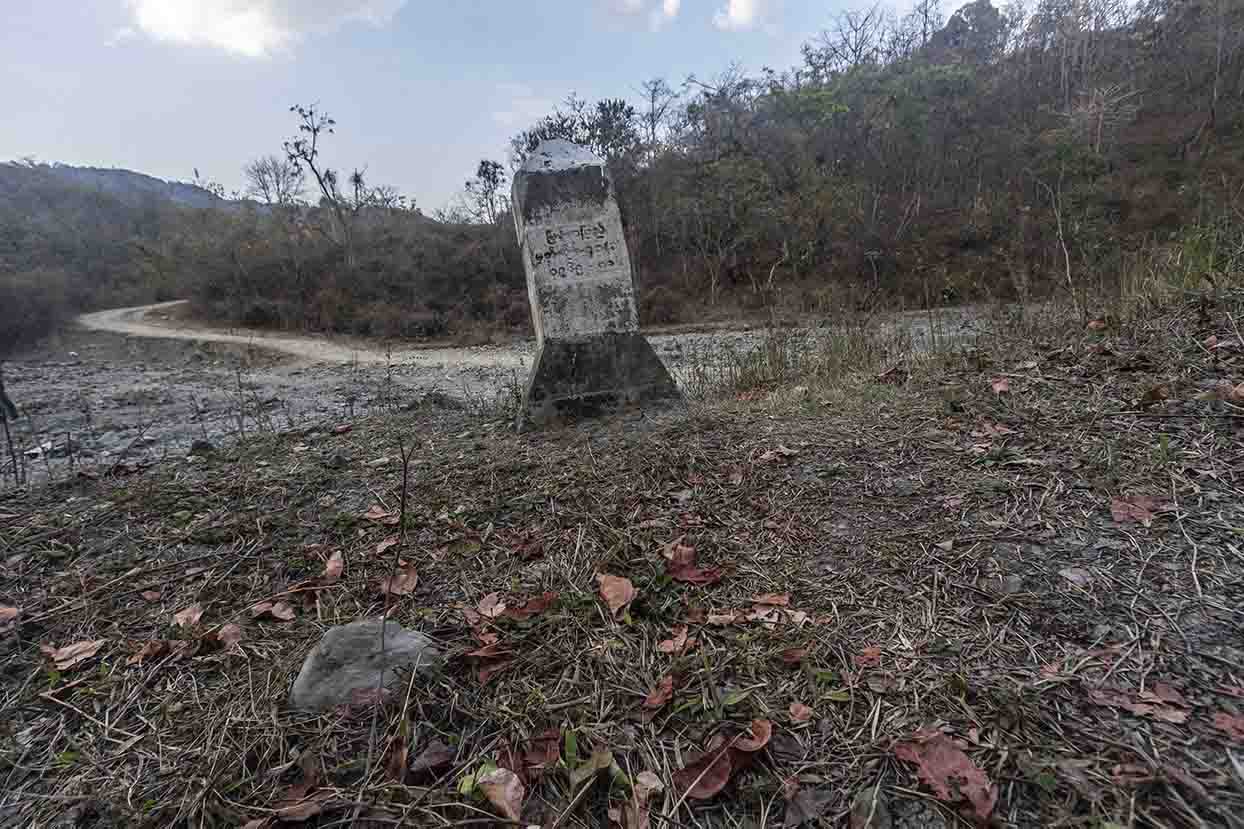
The anxiety in many Northeast states at the Centre’s move to fence the Indo-Myanmar border and also to do away with the free movement regime, FMR, for local populations is understandable. However, there can possibly no other way than for the communities to come to terms with the new reality of the modern Westphalian state.
We do however hope that even after the FMR is scrapped and the fencing is completed, these borders will still remain permeable and a system for easy movements of transborder communities is retained, but in an accounted way, not freely.
The reasons for the fencing policy are many. The foremost of these is the agonising civil strife in neighbouring Myanmar since the February 2021 military coup, and China’s growing influence in the country. India expectedly is uneasy especially of the latter development.
But there are also more fundamental reasons. The Westphalian model agreed upon in Europe was a means to get over an endemic conflict dynamic. As Mohammad Ayoob points out in his book on state-making and regional conflict, Europe signed the Westphalian treaties in 1648 after four centuries of bitter conflicts over overlaps in deemed sovereignties based on ethnicities and faith.
At its crux, the agreement decided national boundaries will be the sole determinant of sovereignty. Hence, any person, regardless of faith or ethnicity, if a legitimate domicile within a national boundary, will be entitled to citizenship of that state, and to all sovereign rights guaranteed by the state. This is the model of the state the postcolonial world inherited.
The state is also an institution run on taxes collected from its citizens, and this tax funds services which are extended back to the citizens. Open, unregulated borders would blur this relationship and the idea of citizenship itself. For then, who should the state tax and who can justifiably have the services and benefits run on this tax money?
As client states dependent on sizeable central government grants, most Northeast states tend to undermine or obfuscate his tax and citizens relations. This also often becomes the cause for dangerous frictions between different sections of people, and Manipur is a case in point.
It is true, as Lord Curzon pointed out in his post-retirement 1907 Romanes Lecture titled “Frontiers”, that the idea of precisely demarcated, delineated, and zealously guarded national boundaries were once unknown outside of Europe. Boundaries in the precolonial world were more frontiers, their extents waxing and waning depending on fluxes in powers of rulers of different feudal principalities.
Curzon implies that almost all modern boundaries in postcolonial nations came into being after the intervention of European colonisers. Most of these are artificially conceived, and only some qualify to be natural, marked as they are by natural geographical phenomena like mountain ridges, deserts, rivers or seas. Many of these boundaries have remained burdensome legacies for former colonies. The case of the McMahon Line between India and China in the Northeast sector is one evidence.
Jurist A.G. Noorani says as much with reference to another sector of this same border in his book India-China Boundary Problem: 1846-1947. When Kashmir came into British hands by default from the Sikhs who controlled the kingdom, after British victory in the First Sikh War 1846, the British had a boundary problem, and this problem was, he writes, Kashmir had no boundaries.
Expectedly, as Europeans unfamiliar with living without boundaries, the British immediately began boundary making exercises, sending out survey expeditions, even constituting two boundary commissions, but in the end left behind three different alignments corresponding to their varying strategic concerns at the time. India again continues to bear the brunt of this inherited uncertainty.
Given the proneness of irridentist nationalism often invoked by populist politics especially in border areas, and the consequent conflicts that tend to result between mobile and sedentary populations, even without the intervention of European colonialism, all states would have probably gravitated towards the Westphalian model, with borders marking sovereignty and a shared, secular, civic and constitutional identity as national identity.
We therefore do not need to invent the wheel again, and instead learn from Europe’s 400 years of conflict experience and get used to accepting the idea of the modern state which resolved that conflict.
The article was first published in The Telegraph. The original can be read HERE

Editor, Imphal Review of Arts and Politics and author