The evolving position of the Kuki-Zo Council (KZC) amidst the ongoing Naga-Kuki hostage crisis reveals a significant political recalibration within Manipur’s fractured conflict landscape. The latest appeals for the release of captives, the lifting of the social boycott against Kuki-Zo MLAs participating in the Manipur government, and the renewed insistence on a separate Union Territory with legislature dividing Manipur into three together indicate that the KZC is no longer functioning merely as a pressure group reacting to events. It is increasingly positioning itself as the central political authority attempting to consolidate the Kuki-Zo movement at a time when the community finds itself simultaneously confronting the Meiteis, the Nagas, internal contradictions, and growing public scrutiny over their armed groups operating in Kuki-Zomi-dominated areas.
The present hostage crisis is not merely an isolated communal confrontation. It has exposed the dangerous militarisation and fragmentation of authority that now characterise large parts of Manipur after the eruption of violent rupture of May 3, 2023 in Churachandpur from where Meiteis were cleansed by the Kuki-Zomi militants. The uncertainty surrounding the fate of six Nagas abducted after the May 13 ambushes has become politically explosive because the Kuki side officially denies holding them while Naga organisations and other released hostages insist that the missing individuals were never released. This dispute has created a moral and political crisis that directly affects the credibility of the Kuki-Zo leadership.
The KZC’s May 22 appeal for the handover of all hostages “whether alive or dead” is therefore politically revealing. The phrasing itself suggests an implicit recognition that some captives may no longer be alive. Such language would not ordinarily appear in a conventional peace appeal unless there existed serious apprehensions regarding custodial killings or enforced disappearances. In effect, the statement appears to acknowledge the gravity of the allegations without directly admitting culpability.
This becomes even more sensitive because a growing perception now exists among general public that the three Thadou church leaders killed in the May 13 ambush may have been targeted not by Naga armed groups but possibly by elements linked to Kuki-Zomi militant groups particularly the President faction of Kuki National Front – KNF(P). Although no conclusive evidence has been officially announced, the circulation of such suspicions has intensified political anxieties within the Kuki-Zo community itself. If the church leaders were indeed killed by factions operating within the broader Kuki-Zomi militant ecosystem, and if the six missing Nagas were subsequently executed, the implications would be devastating for the moral legitimacy of the Kuki-Zo political movement.
It is within this highly sensitive context that the political significance of Nemcha Kipgen assumes extraordinary importance. Nemcha Kipgen is not merely a BJP legislator from Kangpokpi Assembly Constituency or the Deputy Chief Minister in the government led by Chief Minister Yumnam Khemchand. She is also the wife of Thangboi Kipgen, President of the KNF(P) and Chairman of the United People’s Front (UPF), one of the two umbrella bodies representing several Kuki-Zomi militant groups under the Suspension of Operations (SoO) agreement with the Government of India and the Government of Manipur.
This intersection between constitutional authority and militant influence introduces a crucial dimension into the changing dynamics of the Manipur conflict. The convergence of electoral power, militant networks, and ethnic political mobilisation demonstrates how blurred the boundaries between state institutions, civil society leadership, and armed organisations have become in contemporary Manipur. In effect, the conflict is no longer operating through clearly separated domains of “state” and “non-state” actors. Instead, overlapping familial, political, militant, and ethnic relationships increasingly shape the functioning of power in Manipur.
The relevance of this connection becomes sharper amidst allegations surrounding KNF(P) and the hostage crisis. Even though no formal evidence has publicly established the involvement of KNF(P) cadres in either the killing of the church leaders or the disappearance of the six Nagas, the mere existence of these suspicions places enormous political pressure upon the Kuki-Zo leadership. Because the UPF itself remains a recognised negotiating entity under the SoO framework, any allegation involving one of its constituent groups carries implications not only for law and order but also for the legitimacy of the ongoing peace arrangements between the Government of India and Kuki-Zomi armed groups.
This creates a deeply paradoxical situation. On one hand, the Indian state continues to engage with SoO groups as stakeholders in political negotiations. On the other hand, the same militant ecosystem is increasingly accused by rival ethnic groups of involvement in kidnappings, territorial intimidation, and violent enforcement. The participation of Nemcha Kipgen in the Manipur government therefore symbolises more than ethnic representation. It reflects the emergence of a hybrid political order in which militant-linked influence and formal state power coexist within the same structure.
At the same time, the Kuki-Zo political project itself is internally far more fragmented than the nomenclature publicly suggests. The attempt by the KZC and allied organisations to politically consolidate diverse tribes under the broader “Kuki-Zo” identity has not been universally accepted. Significant resistance has emerged from Paite, Vaiphei, Hmar, Zomi, and even Thadou groups, many of whom fear that the umbrella nomenclature conceals unequal power relations and the domination of certain militant-political elites.
Several Paite, Vaiphei, and Hmar legislators and leaders have openly or indirectly expressed discomfort with the imposition of the “Kuki-Zo” identity framework. This resistance is politically important because the Kuki-Zo consolidation project depends fundamentally upon presenting a unified ethnic front before the Government of India and the international community. Any internal fragmentation weakens the claim that a single political aspiration uniformly represents all the tribes grouped under the proposed administrative arrangement.
The contradictions become even sharper because many of the dominant leaders within both the Kuki-Zo civil leadership and the Kuki-Zomi militant structures are themselves from the Thadou community. Yet even among the Thadous there is no complete consensus. A section of Thadou organisations and intellectuals rejects both the “Kuki” and “Kuki-Zo” nomenclatures, arguing that Thadou identity should not be subsumed under broader political constructs shaped by militant-era mobilisation and they believe in coexistence of different ethnic groups in Manipur. Thus, while the KZC attempts to project pan-ethnic unity, the social reality remains layered with competing tribal memories, identities, and political aspirations.
The participation of LM Khaute and Ngursanglur Sanate in the swearing-in ceremony of the new Manipur government further highlighted these underlying complexities. Khaute belongs to the Vaiphei community, which is often politically associated with the broader Zomi grouping, while Sanate belongs to the Hmar tribe. Their return to Imphal alongside Chief Minister Yumnam Khemchand after nearly three years of ethnic separation carried immense symbolic significance. It indicated that despite the continuing rhetoric of total political disengagement from the Manipur state, sections of the non-Thadou Kuki-Zo tribal leadership were prepared to reopen channels of constitutional participation.
There were widespread expectations within political circles that both Khaute and Sanate would be inducted as Cabinet ministers in the new government. Their exclusion from the initial Council of Ministers therefore became politically revealing. The absence of ministerial positions for the Paite, Vaiphei and Hmar representatives reinforced perceptions among some groups that power within the broader Kuki-Zo political space remains unevenly distributed and heavily influenced by dominant networks linked to Kangpokpi-based leadership structures and militant-political alignments.
This has broader implications for the future of the Kuki-Zo movement. The demand for a separate Union Territory with legislature requires not only external legitimacy but also internal coherence. Yet the movement increasingly contains multiple fault lines – between constitutional and militant actors; between tribes embracing and rejecting the Kuki-Zo nomenclature; between SoO-aligned power structures and ordinary civil society; and between competing tribal elites seeking representation within any future administrative arrangement.
The earlier social boycott imposed by the KZC on Kuki-Zo MLAs from participating in government formation must therefore be understood within this wider struggle for internal authority. The boycott was not simply about joining a “Meitei-dominated government.” It was also an attempt by the KZC to discipline divergent political actors and assert central control over the direction of the movement.
Yet the subsequent withdrawal of the boycott demonstrates political pragmatism overtaking absolutist positioning. Beyond the immediate security crisis and the need to prevent deeper fragmentation within the Kuki-Zo political space, the KZC also appears to have recognised the strategic importance of retaining the collective legislative leverage of all ten Kuki-Zo MLAs in the context of the impending lone Rajya Sabha election from Manipur due on June 18, 2026. Continued boycott and political disengagement would have risked reducing the bargaining power of the Kuki-Zo bloc at a crucial moment when every legislative vote carried heightened political value. The KZC likely realised that completely isolating legislators like Nemcha Kipgen, LM Khaute, and Ngursanglur Sanate, and preventing the participation of other Kuki-Zo MLAs in the new government, would not only deepen internal fractures but also diminish the community’s ability to negotiate political concessions within both state and national power structures. The reconciliation between the KZC and participating MLAs, and the subsequent relaxation of restrictions on wider legislative participation, therefore reflected an attempt to restore strategic unity between electoral actors, civil society organisations, church institutions, and militant-linked political structures while simultaneously preserving the collective political leverage of the Kuki-Zo bloc within Manipur’s shifting power equations.
This unity is particularly important because the Kuki-Zo political project increasingly depends upon coordinated pressure from multiple fronts – armed leverage under the SoO structure, constitutional participation through elected representatives, civil mobilisation through tribal bodies, and moral legitimacy through church institutions. The KZC appears to be attempting to integrate all these strands into a consolidated movement centred around the demand for separate administration.
However, this consolidation simultaneously generates serious contradictions.
The closer the association between elected leaders and militant-linked structures becomes, the more difficult it becomes for the Kuki-Zo movement to project itself purely as a democratic constitutional struggle. Rival groups, particularly the Nagas and Meiteis, increasingly expose the Kuki-Zo demand as backed by armed coercive power rather than solely by political grievance. The allegations surrounding the hostage crisis further reinforce these suspicions.
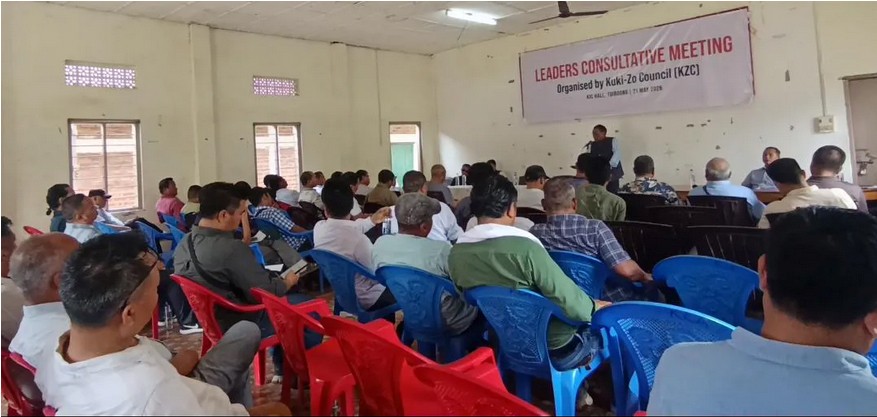
This explains why the KZC has moved rapidly toward a discourse of reconciliation, peace, and Christian brotherhood with the Nagas. The Churachandpur meeting involving tribal leaders, church organisations, chiefs, lawmakers, and civil society groups was not simply a humanitarian exercise. It was a political intervention designed to prevent a full-scale collapse of Naga-Kuki relations similar to the catastrophic ethnic clash of 1992–98. The invocation of Christianity and shared brotherhood reflects an attempt to revive a moral framework capable of restraining retaliatory mobilisation and insulating the broader Kuki-Zo political movement from being delegitimised by the actions of militant actors.
However, beneath this language of reconciliation lies a deeper strategic concern. Since May 2023, the Kuki-Zo political project has increasingly depended on the consolidation of a unified territorial and administrative demand centred around separation from Manipur. That project initially derived its strength from the Meitei-Kuki conflict. And now, they are confronted both by the Nagas and Meiteis.
The KZC’s recent memorandum to Prime Minister Narendra Modi frames the Kuki-Zo community as facing “existential threats from multiple sides” and argues that separation has become an “unavoidable necessity.” Yet the more the Kuki-Zo movement attempts to present itself as a singular collective identity, the more visible its internal contradictions become.
The current crisis therefore reveals not only the fragmentation of Manipur but also the unresolved contradictions within the Kuki-Zo political project itself. The movement today stands simultaneously strengthened and weakened – strengthened by the consolidation of militant, constitutional, and civil society networks around the demand for separate administration; weakened by unresolved tribal tensions, contested nomenclatures, unequal power distribution, and growing allegations surrounding armed actors operating under the SoO framework.
Whether the Kuki-Zo Council’s recalibration leads toward negotiated coexistence or irreversible ethnic partition will depend on three decisive and unresolved questions – whether the truth regarding the six Naga hostages is ever fully established; whether armed groups can genuinely be restrained despite their growing integration into formal political and administrative structures; and whether any credible neutral state mechanism still survives to rebuild inter-community trust in Manipur before the state’s deepening ethnic fractures harden into permanent territorial and political realities.

Senior Editor: Imphal Review of Arts and Politics