
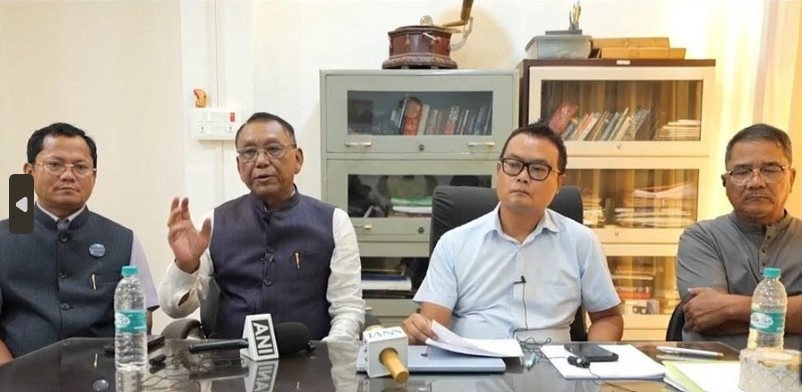
The events of May and June 2026 cannot be understood simply as another tragic episode in Manipur’s continuing violence. They represent a critical inflection point because they expose a fundamental shift in the character of the conflict itself. Since May 2023, the conflict has been sustained not only by armed confrontation but also by competing political narratives. Every incident has generated rival versions of events, with each side seeking to establish moral legitimacy while contesting the claims of the other. For more than three years, these competing narratives have significantly influenced public discourse, often preceding and, at times, overshadowing independent investigations or concealing the truth.
The Kuki-Zo Council’s admission altered that dynamic.
The significance of the confession lies less in its acknowledgment of an already established tragedy than in the fact that it became increasingly difficult to sustain the previous narrative in the face of accumulating evidence, public outrage and institutional scrutiny. In that sense, June 2026 may represent the point at which the politics of narrative began to yield, however imperfectly, to the politics of accountability.
This transition did not occur overnight. It resulted from the convergence of several developments, each reinforcing the other until continued denial became politically more costly than limited admission.
The first factor was the recovery of the bodies themselves.
Before June 11, uncertainty still surrounded the fate of the six abducted Liangmai Nagas. Families hoped that negotiations might yet secure their release, just as they had for other hostages. Once security forces recovered the decomposed and mutilated bodies, however, the issue changed fundamentally. The question was no longer whether the hostages remained alive but who had abducted, detained and ultimately killed them.
Physical evidence carries a political authority that speculation cannot. The recovery of the bodies transformed the discussion from competing allegations into a criminal matter requiring investigation. It also created a powerful moral reaction across communities because the victims were not combatants killed in an armed encounter but civilians who had been abducted and never returned.
The second factor was the humanitarian contrast created by the release of the remaining Kuki detainees.
On June 10, the United Naga Council (UNC) and the Naga People’s Organisation (NPO), together with church leaders and other intermediaries, facilitated the release of the remaining fourteen Kuki detainees. That act was widely interpreted as an effort to prevent the hostage crisis from escalating into a broader Kuki-Naga conflict.
The discovery of the six Naga bodies the very next day inevitably reshaped public perception.
Whatever the competing narratives surrounding the original violence of May 13, 2026, the sequence of events now presented a stark moral asymmetry. One group of hostages had been returned alive through appeal and negotiation. The other had been executed while still in captivity.
This distinction proved politically significant because it shifted public debate away from competing claims regarding who initiated the violence and towards the treatment of civilians after they had already fallen into captivity. In conflicts marked by deep historical and structural grievances, such moments often become defining symbols that influence public memory for years to come.
A third factor was the growing pressure generated by independent investigation and security operations.
The involvement of the National Investigation Agency (NIA) in investigating the killing of the three Thadou church leaders demonstrated that the events of May 13 had acquired national significance. Although the NIA’s mandate concerned the ambush itself, the sequence of events inevitably drew greater attention to the subsequent hostage crisis and the killing of the six Nagas.
Independent criminal investigations operate according to standards fundamentally different from political discourse. Public statements may influence opinion, but forensic evidence, witness testimony, digital records and material evidence ultimately determine criminal responsibility. As investigative processes advance, the space available for contradictory public narratives gradually narrows.
Whether or not the KZC’s admission was directly influenced by investigative developments cannot be established from the public record alone. Nevertheless, it is reasonable to observe that the prospect of more intensive investigation increased the political risks associated with maintaining categorical denials.
And the security forces were compelled to conduct search operations due to mounting pressures from the Naga and Meitei CSOs.
The fourth factor concerns the wider political consequences for the “Kuki-Zo” movement itself.
Since the outbreak of the conflict in May 2023, the political demands advanced by Kuki-Zo organisations have centred on questions of security, constitutional arrangements and administrative reorganisation. Achieving these objectives has required maintaining political legitimacy both domestically and internationally.
The barbaric killing of six abducted civilians complicated that effort.
Regardless of competing interpretations of the broader conflict, incidents involving hostages occupy a particularly sensitive place in international humanitarian law and human rights discourse. They attract attention not merely because lives are lost but because the victims have been deprived of liberty before being killed. Such cases inevitably raise questions regarding command responsibility, organisational accountability and the protection of civilians during conflict.
For any political movement seeking wider recognition or legitimacy, such incidents carry significant reputational consequences.
The KZC’s admission may therefore also be understood as an attempt to contain broader political damage. By describing the killings as a “great mistake” committed in an “outburst of emotion,” the Council appeared to acknowledge the crime while simultaneously portraying it as an exceptional act rather than the product of organisational policy.
Whether that explanation withstands legal scrutiny is for investigators to determine. Politically, however, the language reflects an effort to separate the actions of particular individuals from the legitimacy of the wider movement.
A fifth and equally important factor concerns Kuki-Naga relations.
The ongoing conflict since 2023 has primarily been understood as a confrontation between sections of the Meitei and Kuki-Zomi communities. Although Nagas have inevitably been affected by the broader instability, they have not constituted one of the principal parties to the conflict in the same manner until February 2026.
The hostage crisis threatened to deepen the Naga-Kuki tension which became violent since February 2026.
Historical memory weighs heavily in the hill districts of Manipur. The violence between Nagas and Kukis during the 1990s left enduring scars that neither community has entirely forgotten. The execution of six Liangmai Nagas therefore has added salts to the wounds that decades of reconciliation efforts had sought to heal.
The release of the remaining Kuki detainees by Naga organisations demonstrated a conscious attempt to prevent such an escalation. Once the six Naga bodies were recovered, however, that effort was overshadowed by outrage and demands for justice.
The KZC’s admission can thus also be viewed as an attempt to prevent the complete collapse of Kuki-Naga relations being Christians.
Yet the confession itself exposed another, deeper reality.
For more than six weeks, influential Kuki organisations both armed militants and civil society had categorically denied involvement in the killings. Once the KZC acknowledged that members of their community were responsible, unavoidable questions arose regarding the earlier denials.
Were those denials based upon incomplete information?
Did different organisations possess different levels of knowledge?
Or had political considerations outweighed transparency while uncertainty remained?
These questions though seem simple matter because public trust depends not only upon eventual admissions but also upon the credibility of earlier statements. Once inconsistencies emerge, confidence in future public declarations inevitably weakens.
This may ultimately prove to be one of the most enduring consequences of the June 25 confession.
For three years, the Manipur conflict has been characterised by competing narratives, each seeking to establish its own version of legitimacy. The KZC’s admission demonstrates that narratives cannot indefinitely substitute for evidence. At some point, physical facts, criminal investigation and public scrutiny begin to impose constraints that political messaging alone cannot overcome.
That does not mean the politics of narrative has disappeared. It remains central to the conflict and will undoubtedly continue to shape public debate. Even the confession may be part of the politics of narrative.
It does suggest, however, that a gradual transition may be underway.
As investigations proceed and demands for accountability intensify, the conflict is increasingly moving into a phase in which constitutional institutions, legal processes and evidentiary standards will play a larger role in determining public understanding than competing political declarations alone.
Whether that transition succeeds depends on one fundamental question.
Will the institutions of the Indian State demonstrate that accountability applies equally to every individual and every armed actor, irrespective of community or political affiliation?
The answer to that question will shape not only the future of this investigation but also the credibility of constitutional governance in Manipur itself.
In summary, the recovery of six Liangmai Naga civilians from a forest in Kangpokpi and the subsequent confession by the Kuki-Zo Council mark a moment when one political narrative collided with evidence that could no longer be denied. Whether that moment becomes the beginning of genuine accountability or merely another episode of managed political damage will depend not upon the statements of community organisations but upon the resolve of constitutional institutions. Justice delivered impartially is not only the foundation of criminal law; in a fractured society, it is also the foundation of reconciliation. If the Indian State demonstrates that every life carries equal constitutional value, the tragedy of June 2026 may yet become a turning point towards peace. If it fails, the confession will be remembered not as the end of denial but as another reminder of how fragile the rule of law has become in Manipur.

Senior Editor: Imphal Review of Arts and Politics




1 thought on “The End of Denial: How the Kuki-Zo Council’s Confession Reshaped the Politics of the Manipur Conflict”
I’m reminded of how the 1997 abduction and murder of renowned social activist Sanjoy Ghose marked the beginning of the end for the United Liberation Front of Asom (ULFA), and perhaps changed the public perceptions and idea of Asom forever. Curiously, this insightful view of the editor, mentions something buried within it. To wit, “the security forces were compelled to conduct search operations due to mounting pressures from the Naga and Meitei CSOs.” The conclusion that compulsion due to public pressures to conduct a constitutional duty of the state’s forces deeply involved in ‘law and order’s, has deep significance. As an observer, who has personal, cultural and historical close links with members of most of the communities of Manipur, the tidal change in public, street and household conversations and discourse, if one may call it so, is palpably disturbing the usual hate-ridden trajectories. On another disturbing note, very little, if at all, is being said of the rooted involvement of the Christian Church or bewilderingly myriad churches operating in this small territory of Bharat. “Christian peace-building” and suchlike are religiously strewn across the tables where efforts and ideas are discussed or negotiated. Christian conflict-building is oft buried. It starts small, at the family and village levels, steered by institutionalised deep state, conducted as long-term visions and strategy, with military precision. Arguably, the same can be said of all churches established by every modern religion. One murder, far away, two millennia ago, is still shaping the shit we’re in today.
Comments are closed.