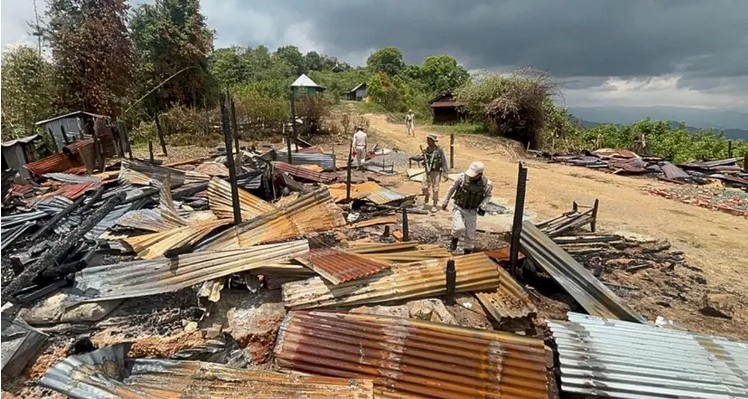

The arrest of one United States national, Matthew Aaron VanDyke, and six Ukrainian citizens – Hurba Petro, Slyviak Taras, Ivan Sukmanovskyi, Stefankiv Marian, Honcharuk Maksim, and Kaminskyi Viktor – by the National Investigation Agency (NIA) for entering Mizoram illegally and crossing into Myanmar to train ethnic armed groups has added a deeply consequential layer to the already complex discourse surrounding the Manipur crisis. What might have remained a peripheral security development has instead intersected sharply with one of the most disturbing episodes of the conflict – the drone bombings on civilian areas in Koutruk and Kadangband villages in Imphal West on September 1, 2024, which killed a 31-year-old woman and injured her eight-year-old daughter and a journalist, among many others.
This convergence – between allegations of foreign training in drone warfare and the actual deployment of drones in Manipur – demands a more rigorous reassessment of competing narratives about the crisis that erupted on May 3, 2023. It is no longer sufficient to view the conflict solely through binaries of ethnic hostility or state complicity. The technological escalation represented by drone attacks forces us to confront the possibility that the very nature of violence in Manipur has undergone a qualitative transformation.
The attack on Koutruk and Kadangband villages was not merely another episode in a cycle of retaliatory violence; it marked a decisive shift in the character of the conflict. Reports indicated that explosives were dropped using drones from hill ranges in Kangpokpi district –areas widely understood to be under the influence of Kuki-Zomi militant groups – targeting civilian settlements in the peripheries of Imphal valley. This was unprecedented in Manipur’s long history of insurgency. Even during decades of insurgent movements, the use of aerial or drone-based attacks on civilian targets was virtually absent. The Koutruk and Kadangband incident therefore stands out not only for its brutality but also for its technological sophistication.
Drone warfare fundamentally alters the logic of conflict. It enables attackers to strike from a distance without direct engagement, minimise risk to operatives, target civilian or strategic locations with relative precision, and generate psychological terror disproportionate to the scale of the attack. In this sense, the Koutruk and Kadangband bombings become a critical empirical anchor for evaluating claims about tactical evolution, external training, and the diffusion of warfare techniques from neighbouring conflict zones such as Myanmar.
The allegations emerging from the National Investigation Agency investigation acquire particular significance in this context. The arrested individuals are suspected of providing training in weapons handling and drone warfare to ethnic armed groups in Myanmar, while also facilitating the movement of drone consignments from Europe into conflict zones. This raises an unavoidable question: is there a connection – direct or indirect – between such training networks and the drone attacks witnessed in Koutruk and Kadangband?
At a minimum, the parallel is difficult to ignore. Myanmar’s ongoing civil war has already seen the increasing use of drones by resistance forces against the military junta. If foreign nationals were indeed involved in training these groups in advanced drone operations, it is plausible that such knowledge could travel across the porous India–Myanmar border through existing ethnic and militant linkages. The Kuki-Chin-Zomi continuum – spanning Manipur, Mizoram, Myanmar’s Chin State, and parts of Sagaing – provides precisely such a conduit. Even in the absence of direct evidence linking the individuals arrested by the National Investigation Agency to the Koutruk and Kadangband attacks, the structural conditions for knowledge transfer are clearly present.
At the same time, investigative findings have also indicated that the drones and accessories used in the attack were procured locally, reportedly sourced from suppliers in Delhi and Rohtak by a key suspect identified as Khaigoulen Kipgen. The fact that such technologies could be assembled and deployed locally underscores an important point: external training and local procurement are not mutually exclusive. Rather, they may operate in tandem –external inputs providing knowledge and tactics, while local networks ensure logistical execution.
This brings us to the first major narrative that has shaped public discourse – that Kuki-Zomi militant groups pursued a deliberate strategy to drive out Meiteis from hill areas to create an exclusive territorial entity. The Koutruk and Kadangband drone bombings undeniably strengthen one aspect of this narrative – that these groups have developed offensive capabilities that go beyond defensive mobilisation. The use of drones suggests a level of planning and coordination beyond spontaneous violence, access to technical expertise, and an apparent willingness to expand the theatre of conflict from the hills and foothills into the valley.
When read alongside the NIA’s findings regarding foreign training in drone warfare, the argument that Kuki-Zomi militant groups possess enhanced operational capabilities gains credibility. However, caution remains essential. Enhanced capability does not automatically translate into a coherent political project of ethnic cleansing aimed at territorial reorganisation. The Koutruk and Kadangband attacks, while indicative of offensive intent and technological advancement, do not by themselves establish a structured blueprint such as Zalengam or Kukiland. What they do establish is that the conflict has entered a phase where asymmetric technologies are being deployed against civilian populations, dramatically raising the stakes.
The second major narrative – that the crisis was engineered by the Government of India (GOI), possibly through its handling of Suspension of Operations (SoO) agreements with Kuki-Zomi militant groups, to suppress Manipur insurgency led by Meiteis for restoration its sovereignty – also requires re-examination in light of these developments. The use of drones introduces a layer of complexity that challenges simplistic assertions of state orchestration. If such attacks are indeed being carried out by non-state actors with evolving technological capabilities, it suggests the presence of autonomous dynamics that are not easily reducible to a centrally controlled strategy.
At the same time, the Koutruk and Kadangband incidents raise uncomfortable questions that cannot be ignored. Is the state complicit, negligent, or simply overwhelmed? Were there intelligence warnings regarding the acquisition or use of drones? How did such technologies circulate within the region? Why was there no effective deterrence against escalation to aerial attacks on civilians? These questions shift the focus from conspiracy to capacity – from the idea of deliberate design to the reality of potential institutional failure.
Thus, rather than reinforcing the notion of a “state-engineered crisis,” the convergence of the drone attacks and the NIA arrests points more convincingly toward a troubling possibility – that the Indian state was unprepared for the rapid technological evolution of violence in the region and has struggled to respond effectively though the possibility of exploiting the Kuki-Zomi militants by GOI to suppress the Manipur insurgency cannot be ruled out flatly.
The broader regional context further complicates the picture. Myanmar’s civil war has become a laboratory for new forms of insurgent warfare, including improvised drone strikes, decentralised command structures, and hybrid tactics that combine guerrilla methods with technological innovation. If foreign trainers – such as those now under investigation by the National Investigation Agency – have contributed to this evolution, the risk of spillover into India’s Northeast particularly Manipur becomes significant. The Koutruk and Kadangband attacks may well represent one of the earliest manifestations of this spillover.
What emerges from integrating these developments is the inadequacy of binary explanations. The Manipur crisis cannot be fully understood as either a unilateral project of militant expansion or a centrally orchestrated state strategy. It is, instead, a multi-layered conflict shaped by political structures, internal ethnic and territorial disputes, cross-border militant ecosystems, technological diffusion from neighbouring war zones, and the growing role of transnational actors, including foreign individuals.
The drone attacks serve as a stark reminder that the conflict is evolving faster than the narratives attempting to explain it. They mark a turning point not just in tactics but in the very nature of violence. Warfare has shifted from direct clashes to remote strikes, from combatant-focused engagements to civilian targeting, and from visible confrontation to invisible threat. When such a transformation coincides with allegations of foreign training in advanced warfare techniques, the implications are profound and immediate.
The arrests by the National Investigation Agency and the drone bombings at Koutruk and Kadangband are therefore not isolated developments. Together, they compel a fundamental rethinking of the Manipur crisis. They suggest that external actors may be contributing to the technological escalation of the conflict, that militant capabilities in the region are evolving in ways that demand urgent attention, and that the state’s response mechanisms must adapt to a rapidly changing security paradigm.
Yet, they do not provide definitive answers to the competing narratives that dominate public discourse. Instead, they push us toward a more complex but necessary conclusion: that the truth of the Manipur crisis lies not in singular explanations, but in the intersection of multiple, overlapping realities.
To ignore the foreign angle would be a strategic mistake. To reduce the crisis to it would be an even greater one. The challenge lies in confronting both the internal and external dimensions of the conflict with equal clarity – before the next Koutruk and Kadangband becomes not an exception, but a pattern.

Senior Editor: Imphal Review of Arts and Politics