
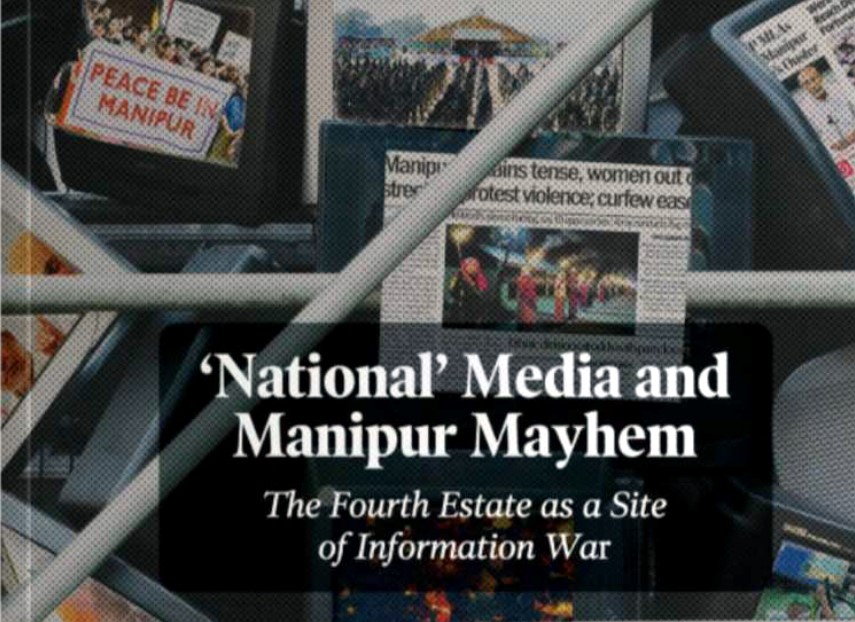
Dr. Damudor Arambam’s essay, “Media, Majority, and Manufactured Silence in Manipur” (Imphal Review of Arts and Politics, August 23, 2025), sharply critiques how the media has shaped the conflict in Manipur. His concern that the media environment has narrowed into a single valley-centric narrative is valid and urgent. At the same time, his framing risks overstating the power of media while underplaying the more exhaustive political and social breakdown. This reply accepts some of his concepts, but also questions the limits of his conclusions.
Dr Arambam asserts that the sprouting of channels and online platforms has not led to diversity but uniformity. Though all of this is an accurate claim, implying that the valley story is the only reason we are silent is disingenuous. As Hannah Arendt reminds us in Truth and Politics (1967), “Truth, though powerless and always defeated in a head-on clash with the powers that be, possesses a strength of its own.” In other words, truth has not disappeared in Manipur, nor has it been thoroughly crushed by the majority media. What has failed is not only plurality in the press, but the broader political and civic procedures that should have guaranteed spaces for debate.
The phrase “manufactured silence” is powerful, but also risks simplification. Silence in Manipur is not manufactured only by majority-controlled narratives. It is also produced by fear, retaliation, lack of trust, and the impossibility of safe communication across divided geographies. To locate the problem almost entirely in the valley media is to miss how silence grows equally from violence on the ground and the unwillingness of all sides to listen.
Here, Dr. Arambam’s argument could have gone further. As Noam Chomsky and Edward Herman argue in Manufacturing Consent (1988), the media can shape consent through selective reporting. Yet in Manipur, the dynamics are different. Local journalists are not corporate actors with national reach. They are often community members working in conditions where neutrality can cost them their lives. In this sense, the silence is not simply manufactured but enforced by survival.
Dr. Arambam rightly laments the failure of the media to foster plurality. However, treating the valley narrative as a single monolithic block is inaccurate. At the same time as valley-based outlets repeat specific fears, there are equally strong hill-based platforms circulating their own narratives
on social media. The real problem is not just uniformity, but fragmentation. As Jürgen Habermas explains in The Structural Transformation of the Public Sphere (1962), democracy requires a shared space of rational debate. In Manipur today, there is no such shared space. There are only parallel monologues.
Dr. Arambam is correct in warning that erasure of dissent threatens democracy. However, to imply that the media itself is the central architect of this erasure is to let politics and governance off the hook. Political leaders allowed internet bans to cut citizens off from independent reporting. It is the failure of state institutions that left journalists without protection. And it is society itself that has normalised suspicion between communities. The media did not create these fractures; it reflects and sometimes reinforces them.
The way forward requires a more balanced diagnosis. Yes, the media in Manipur has too often echoed the majority’s fears and marginalised minority voices. But equally, the silence also comes from journalists lacking access, security, and trust. Suppose we hold the media solely responsible, as Dr. Arambam suggests. In that case, we reduce a complex crisis to a one-dimensional blame game.
As Arendt reminds us, truth always carries a fragile strength, however much it may be covered up. Manipur’s challenge is not just to reveal manufactured silence but to recreate a public domain where multiple truths can be envisaged. This includes critical journalism, institutional reform, a renewal of dialogue culture and political accountability.
Dr. Arambam’s piece points out the risks of a media environment controlled by one perspective. Yet, in accusing the media of “a manufactured silence,” he risks exaggerating the media’s role and underestimating the deep structural collapse of politics and trust that drives such silence. Blaming and shaming the media is easy, but it’s not the only one at fault. To progress, Manipur has to face
both bias in its press and the deeper shortcomings of its political and social order.

The writer is an independent researcher