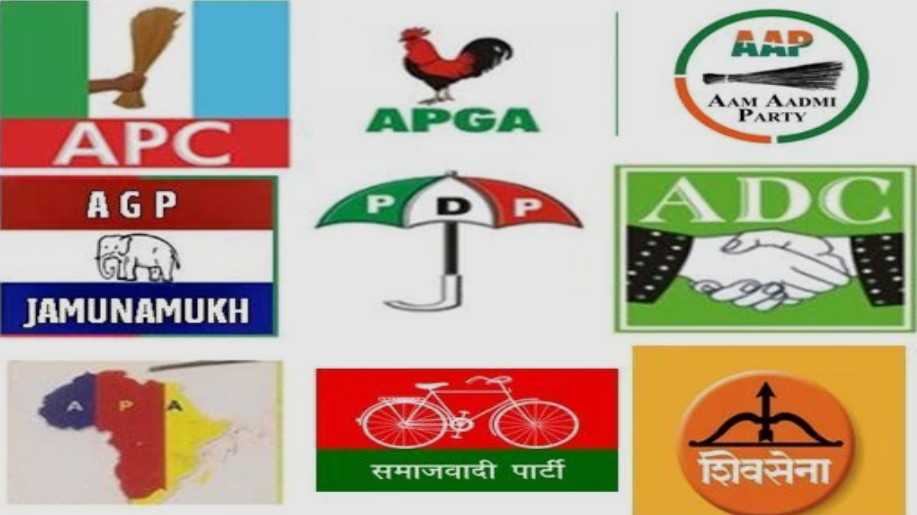
Since the dawn of modern democracy, political parties have played an instrumental role in maintaining democratic mechanisms and keeping political systems in motion. But how and why did they exist, and what fate awaits them? A political party is a well-organised group of people who share political views, values, objectives and seek to acquire and use power to carry out their agendas through governance.
Before examining their fate, it is better to understand how political parties differ from the general public and civil society. A political party serves as a forum where people interested in politics work together to achieve common goals and make their voices heard. It exists to gain or influence authority through elections, policymaking, and lobbying, and its members are meant to be active in shaping how a political system works. Though the general public may share views on social or political issues, it is usually uncoordinated, scattered, and unorganised, tending to remain unaffiliated, independent, or loosely aligned with any party; it does not function within a particular structure or discipline. Meanwhile, civil society, though organised, tends to carry out public-oriented roles, such as influencing public discourse or policy, without seeking political power, and operates independently of the state or parties, at least in principle.
Numerous political parties have experienced disintegration or self-destruction throughout contemporary democracies. Antonio Gramsci, in his Prison Notebooks, observed that the crisis “consists precisely in the fact that the old is dying and the new cannot be born; in this interregnum a great variety of morbid symptoms appear.” After decades of domination, Christian Democracy in Italy disbanded in 1994, and its members either joined Forza Italia or founded the Christian Democratic Centre. Following the dissolution of the Union of the Democratic Centre in post-Franco Spain, a small group of people founded the Democratic and Social Centre. Political parties in post-independence India, both national and regional, are no exception. The reasons for their fragmentation or dissolution are not merely external but are rooted in ideological contradictions and personal ambitions within. These obstruct the continuation of a party and divert it from its core purpose unless the contradictions are properly handled. In one of the worst-case scenarios, mechanical dogmatism could emerge, weakening the party’s ideological integrity and ultimately leading to its end as a single entity.
However, it is an opportunity for a party to continue moving forward if the primary contradictions are addressed through criticism, including self-criticism. The ultimate challenge lies in establishing the platform for this ideological process. Only the party’s rejection of opportunism and adventurism can create the conditions for these contradictions to be resolved. Elements whose actions corrode the party’s integrity should be met with a political remedy that challenges reckless narcissists, polemicists, and dogmatists. The key to initiating this process is to understand the two aspects and the particularity of each contradiction, and to identify the principal contradiction and the principal aspects of a contradiction at different stages in the process of development.
The internal life of a political party rarely receives attention in contemporary intellectual discourse; instead, the focus is often mechanically fixed on its public image. As Edmund Burke wrote in Thoughts on the Cause of the Present Discontents, a political party is “a body of men united for promoting by their joint endeavours the national interest, upon some particular principle in which they are all agreed.” Among the contradictions within a party at different stages in the of development, the contradiction between unity and struggle emerges as the principal one, particularly during internal debates on line or strategy in peacetime. During such periods, two aspects arise from this contradiction: ideological unity and ideological struggle, with one dominating the other depending on the specific context and becoming the principal aspect of the contradiction. The principal aspect is not static, and it is better that it remains dynamic.
Ideological unity becomes the principal aspect of the principal contradiction when the party needs to carry out concrete action, coordinated decision-making, and build a unified struggle, often at the expense of dissent, innovation, and adaptation. If these are heavily suppressed, the tendency toward mechanical dogmatism and vulgar evolutionism comes into full play.
However, ideological struggle takes precedence when the party must resolve confusion and correct its strategies for survival, though this may come at the cost of disintegration, factionalism, paralysis, and external interference. This contradiction, like all other principal contradictions at different stages in the process of development, must be handled correctly before it intensifies.
At different stages of his revolutionary journey, Sun Yat-sen addressed particular contradictions in his Three Stages of Revolution. The contradiction between democratic constitutionalism and Yuan Shikai’s growing authoritarianism and warlordism was handled in the first stage, Military Rule. The second stage, Political Tutelage, was meant to respond to the contradiction between traditionalism and democratic modernity, though Sun never saw it fulfilled, as he passed away before its success.
It was Chiang Kai-shek’s adventurism and failure to identify the principal contradiction and its principal aspect at a later stage in the process of development that caused the second stage to miss its purpose, ultimately sealing the fate of the Kuomintang. Thus, the contradiction and the method for handling it require careful attention, as the contradiction remains in motion.
A political party is not an automatic machine but a living organism fuelled by ideological metabolism, which itself contains elements of fragmentation and degradation if not properly handled. To understand the development of a thing, that is, the motion which is the essence of all things in the universe, including a political party as a living organism, understanding the historical context is key. This is not to cling to history, but to uncover the nature of its origin and the manner of its historical interpretation, interaction, and resolution at different stages in the process. Whether it is judged as rational or not, culture, tradition, religion, and identity play a crucial role. In fact, the development of a thing, that is, motion as the essence of everything, including the political party, is not a rectilinear progression. In this nonrectilinear struggle, the very survival of a political party is determined. It is not external pressure that destroys a party, but its inability to handle contradictions and respond appropriately.

The writer passed out from the Centre for French and Francophone Studies Jawaharlal Nehru University