The racial slurs against Arunachali girls in Delhi, or the murder of Anjel Chakma in Dehradun has forced us to remind that racism and racial violence against Northeastern people in this country is as Indian as Ganga and its great plains. Intermittently, we have to experience the haunting ritual of a mongoloid person facing violence either because of his/her identity or assertion of equal rights against mainland Indians. It has also brought us to a torrent of constant reminder that despite being an Indian; we will be judged through our race while trying to prove our loyalty as Indian. Curiously, seeking this validation of “we are Indians”, and thus, must be treated equally by all Indians reeks of dangerous logic and overlook the reality.
Such argument presupposes that having a formal equal right as citizens will protect his rights, life and dignity. However, in a society where “Indianness” is dominantly perpetuated, seen and understood from a mainland perspective; such claim of being Indian through equal citizenship is disturbing. First, it places a burden on individuals from the northeast having to prove their sameness rather than assert the right to be different. Secondly, it indirectly frames the notion that racial discrimination against non-Indian like a Chinese or a black person is acceptable. Significantly, people from the Northeast have unconsciously absorbed this notion. Anjel Chakma’s assertion before his death that, “I am an Indian” and thus have equal rights as citizens sadly failed to protect his life. In tandem, the amplification of “we are all Indians” in racial discrimination discourse has been used to hide the racial lens in tackling racial violence against Northeastern people.
Such discourse leads to a sly deflection of racial discriminations faced by Northeast people to some unruly individual actions, shielding institutions’ failure. This lack of institutional mechanism to address racism, entwined with everyday subtle racial prejudices fester continuity of racial experiences. “Harmless” remarks on looks and eating habits, blasting racial epithets and laughing among themselves to a northeastern person might be seen as an uncouth individual behaviour. However, such everyday racial experiences create dysphoric emotions, which Cathy Park Hong describes as “minor feelings”. While narrating racism endured by Korean American in the USA she writes, “minor feelings are not generated from major change but from the lack of change, in particular, structural racial and economic change.” She further extends the experience of this “minor feelings” to the “trauma of a racist capitalist’s system that keeps the individual in place.” This structural relation between racism and institution is more profoundly expressed by James Baldwin. He said, “I don’t know how most white people in this country feel, but I can only conclude what they feel from the state of their institution.”
For a sincere discourse on racism, any debate and discussion without scrutinising structural and institutional conditions will only serve it half-heartedly. As a case in point: India missed a momentous opportunity when Bezbaruah Committee in 2014 recommended the government of India to tackle racial violence against Northeast people by enacting a separate law, among others. Despite the Constitution of India clearly prohibiting discrimination against citizens based on religion, race, caste, etc. (Article 15) while also underlining “equality before law” (Article 14), we evidenced a strategic silence from the government. Whatever the discomfort New Delhi feels, but any action addressing racism is insufficient till structural issues are addressed. This is established in anti-discrimination jurisprudence as “disparate impact”. Simply speaking, it acknowledges that inequality and discrimination results because of structures and institutions, but not of individual hostile acts.
Reminding again, Bezbaruah committee was constituted by the government of India because of massive outraged by the northeastern communities in Delhi after the murder of Nido Tania. Like Capulet spurning the Montagues, racial debates had become a scene of denial, where the mainstream rejected Northeastern claims of racism. Most devious argument presented was that “all communities face discrimination of some kind, and what we experience is regionalism rather than racism”. Such equivocation eschews the fact that the discrimination of the Northeastern people in metropolitan cities in mainland India is “unique because difference is couched almost exclusively as race rather than other fissures such as language, caste, religion etc.”
Because of intense pressure, some suggestions for awareness and administrative mechanisms were put in place, especially in Delhi. However, till date, we have not seen any specific legal measures by the government. Instead, we see a timid introduction of section 103(2) of BNS in 2023 which provides severe punishment for murder based on victim’s identity- like religion, race, caste etc. As opposed to the Committee’s recommendation, it clubbed all the causes of murder, while specifically increasing the sentence for murder related to religion, race, caste etc. This clubbing alludes to the long-held denial by the mainstream on the existence of racism and racial violence by overlooking a different lived experience of the Northeast people in the mainland. Acknowledging this, the committee had insisted on bringing legal reform that recognizes such experience by introducing a separate legal mechanism.
The mainstream debate on racism is largely limited to experiences of Northeast people in metropolitan cities in India. Such debate confines the issue of racism to the question of citizenship and their associated rights, while ignoring the role of hierarchical institutional relationship between mainland and northeast India. Scholars from the Northeast and experts on borderland studies have been pointing to various structural and legal mechanisms which may implicate racism to the functioning of state and its institutions.
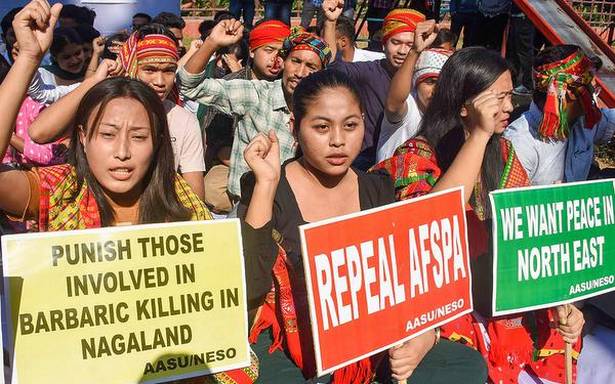
Duncan McDuie-Ra argues that the creation of the category “Northeast” for administrative convenience to control and govern rebellious eastern frontier has led to the homogenisation of a heterogenous group of people to a particular racial category. Though this has created solidarity among various groups of people from the Northeast in the mainland; but it also heightened the association of their identity to a mere racial stock. Further, the absolute reliance on security perspective in governing the region and providing constitutional protection to extraordinary law has led to the othering of Northeast people. Drawing from history and analysis of the nature of Indian state and AFSPA in the region, Bimol Akoijam claims that when violence emanates itself from the law (including institutions), this safety net of citizenship seeking justice falls flat. This is further complicated by the process of making the Indian nation state in the region. By carving a “space of exception” in the region through AFSPA, this process of “inclusion by exclusion” has further reinforced the notion of “other” in the region and within New Delhi. All this function within a backdrop of hierarchical relationship where the region remains underdeveloped and relies on grants from Delhi for its survival. This ensures a migration of Northeastern people to metropolitan cities. Deepak Kumar connects this racialisation of Northeastern people to a phenomenon of “socio-spatial process driven by neoliberal urban policies, state practices, and migrant self-identification, rather than mere biological racism or static ethnic differences”.
It is time that India acknowledges that racism exist and Indian reality demands that it must be addressed at institutional levels, rather than deflecting it to an unwanted individual incident.
References:
- Bimol Akoijam, “Violence of Law and Citizenship: Conundrum of Democracy under Nationalist Ethos” in Surinder Jodhka, (ed) Interrogating India’s Modernity: Democracy, Identity, and Citizenship,
- Cathy Park Hong, Minor Feelings.
- Duncan McDuie-Ra, Debating race in contemporary India,
- Deepak Kumar, “Racialization of Northeastern people in Indian Metropolitan Cities: Difference, Racism and Identity”, Journal of Asian and African Studies, 2025.

The writer teaches law at Nagaland University