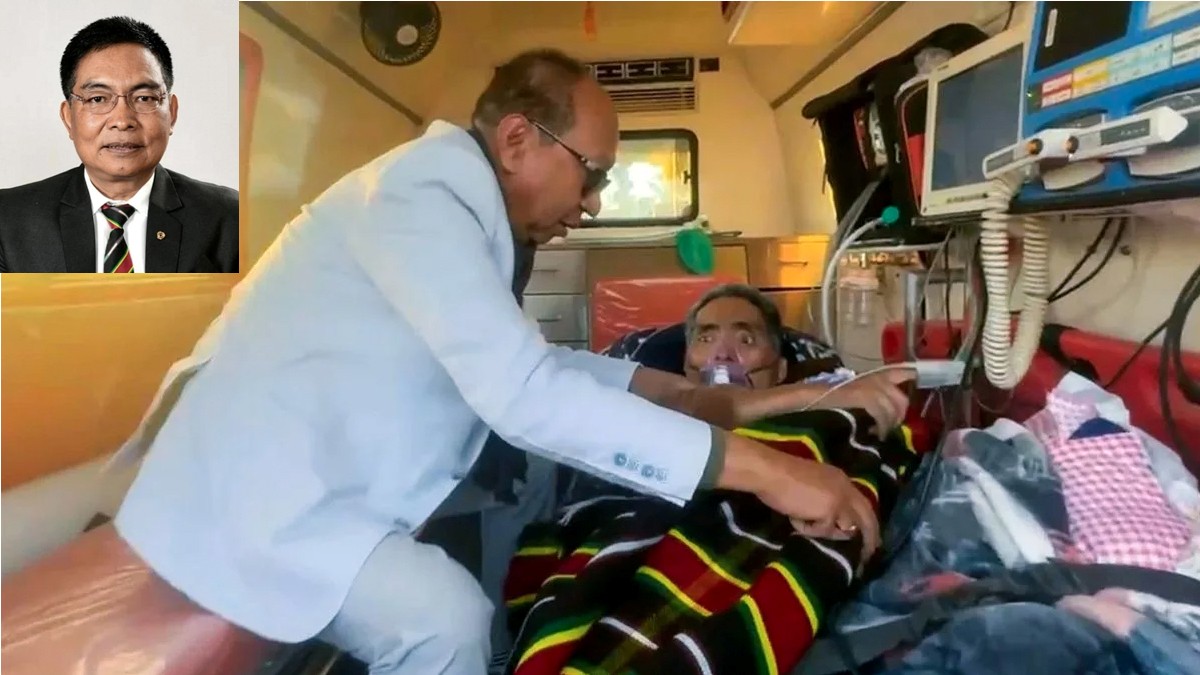
The passing of Vungzagin Valte, three-term MLA from Thanlon Assembly Constituency and a senior leader of the Bharatiya Janata Party (BJP) in Manipur, should have been a moment of unambiguous mourning. Assaulted by a mob in Imphal on May 4, 2023 – one day after the Kuki-Zomi militants’ violence against the Meiteis erupted in Churachandpur and extended to Kuki-Zomi dominated districts in the evening – Valte survived nearly three years after the attack but remained paralysed. His death in a Haryana hospital on February 21, 2026 has reopened not only the wounds of that day but also deeper questions about justice, governance, ethnic boundaries, the moral limits of political negotiation, and the instrumentalisation of grief in Manipur’s protracted crisis.
Yet his funeral has not taken place. His family has refused burial until two demands are met – a probe by the National Investigation Agency (NIA) into his assault and death, and the creation of a separate district for the Zomi tribes (Paite, Gangte, Simte, Sukte, Vaiphei, Zou and Mate) – often referred to as “Lamka district” – to be carved out of Churachandpur. This decision has transformed a moment of mourning into a constitutional and political confrontation. It forces us to ask uncomfortable questions – Is the demand for a Zomi district an extension of the 2015 “anti-tribal bills” agitation? Is it a recalibrated response of the Zomis to the rejection of “Separate Administration” by the Union government? Are the violence of 2015 and 2023 historically connected in ways that are now being politically mobilised? And what does it mean when a dead body becomes the fulcrum of negotiation?
To examine these questions critically is not to deny grief or diminish injustice. It is to insist that in a fragile, conflict-scarred society, and multi-ethnic state, symbolic acts carry structural consequences.
The Assault and the Absence of Justice
Valte’s assault in Imphal on May 4, 2023 has been widely reported. He had attended a security review meeting at the Chief Minister’s Office and was returning when he was attacked. In a letter dated September 13, 2025, addressed to Prime Minister Narendra Modi, Valte alleged that he had been brutally assaulted by “Meitei militia (Arambai Tenggol).” Though the case has been handed over to the Central Bureau of Investigation (CBI), no arrests have been made.
In a state where hundreds have been killed and thousands displaced since May 3, 2023, the absence of accountability is not unique to Valte’s case. But his position – as a sitting BJP MLA attacked in the state capital – makes the inertia particularly stark. It signals either incapacity or unwillingness, both of which erode public trust.
The family’s demand for an NIA probe is therefore not unreasonable on its face. In fact, in a case so politically sensitive, expedition of CBI investigation or NIA probe might restore a degree of credibility. However, the second demand – the creation of a Zomi-majority district – shifts the terrain from criminal justice to territorial reconfiguration.
The Road from Aizawl to Churachandpur
Valte’s body was flown from Delhi to Mizoram’s capital Aizawl instead of Imphal from where he was flown by air ambulance for advanced treatment at the family’s request, then transported by road from Lengpui Airport to his residence in Churachandpur. Tributes were paid along the way.
However, the narrative of state indifference is more complex than it first appears. When Valte’s condition deteriorated, his son reportedly made an urgent late-night appeal to the newly sworn-in Chief Minister Yumnam Khemchand Singh. Khemchand responded by dispatching a medical team to Churachandpur. He also arranged for an air ambulance from Imphal Airport to transport Valte for advanced treatment outside Manipur. Significantly, Khemchand personally saw Valte off at the airport.
These actions complicate any simplistic portrayal of abandonment. They demonstrate that, at least at the level of emergency response and medical evacuation, the state machinery –and the Chief Minister himself – acted with urgency and visibility. Yet emergency medical intervention and long-term criminal accountability are not the same. The former may signal compassion; the latter tests institutional will.
And official state mourning was declared. Governor Ajay Kumar Bhalla visited and paid respects. Security Adviser Kuldiep Singh laid a wreath. Chief Minister Yumnam Khemchand Singh assured state honours.
Yet the burial remains suspended.
The refusal to bury a political figure until demands are met has precedent in Manipur. The most notable example occurred in 2015–2017, when the bodies of nine tribal protestors killed allegedly in police firing in Churachandpur were kept unburied for over a year and a half during agitation against three bills passed by the Okram Ibobi Singh government in 2015. Those bills – the Protection of Manipur People’s Bill 2015, the Manipur Land Revenue and Land Reforms (7th Amendment) Bill 2015, and the Manipur Shops and Establishments (2nd Amendment) Bill 2015 – were perceived by many tribal groups as threats to land rights and autonomy.
The Joint Action Committee Against Anti-Tribal Bills (JACAATB) made burial conditional on political concessions. Eventually, after negotiations, an MoU was signed on May 10, 2017, after Chief Minister Nongthombam Biren Singh’s BJP-led government came into power. The MoU acknowledged, among other things, that the demand for a new district – Lamka –would be considered by the state cabinet upon submission of a District Boundary Commission report.
Then, the bodies were buried on May 24, 2017.
This history is crucial. The strategy of withholding burial until political demands are addressed has already been used once to secure concessions. It established a template.
2015 and 2023: Separate Events or Linked Trajectories?
Are the violence of 2015 and 2023 connected?
At one level, they are distinct. The 2015 agitation was directed against the state legislation perceived as “anti-tribal.” The 2023 violence erupted during and after the “Tribal Solidarity March” on May 3 organised by the All Tribal Student Union Manipur (ATSUM), opposing a High Court order related to the demand for Scheduled Tribe status of Meiteis and spiralled into widespread violent clashes between Kuki-Zomi and Meitei communities.
Yet structurally, both episodes revolve around anxieties over land, political representation, and administrative control. The 2015 bills were seen as enabling valley-centric encroachment into hill areas. The 2023 crisis revived fears of demographic and legal reordering. Both moments exposed the fragility of multi-ethnic Manipur’s equilibrium.
The Lamka district or Zomi district demand originates in the 2015 context. It was framed as an administrative necessity for better service delivery in a large district (Churachandpur), but it also had an unmistakable ethnic subtext – carving out a Zomi-majority district would symbolically and administratively consolidate identity.
After the 2023 violence, the “Kuki-Zo” leadership including the MLAs of BJP and its allies escalated demands to “Separate Administration,” effectively seeking a Union Territory or arrangement outside the authority of the Manipur government. The Union Ministry of Home Affairs reportedly rejected this demand “as of now.”
In this context, the reactivation of the Lamka district demand may represent strategic recalibration. If Separate Administration is politically unviable, a new district could serve as an intermediate gain for the Zomis – less radical, but still identity-affirming.
Is the Dead Body a Bargaining Chip?
This is the most uncomfortable question.
Vungzagin Valte’s death is undeniably linked to the 2023 violence. The absence of arrests is indefensible. His family’s anger is justified. Yet tying his burial to the creation of a district that was originally negotiated in a different political moment raises ethical and political concerns.
When a funeral becomes conditional upon administrative restructuring, grief enters the domain of bargaining. One may argue that in Manipur’s history, martyrdom has often catalysed change. But there is a thin line between moral pressure and instrumentalisation.
If the demand were limited to an NIA probe, the moral coherence would be clearer – justice for the assault that caused his death. The addition of the district demand complicates the narrative. It risks being perceived – especially by other communities – as leveraging death for territorial gain.
Such perception matters. In a deeply polarised environment, symbolic acts are read through suspicion.
Administrative Logic or Ethnic Cartography?
The argument for a Lamka (Zomi) district is not entirely new. Churachandpur has historically been one of the largest districts in Manipur. It was bifurcated in 2016 to create Pherzawl district dominated by Hmar tribe. However, in January 2022, Thanlon subdivision was re-amalgamated to Churachandpur from Pherzawl district.
Administrative reorganisation is common across India. District creation can improve governance, decentralise services, and enhance representation. However, in Manipur, district boundaries are rarely neutral and natural. They intersect with ethnic demography.
Creating a district explicitly framed as “Zomi” would formalise ethnic cartography in the multi-ethnic state of Manipur. That could have three potential consequences:
- Short-term appeasement: It might temporarily satisfy a section of Zomi leadership, providing a symbolic victory after the setback on Separate Administration.
- Precedent escalation: Other sub-groups may demand analogous arrangements, intensifying fragmentation.
- Entrenchment of ethnic lines: Administrative borders could harden psychological boundaries, reducing incentives for inter-ethnic coexistence.
Would a Zomi district subside the Separate Administration demand? Possibly and temporarily, but only if it is accompanied by credible security guarantees and political dialogue. Otherwise, it may be seen as insufficient.
The MoU of 2017: Deferred Promise or Political Convenience?
The May 10, 2017 MoU signed between the Manipur government and JACAATB stated that the Lamka district demand would be considered by the state cabinet upon submission of a District Boundary Commission report. It did not promise immediate creation. It acknowledged consideration.
Nearly nine years later, the report’s status remains unclear in public discourse. Was the process stalled? Was it politically inconvenient? Or was it overtaken by subsequent crises?
Critically, if the demand is now revived as a precondition for burial, it places the present government in a bind. Conceding under funeral pressure could be seen as capitulation. Refusing could be portrayed as betrayal of a prior commitment.
The 2017 MoU also promised proper investigation into the 2015 police firing. The parallels are striking – investigation and district reorganisation were intertwined then, as now.
But there is a key difference. In 2015, the violence was directed against legislation. In 2023, the violence involved ethnic groups and militarised. The stakes are higher.
The Role of the BJP and Internal Contradictions
Vungzagin Valte was a BJP MLA. The MoU acknowledging Lamka was signed during a BJP-led government. The current state government is also BJP-led NDA government where BJP commands 37 in their 55-member ally in a 60-member house though effectively 59 now due to the passing away of Tadubi AC MLA. The demand for a Separate Administration was also made by the MLAs of BJP and its allies on May 12, 2023. The Prime Minister to whom Vungzagin Valte wrote is from the BJP.
This creates an internal contradiction – the party that promised consideration of the district is now confronted with its own MLA’s death being used to demand it.
If the government resists, it risks alienating Zomi supporters. If it concedes, it risks antagonising Meitei and other Non-Zomi constituencies who may interpret the move as rewarding ethnic pressure.
The BJP’s balancing act in Manipur has always involved managing competing ethnic aspirations while maintaining central authority. The Valte episode exposes the limits of that strategy.
Separate Administration: Deferred or Disguised?
The demand for Separate Administration by “Kuki-Zo” groups emerged after the violence erupted on May 3, 2023. It seeks a political arrangement insulated from the government operating from Imphal. The MHA’s rejection does not extinguish the aspiration.
Could a Zomi district function as a stepping stone? Possibly. Administrative consolidation often precedes political escalation. A district provides bureaucratic infrastructure, territorial definition, and a platform for further claims.
However, it is equally possible that a district could channel aspirations into constitutional frameworks, reducing the appeal of extra-constitutional demands. The outcome depends on accompanying political processes.
Justice Before Geography
From a normative standpoint, the priority should be justice for the assault. An NIA probe, if credible and time-bound, would address the immediate grievance. It would also signal that attacks on elected representatives – even in mob contexts – are intolerable.
Administrative restructuring, by contrast, requires consultation across communities. Fast-tracking it under funeral pressure risks deepening mistrust.
Mourning in a Fragmented State
Manipur’s tragedy is that mourning is rarely shared. Valte’s assault in Imphal was seen by many Kuki-Zomis as emblematic of Meitei hostility. Conversely, Meitei victims of 2023 violence are mourned within the valley. However, the passing of Vungzagin Valte is mourned by many Meiteis.
When mourning becomes segmented, it becomes politicised. The refusal to bury Valte until demands are met may resonate within his community as dignified resistance. But across the divide, it may reinforce narratives of transactional politics.
The state’s responsibility is to prevent grief from hardening into geography.
Conclusion: Between Conscience and Calculation
The demand for a Zomi (Lamka) district over the body of Vungzagin Valte sits at the intersection of memory, strategy, and unresolved promises. It draws legitimacy from the 2017 MoU and from long-standing administrative grievances. It draws urgency from the injustice of his assault. But it also carries the risk of Instrumentalising death in a context already saturated with suspicion.
Are 2015 and 2023 connected? Yes, in the deeper sense that both arise from structural insecurities about land and representation. Are the Zomis using the dead body as leverage? Inevitably, the act of conditional burial functions as leverage, regardless of moral framing. Will a new district calm or inflame? It could do either, depending on process and perception.
The government faces a choice. It can separate the demand for investigation from the demand for district creation – acting swiftly on the former while initiating transparent consultation on the latter. Or it can treat both as pressure tactics and refuse, risking further alienation.
In a state where violence has already redrawn invisible borders, the creation of visible ones must be approached with caution. Justice for Vungzagin Valte is urgent. Redrawing Manipur’s map is not.
The dignity of the dead demands accountability. The stability of the living demands deliberation. Conflating the two may satisfy immediate anger but could complicate the long road to reconciliation.

Senior Editor: Imphal Review of Arts and Politics