
The ethnic conflict in Manipur between the Meiteis and Kuki-Zo group of tribes is seemingly cooling a little, giving hope that a consensual agreement can be reached across the table to restore normalcy in the state. President’s Rule has been lifted and a popular government reinstated in which all communities, including the Kuki-Zo’s are represented. It is another matter that some hardliners amongst the Kuki-Zos have objected to this initiative towards return to unity and coexistence.
If this is happening at one level, the problem is also increasingly acquiring another dimension, with heightened tensions between the Kukis and Nagas who share living spaces in the hills of the state.
First it was the Zeliangrong Nagas who showed signs of discontent at the officially sanctioned expansion of Kuki influence in the power balance in lands they consider are traditionally theirs. The Zeliangrongs are in particular unhappy that the government has relocated a designated camp of Kuki militants under Suspension of Operation, SoO, agreement, at Kharam Vaiphei along the Kangchup ranges in the Singda Dam area. Among those in the forefront of this opposition are Ireng Naga and Konsakhul, both neighbours of Kharam Vaiphei.
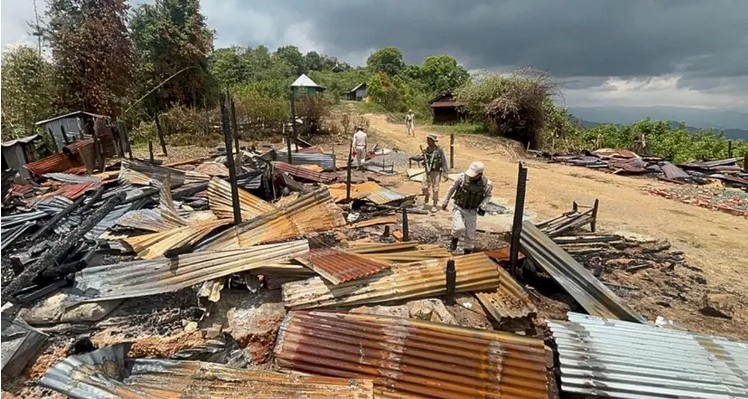
In the wake of this tension, in the last few months, a prominent Zeliangrong Naga militant group, Zeliangrong United Front, ZUF, has been on a campaign of destroying poppy fields which the orgainsation claims were on the traditional land of Zeliangrong illegally encroached and used by Kukis. The last of these anti-poppy operations was on January 26, 2026, coincidentally India’s Republic Day, in which houses which they claim were no more than rest sheds of a poppy farm were burnt down. Kukis however said the houses were of K. Songlung-II Kuki village.
But the problem, it is now showing runs much deeper, and may even be primordial in nature. In the latest violent confrontation, Kukis and Tangkhul Nagas clashed at Litan town in Ukhrul district.
Reports say the Litan flare-up was sparked by a few Kukis in a drunken brawl seriously beating up a Tangkhul teacher identified as A.S. Sterling about 7pm on February 7. According to reports, Sterling was returning from home to his village Sarkaphung (also known as Sikibung) from Litan town, shining a torch to find his way. The reports say the beam from the torch fell on some Kuki men who took strong offense. In the altercation that followed, the Kuki men assaulted Sterling, injuring him seriously.
Efforts to reach an amicable settlement on February 8 fell through and by February 9 riots broke out. Despite the state government rushing in additional security, and district administration imposing curfew and suspending internet services in Ukhrul district to prevent escalation of violence, in the next few days, close to 50 houses belonging to both Tangkhuls and Kukis ended up burnt by mobs from either side.
Situation has now been brought under control by a strong presence of central and state security forces, but place still remains tense.
This development is unfortunate, but what has to be taken note of is the fact that a single spark cannot cause a major inferno if there were nothing to burn. It is evident from the Litan case there were indeed plenty of dry cinders to catch flame. As in other Naga areas, the Tangkhul Nagas too consider the Kukis as late arrivals and the land on which the Kuki villages are located in Tangkhul areas were originally leased out to the Kukis by Tangkhul villages nearby, therefore the land still belonged to the Tangkhul villages that leased them out.
By this assumption, the Tangkhul claim that land on which the Kuki village of Litan Sareikhong stands today was originally leased out by nearby Tangkhul village of Sarkarphung. The Kukis however counterclaimed that Sareikhong and Sarkarphung were two separate villages legally unrelated to each other. The tension mounted in recent times in matters related to compensation claims for land the government acquired for broadening of the Imphal-Ukhrul highway. This underlying tension is what exploded into an raging flame on February 9 by the spark provided by the Litan altercation of February 7 evening.
Vindicated in the process is also our consistent prediction since the violence broke out between Meiteis and Kuki-Zos in 2023. We have repeatedly argued that Manipur is a complex multi-ethnic state, and no bilateral agreement between Meiteis and Kuki-Zos can be treated as a solution to Manipur’s problem. Nagas in particular, though they had not become part of the conflict, were big silent stakeholders and that even if the Meiteis had agreed to a separate administration demand of the Kuki-Zos, if this administrative arrangement is territorial in nature, it would have a larger conflict potential in the hills between the Nagas and Kukis.
We do hope this reality has dawned on every stakeholder in Manipur affairs. Working towards peaceful coexistence is predestined. Manipur in this sense is not just a political construct, but a geographical destiny for all its communities. And as Robert Kaplan has warned in his bestselling “The Revenge of Geography” and before him Halford Mackinder in his “Geographical Pivot of History”, some of the deadliest conflicts in history were the results of attempts to alter similar geographical destinies.
There can be no argument that the hills and valleys together make integral geographies, and those living in such integral geographies have no choice but to find ways to peacefully coexist. Just as the rivers, lakes, forests, mountains and valleys survive together in a symbiotic relation, those living in such geographies too must emulate this interrelatedness for their own greater common good.
Let all in Manipur then leave behind their pasts and take the pledge to live in the present, adjusting to and accommodating to each other’s changing needs from time to time, and thus continually evolve a common platform, firm, resilient yet not rigid, on which all can stand together steadily and with no sense of injustice.

Editor, Imphal Review of Arts and Politics and author