“Martial identity” refers to the way societies organize their values, institutions, and self-image around warfare, defense, and the ethics of combat. While every civilization has engaged in conflict, only some have elevated warfare into a defining cultural principle. A comparative glance across world history shows that martial identity emerges under specific conditions – persistent external threat, expansionist ambition, or rigid social organization – and takes distinct forms in different contexts.
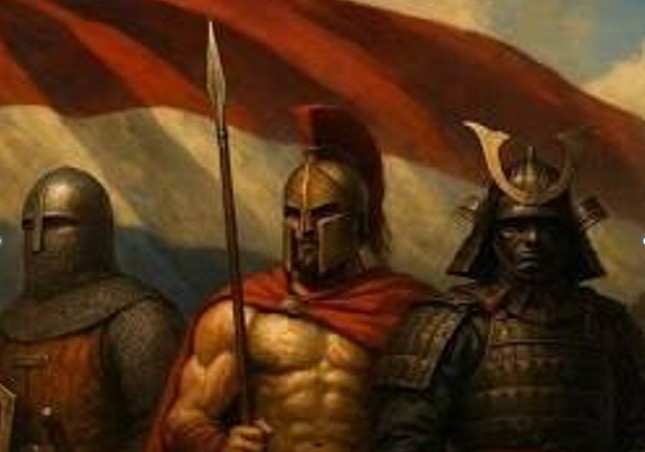
In ancient Greece, particularly in city-states like Sparta, martial identity was inseparable from citizenship. The Spartan system transformed every male citizen into a lifelong soldier through the agoge, a rigorous state-controlled training regime. Valor, discipline, and obedience were the highest virtues, and the individual existed primarily for the survival of the state. Even beyond Sparta, the Greek hoplite, heavily armed infantry fighting in the phalanx, symbolized a collective martial ethic. Warfare was not just the business of elites but a civic duty, embedding martial identity within the political structure of the polis.
The Roman Republic and later the Empire institutionalized martial identity at an unprecedented scale. The Roman legion was not merely an army but a disciplined social institution that shaped governance, engineering, and law. Figures like Julius Caesar exemplified the fusion of military success and political authority. Expansion was both a strategic necessity and a cultural expectation. Roman identity came to be defined by conquest, order, and the ability to impose peace – Pax Romana – through military dominance.
In feudal Japan, martial identity crystallized in the figure of the samurai. Governed by the ethical code of Bushidō, the samurai embodied loyalty, honour, and self-sacrifice. Warfare was not only a profession but a moral discipline. Under the Tokugawa shogunate, even during prolonged peace, the martial identity persisted as a cultural ideal. The samurai became administrators and moral exemplars, demonstrating how martial values can outlive actual warfare and become embedded in social hierarchy and ethics.
In medieval Europe, the knight represented a fusion of martial skill and aristocratic status. The code of chivalry combined Christian morality with warrior ethics, emphasizing bravery, loyalty, and protection of the weak, though often more idealized than practiced. Events like the Crusades further reinforced martial identity by framing warfare as a sacred duty. Here, martial identity was closely tied to feudal hierarchy and religious ideology.
Among the nomadic societies of Central Asia, martial identity was shaped by mobility and environment. Groups like the Mongols, under leaders such as Genghis Khan, developed highly adaptable military systems based on cavalry and archery. War was integral to survival and expansion. The entire society was organized around military efficiency, with little distinction between civilian and soldier. This produced one of the most formidable martial cultures in history, capable of rapid conquest across vast territories.
In South Asia, martial identity appeared in multiple regional forms. The Rajputs cultivated a warrior ethos centered on honor, lineage, and battlefield valor, often expressed through resistance and ritualized combat. Similarly, the Marathas under Shivaji developed a dynamic martial system combining guerrilla tactics with strong regional identity. Here, martial identity was closely tied to political autonomy and resistance against larger empires.
Across civilizations, certain common patterns emerge in the formation of martial identity. It tends to be strongest where warfare is deeply integrated into social and political institutions, as seen in societies like Sparta and ancient Rome, where military service was inseparable from citizenship and governance. At the same time, martial values are often shaped by ethical systems, such as Bushidō in Japan or the chivalric code in medieval Europe, which transform violence into a regulated moral framework. These identities typically arise in response to persistent threats or opportunities for expansion, as in the case of the Mongols under Genghis Khan, where warfare became central to survival and dominance. Importantly, even after periods of active conflict decline, martial values often persist as cultural symbols, shaping collective memory and identity. Martial identity, therefore, is not merely about the act of fighting; it reflects how societies organize, justify, and internalize conflict within their broader cultural and historical experience.
Manipur, located at the crossroads of South and Southeast Asia, offers a compelling case of such an identity – one that is neither merely militaristic nor reducible to colonial stereotypes, but rather embedded in its cosmology, polity, and everyday life. The martial identity of Manipur evolved through centuries of geopolitical pressures, internal consolidation, and cultural codification, culminating in a distinctive ethos that balanced warfare with ritual, discipline, and statecraft.
Historical Foundations of a Martial Ethos
The roots of Manipur’s martial identity can be traced to its early state formation under the Meitei kings, whose authority depended not only on ritual legitimacy but also on military prowess. Chronicles such as the Cheitharol Kumbaba record frequent military expeditions, defensive campaigns, and territorial negotiations. Kings like Khagemba (r. 1597–1652) consolidated the kingdom through both administrative reform and military expansion, repelling external invasions and integrating diverse groups into the polity.
Similarly, Pamheiba (r. 1709–1748), also known as Garib Niwaz, expanded Manipuri influence into the Burmese plains. These campaigns were not mere acts of conquest but part of a broader geopolitical strategy to secure the kingdom against recurrent threats from the east, particularly from the Burmese Kingdom. The repeated invasions and counter-invasions created a cycle of militarization that permeated society at large.
This martial orientation intensified during the period of the “Seven Years Devastation” (1819–1826), when Burmese forces occupied Manipur, leading to widespread displacement and social breakdown. The collective trauma of this period further solidified a defensive martial consciousness among the Manipuris, reinforcing the necessity of military preparedness as a condition for survival.
The martial identity of Manipur is not confined to the battlefield; it is deeply inscribed in its cultural practices, most notably in the indigenous martial art known as Thang-Ta. Literally meaning “sword and spear,” Thang-Ta (also referred to as Huiyen Lalong) encompasses not only techniques of combat but also a philosophical framework that integrates physical discipline with spiritual cultivation.
Training in Thang-Ta was historically a component of socialization, particularly among the male population, though it also had ritual and performative dimensions. The art form encodes a moral universe where valor is tempered by restraint, and where the warrior is expected to embody both courage and ethical responsibility. In this sense, martial identity in Manipur is not synonymous with aggression; rather, it reflects a disciplined readiness shaped by historical necessity. The ritualization of martial practices, seen in ceremonial dances, festivals, and even in the structuring of space within the polity, suggests that warfare was not an aberration but a normalized aspect of life, integrated into the symbolic order of society.
Institutions and Militarized Society
The institutional framework of the Manipuri kingdom further reinforced its martial character. The Lallup system, a form of corvée labor, required adult males to serve the state in rotational shifts, often involving military duties. This system effectively transformed the population into a reserve army, ensuring that the kingdom could mobilize quickly in times of crisis.
Unlike standing armies in centralized empires, this decentralized militarization allowed Manipur to sustain prolonged resistance against external powers. However, it also meant that warfare was a shared social responsibility, blurring the distinction between civilian and soldier. The martial identity thus became a collective attribute rather than the preserve of a professional warrior class.
Colonial Encounter and the Crisis of Martial Identity
The encounter with British colonialism in the 19th century marked a decisive turning point. The Anglo-Manipur War exposed both the strengths and limitations of Manipuri martial traditions. Leaders such as Bir Tikendrajit exemplified the enduring valor of the Manipuri warrior ethos, organizing resistance against a technologically superior colonial force.
Despite fierce resistance, the defeat of Manipur in 1891 led to the dismantling of its indigenous political and military institutions. The British, while recognizing the martial qualities of the Manipuris, reconfigured them within the framework of colonial military recruitment, similar to their treatment of other “martial races” in India. This reclassification both preserved and distorted the indigenous martial identity, detaching it from its original socio-political context.
Martial Identity Beyond Militarism
To understand Manipur’s martial identity solely through the lens of warfare or colonial classification would be reductive. Rather, it should be seen as a historically contingent formation that encompasses a broader ethical and cultural orientation. The Manipuri conception of warfare was intertwined with notions of honor, duty, and cosmic order, rather than mere conquest or domination.
Even in contemporary times, elements of this martial identity persist, not necessarily in organized warfare, but in cultural expressions, sports (such as Sagol Kangjei, the precursor to modern polo), and a collective memory that valorizes resistance and resilience. The endurance of these elements suggests that martial identity in Manipur is less about perpetual conflict and more about a deeply ingrained disposition toward defense, discipline, and dignity.
Manipur’s martial identity is the product of a long historical process shaped by geography, politics, and cultural innovation. It is an identity forged in the crucible of conflict but refined through ritual, ethics, and institutional practice. From the campaigns of its early kings to the resistance against colonial domination, the martial ethos of Manipur has been both a means of survival and a marker of collective selfhood.
In a world where martial traditions are often either romanticized or condemned, Manipur offers a nuanced example of how a society can integrate the demands of warfare with the imperatives of culture and morality. Its martial identity, far from being an anachronism, remains a vital lens through which to understand its past and navigate its future.

The writer is Assistant Professor, Imphal College