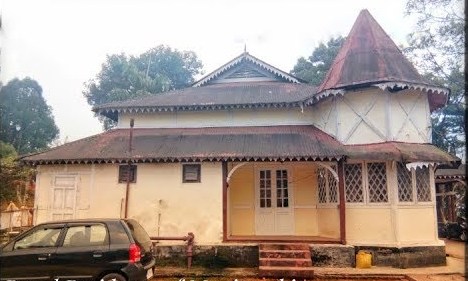
The controversy surrounding the recent demolition of Redlands, former summer residence of Manipur royalty since the time of Maharaja Sir Churachand Singh, in Shillong is unfortunate. Sketchy news reports say this was done with the intent to build a new Manipur Bhavan over where the old and historic bungalow stood. If this intent is confirmed, then there can be no words to condemn the move. However, in a hasty clarification after a public uproar broke out, the Planning and Development Authority, PDA, Manipur, has now said the demolition was with the intent of renovating this historic bungalow.
Even if the intent for the demolition is indeed honourable, all action regarding the matter should have been made transparent. There can be no doubt that the ageing structure with wooden framework and lime plaster as walls would have suffered its share of ravages of time, therefore would have been needing renovation. But since the PDA chose not to inform the public, nothing is known for sure how badly the structural integrity of the bungalow had deteriorated, and what extent of restoration work was necessary. This being so, the public outrage at its demolition is perfectly understandable.
Again, since this structure has a relic value, there ought also to have been wide consultations on how to proceed, which archaeological, architectural and engineering experts to engage etc. When the structures within Kangla Fort was being renovated, this was the way things were done, although it must be added here too that the manner in which the props “kabak” in the mouth of the two Kangla Sha at the Kangla were removed with impunity in June, 2021, tampering with history, is equally atrocious.
Restoration of monuments of historic values cannot be the job of any contractor, engineer or politician, but what more to say than that this is Manipur, a place where norms, protocols and traditions are often thrown into the winds by those in power.
The Redlands is old. It came in the hands of the ruler of the erstwhile Princely State of Manipur, Churachand Maharaja in 1927. The sprawling 20-acre estate on a solitary hilltop at Laitrumkhrah in Shillong, has a very interesting history too. The circumstance it came to be in Manipur’s possession is curious, but its most engaging significance as a historical relic is that it is associated with a very intimate memory of Manipur. This is where Maharaja Bodhchandra who succeeded his father Maharaja Churachand to the Manipur throne, was held under house arrest for four days in September of 1949 before he gave in and signed the Manipur Merger Agreement on September 21. This agreement came into force from October 15 the same year.
On several earlier occasions Redlands had been in the news, unfortunately for all the wrong reasons. For instance, on February 27, 1980 it had been quietly sold by Maharaja Bodhachandra’s son Okendro, mediated by one B.K. Roy Choudhury for Rs. 4 lakhs to two rich businessmen Nismit Laloo and J. Pyngrope. According to records at the time, Rs.2 lakhs of this amount had already been paid by one of the parties. Thankfully, on April 4, 1980 this transaction was challenged in court by descendants of Redland’s caretaker family, headed by Sovasini Devi.
This case dragged on, but on August 12, 2021, a settlement was reached whereby the Government of Manipur was allowed acquire the estate back from those it had been sold for Rs. 91,0478.
The case remained a backstage affair all the while, but in the mid-1990s when winds of it reached the ears of the Manipur public, it became an issue in the state. In response, the late Maharajkumari Binodini Devi, daughter of Churachand Maharaja, fondly Imasi to many of my generation, wrote a touching piece which was published in the then Imphal Free Press under my editorship. The article has been reproduced in IRAP once again.
Even before the demolition, it was quite apparent to all who have visited the place that Redlands was progressively losing its old charms. The first to disappear was the enchanting canopy of bottle brush and bougainvillea that once lined the short, steep drive up to it from the main road. The small flat ground just below the cottage, big enough for two or three tennis courts, where once residents as well as students from Manipur on off days gathered to play badminton or else on Yaoshang day held Thabal Chongba, disappeared. Vanished is also the Les Charlette, the adjacent quaintly beautiful cottage within the Redlands complex.
This estate was once owned by the British administration in Shillong, the then provincial capital of British Assam, and was gifted to Churachand Maharaja in lieu of the king’s lakeside property English Bye which the British wanted to take over to become part of their extended administrative block. The staff quarters that flanked Redlands, were where descendants of the staff of Churachand Maharaja were put up. If not for them, Redlands probably would have been sold and this historical relic would have faded from Manipur’s memory long ago.
As Imasi Binodini pointed out in her article cited above, before Redlands and English Bye her father had acquire another property called Rose Cottage on the picturesque Shillong Peak. She however has very faint memory of this bungalow as she was too young at the time. What has become of that property is little known.
Manipur as such, but Meiteis in particular, are not relic hunters or have any special passion or respect for relics. They are temperamental and tend to be swept by the currents of emotions that explode every now and then. Take for instance Maharaja Churachand’s memorial at the place he was cremated at Nabadip in West Bengal, a popular pilgrimage site for Hindus. The king, breathed his last here. The site is today completely neglected with grass and shrubs reclaiming it.
Likewise, one generation ahead of CHurahand Maharaja, his uncle Kulachandra Maharaja and his younger brother Angou Sana Senapati, were exiled in Andaman Nicobar after the 1891 war. When Maharaja Kulachandra’s health deteriorated, on request the British transferred them and family to a jail in Bihar. When Kulachandra Maharaja’s condition did not improve and he wished to die at another pilgrim spot for Hindus, Radha Kund, this was obliged and the two brothers and family were given an estate at the holy city where they were kept under house arrest.
Long after the two royal prisoners are gone, the property remained as a shelter for Meitei Hindus pilgrims visiting Radha Kund. The information is, this property is where the Radha Kund ISKCON temple is now. How did this happen, and who sold it, and under what authority?

Editor, Imphal Review of Arts and Politics and author