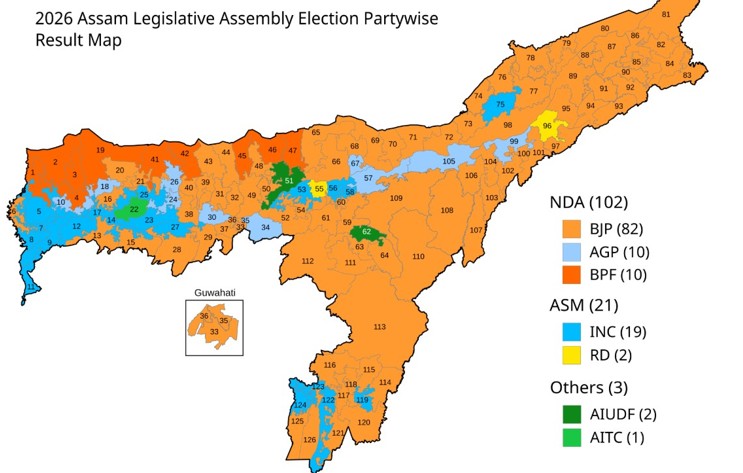
The BJP victory in Assam did not come as a surprise, not the least in the Northeast. The party returned 82 seats in the house of 126, giving it a majority on its own. Its allies in the North East Democratic Alliance, NEDA, Asom Gana Parishad, AGP, Bodoland People’s Front (BPF) also won 10 seats each.
Many factors ensured this. The foremost is the charisma of chief minister Himanta Biswa Sarma, and his well-calculated and calibrated populist agenda whipping up and capitalising on the inherent Assamese demography anxiety of being overwhelmed by Muslim immigrants from Bangladesh. Whether this proves a boon or bane for Assam in the long run is a matter of anticipation.
Equally important is also the fact that dislodging a party in power, especially if this is also the party in power in New Delhi, has never been easy in the Northeast which today suffers from a psychology of living on Delhi’s charity, therefore seeing themselves safer on the right side of the power that be in Delhi. BJP victory was also helped by some high profile, pre-election defection to it, engineered or otherwise, from its major rival, Congress.
The Congress was left licking wounds garnering just 19 seats, down 10 seats from its share in the last election. Even its flag bearer, Gaurav Gogoi lost in his home constituency Jorhat.
While it does seem like a complete decimation of the Congress, a little rethink is called for. In terms of votes share, the picture is quite different. While the BJP won 38.61 percent votes polled, the Congress received 29.24 percent. While nobody can argue BJP has won decisively, in terms of actual support base, the margin is not too great as the number of seats each won make it seem.
The debate on the pros and cons of the first-past-the-post electoral system is another matter, but what all need to not lose sight of is that while victors have all the right to celebrate their victory, this paradox is a reminder they need to be also humble in the knowledge that there are citizens on the opposite end of the spectrum of political power contest who number almost as many as those who supported them.
Assam victory is important for the BJP and its prospect in the Northeast. This upbeat mood is also bolstered tremendously by the party’s victory in West Bengal in this round of state elections. For the Northeast region, Kolkata is a parallel junction to Guwahati in the region’s connectivity to the rest of the country.
This being so, whatever happened in Bengal, has always had very profound impacts on the Northeast as well. This was so from the colonial days. Indeed, when the British annexed Assam in 1826, it was made an extension of Bengal. Likewise, the Curzon’s Partition of Bengal, and finally its reunification, all have had great bearings on the politics and psychology of ordinary people in the Northeast. Not the least, most of the first-generation western educated pioneers from the region acquired their degrees from Kolkata and Dhaka univesities, making this connection even deeper rooted.
How then would the BJP victory in Assam and West Bengal pan out in the rest of the Northeast is a question all observers of politics in the region would be asking. Of the seven Northeast states, excluding Sikkim, which is more in the West Bengal orbit, four states, namely Assam, Tripura Arunachal Pradesh and Manipur are BJP ruled.
The remaining three which are core Christian states, namely Meghalaya, Mizoram and Nagaland are ruled by regional parties, but allied with the BJP, not for any ideological affinity, but driven by transactional consideration of aligning with the power corridors in New Delhi. This profile of political equation in the region is unlikely to change. What the BJP victory in Assam and West Bengal has probably done is to ensure this equation remains secure and intact.
This said, there are also local issues unique to each of the states that can change the colours of politics in each of them. The Manipur case would be most urgent. Election in this state is due less than a year in February 2027, and the ongoing ethnic crisis in the state, can make or mar the prospect of any political party.
On May 3 this year, a violent conflict between the majority Meiteis and Kuki-Zo group of tribes which has claimed over 260 lives and displaced many more completed three years, but there is still no immediate end in sight. Not only this, the conflict has acquired another dimension, with an underlying land friction between Kukis and Nagas turning violent, and threatening to be even more sustained and irresolvable. The divisions between the state’s three major communities will understandably complicate electoral strategies of all parties.
There are also issues such as a demand for drawing up a National Register of Citizens, NRC, as in Assam to sort out illegal immigrants from the voters list before elections, success of failure to comply to which can alter political fortunes of parties. The ruling BJP in the state, has been trying to negotiate these issues, and the measure of success in this negotiation it meets can determine its fortune in the coming election.
In the other Northeast states, elections are still two to three years away, so the urgency is still missing. But by and large, because the BJP will remain in power at the Centre when these elections happen, together with the recent BJP victories in Assam and West Bengal should give the party a head start in the race.
Because these states are also vulnerable border states, and insurgency torn, their political stability can also alter dramatically overnight. With a perception of foreign powers, in particular China but also the US, seen as having an interest in the current trouble in Myanmar, New Delhi’s policies can shift radically, unsettling these fragile electoral political equations.
For instance, the Central government recently announced it was set to erase insurgency in the Northeast by 2029. As has often happened in the past, this could result in the reading of insurgency as merely a law-and-order problem, and not also a social issue, orienting operations towards a military solution. Depending on the approach taken, political equations can change radically.
This article was first published in The New Indian Express. The original can be read HERE

Editor, Imphal Review of Arts and Politics and author