
Manipur stands today not merely at a crossroads, but in a prolonged interregnum between violence and reconciliation, between displacement and return, between governance and symbolism. Nearly three years after the violent conflict of May 3, 2023, the geography of the state remains morally and politically fractured. Large sections of the population continue to live not in their ancestral homes but in relief camps – Meiteis uprooted from Churachandpur district, Kangpokpi district, Pherzawl district and the surrounding areas of the districts and the border town of Moreh; Kuki-Zomi families fled from Imphal Valley and Jiribam. The architecture of daily life has been replaced by old school buildings, prefabricated shelters, and the monotony of waiting.
It is within this fragile landscape that Chief Minister Yumnam Khemchand’s February 19, 2026 interaction with Internally Displaced Persons (IDPs) must be situated and evaluated – not as an isolated humanitarian gesture, but as a political act with layered implications. The event, interacted physically at the Alternate Housing Complex, National Games Village (NGV) Relief Camp in Imphal West and virtually linked to camps in Churachandpur and Kangpokpi, was presented as a defining step in Manipur’s rehabilitation and reconciliation process. Approximately Rs. 33 crore was disbursed through Direct Benefit Transfer (DBT), benefiting nearly 19,000 displaced persons.
On its face, the initiative appears significant. For the first time since the eruption of violence, displaced persons from both Meitei and Kuki-Zomi communities were brought onto a single interactive platform. The programme included the virtual presence of BJP legislators who had previously resisted joining government processes without concrete movement toward their demand for Separate Administration – notably Paolienlal Haokip and Letzamang Haokip, alongside Deputy Chief Minister Nemcha Kipgen and MLA L M Khaute (the latter two already aligned with the government). To some observers, this participation marked a thaw.
Yet the more difficult question is not whether the programme was well-intentioned, but whether it signals structural change or merely performs reconciliation without transforming the conditions that produced displacement in the first place.
Relief in a Landscape of Structural Displacement
The humanitarian crisis remains stark. Relief camps continue to house thousands who have lost homes, livelihoods, educational continuity, and the fundamental sense of belonging to place. Displacement in Manipur is not an episodic emergency; it has become semi-permanent. Children were born in the relief camps. Children have grown up inside camps. Youth have lost critical academic years. Elderly people wait not just for compensation, but for closure.
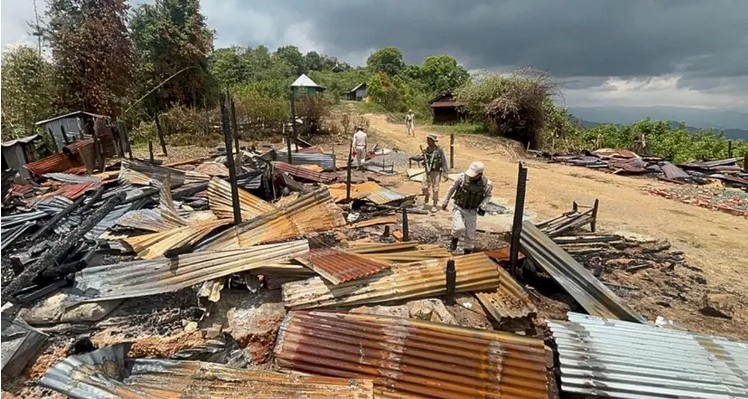
The material conditions inside camps – shortages of essentials, irregular medical access, and psychological trauma – cannot be remedied by a one-time financial transfer in instalments. Rs.33 crore, when distributed across nearly 19,000 beneficiaries, offers temporary relief but not reconstruction. Burnt houses remain burnt. Agricultural cycles remain interrupted. Markets remain divided along ethnic lines and what not.
More importantly, displacement is not only economic but territorial. The conflict hardened new spatial realities – buffer zones enforced by central security forces; de facto segregated habitations; stretches of National Highways that Meiteis are not allowed to move freely and safely due to militant presence and community hostility besides the restrictions from the security forces; hill districts that Kuki-Zomi residents fear to leave without security assurances. These are not abstract anxieties. They represent lived geographies of fear.
In such a context, relief without mobility risks becoming management of displacement rather than its resolution.
The Political Weight of Participation
The February 19 interaction drew attention primarily because of the participation – albeit virtual – of MLAs who had earlier opposed joining government initiatives before progress on Separate Administration. Paolienlal Haokip and Letzamang Haokip among others had articulated a hardline political position – that governance participation must be contingent upon structural political guarantees for the Kuki-Zomi areas. Their presence in the programme therefore raised questions.
Was this participation a sign of reconciliation? Or was it strategic accommodation? The answer likely lies somewhere in between.
There is little evidence to suggest that the demand for Separate Administration has been diluted. Rather, cooperation with the Chief Minister’s programme may reflect a tactical recalibration – engaging with the government to influence relief distribution, signal responsiveness to displaced constituents, or position oneself within evolving negotiations. Virtual participation also carries ambiguity – it signals neither full endorsement nor outright rejection.
For the state government, their presence was politically useful. It conveyed an image of inclusivity or bipartisan engagement. But optics must not be mistaken for consensus. The deeper disagreements over territorial governance, constitutional arrangements, and security accountability remain unresolved.
Trust Deficit as Structural Condition
The Chief Minister’s repeated emphasis on bridging the “trust deficit” between communities is rhetorically appropriate. But trust deficit is not merely psychological; it is institutional. It stems from competing narratives of victimhood, contested security arrangements, and perceptions of state partiality during the early phases of the violence.
Communities do not rebuild trust solely because leaders share a virtual platform. Trust requires:
- Accountability: Credible and impartial investigation into episodes of violence.
- Clear demarcation and eventual dismantling of buffer zones.
- Assurance that armed actors – whether militants or vigilante formations – do not operate with impunity.
- Visible restoration of freedom of movement across the state.
Without these, reconciliation events risk being episodic rather than transformative.
The restriction of Meiteis from freely accessing National Highways remains a particularly sensitive issue. Highways are not merely trade routes; they are constitutional arteries. If citizens of a state cannot move safely across its territory, sovereignty is hollowed from within. Ensuring secure, unimpeded movement must be a foundational measure of normalcy – not a deferred aspiration.
Listening Sessions or Political Theatre?
The interaction programme allowed IDPs to articulate grievances – disrupted education, medical inaccessibility, longing to return to Moreh and other hometowns. These testimonies are essential. Yet the durability of such engagement depends on follow-through.
Listening sessions can perform empathy. They can also serve as symbolic closure without material change. The test lies in implementation timelines. Has a concrete roadmap been announced for phased return? Are security deployments being restructured to enable reintegration rather than maintain separation? Is there a time-bound reconstruction plan for destroyed properties?
Absent these specifics, interaction risks being reduced to a spectacle of compassion – emotionally resonant but administratively thin.
The Limits of Direct Benefit Transfers
Direct Benefit Transfer is administratively efficient and politically visible. It signals state presence. It injects liquidity into households in crisis. But DBT cannot substitute for structural rehabilitation.
True rehabilitation would require:
- Comprehensive house reconstruction schemes with technical and logistical support.
- Livelihood restoration packages tailored to agrarian and small-business contexts.
- Educational bridging programmes for displaced students.
- Integrated health outreach beyond camp-based clinics.
- Psychosocial counselling infrastructure.
The February 19 programme foregrounded financial assistance. It did not clearly articulate how these longer-term measures will be institutionalised.
There is also a broader question of equity and transparency. In a deeply polarized environment, distribution processes must be scrupulously impartial to avoid reinforcing grievances. Any perception of preferential treatment risks undoing fragile confidence-building.
Separate Administration and the Constitutional Question
The political shadow over every reconciliation effort in Manipur remains the demand for Separate Administration by sections of the Kuki-Zomi leadership. This demand emerged from a perception of insecurity and marginalization among others. Whether or not one agrees with its constitutional viability, it reflects an unresolved crisis of governance.
The Chief Minister’s initiative did not directly address this structural question. Nor perhaps could it. But reconciliation efforts that bypass the political core of the conflict risk treating symptoms while leaving causes intact.
The participation of hardline MLAs may indicate willingness to engage within existing constitutional frameworks. Yet engagement and political negotiation cannot be replaced by welfare outreach.
Buffer Zones and the Geography of Division
One of the least discussed but most consequential features of post-2023 Manipur has been the normalization of buffer zones. These zones, enforced by security forces, have prevented direct clashes but have also institutionalized separation. They function as both peacekeeping mechanism and symbol of division.
If buffer zones become permanent, they transform temporary conflict lines into enduring boundaries. Peace cannot mean frozen segregation. Any roadmap for IDP return must include gradual dismantling of such divisions, accompanied by community-level confidence-building measures and security guarantees.
Beyond Symbolism: What Would Real Progress Look Like?
If the February 19 programme is to mark more than a moment of managed optimism, it must be followed by measurable outcomes:
- A publicly available phased return plan for IDPs, with security and reconstruction benchmarks.
- Transparent monitoring mechanisms involving civil society from both hills and valley.
- Restoration of safe, regular civilian traffic on National Highways.
- Dialogue forums addressing political issues.
- Independent review of security arrangements to prevent recurrence of violence.
Without these, relief distribution will remain palliative.
Conclusion: Hope, Caution, and the Politics of Appearance
Chief Minister Yumnam Khemchand’s initiative deserves recognition for attempting to create a shared platform in a deeply divided state. The financial assistance has provided immediate relief to thousands who desperately needed it. The presence of previously resistant legislators signals at least a willingness to engage.
Yet cautious skepticism is not cynicism. It is necessary political realism.
Manipur’s crisis was not born of administrative neglect alone; it emerged from structural contestations over land, identity, governance, and security among others. A single interaction programme, however well staged, cannot undo three years of entrenched displacement and mistrust.
The true measure of success will not be the quantum of funds transferred, nor the images of leaders addressing camps. It will be whether families can return to their homes without fear; whether children can attend school without crossing invisible frontlines; whether Meiteis can traverse National Highways without anxiety; whether Kuki-Zomi citizens besides Thadous can move through the valley without insecurity; whether buffer zones can be dismantled rather than normalized.
Peace in Manipur cannot be performed. It must be built – institution by institution, road by road, home by home.
Although Manipur Chief Minister Yumnam Khemchand government’s strategy marries welfare to trust-building and political engagement, the state remains at a crossroads – suspended between relief and resolution, between optics and transformation.

Senior Editor: Imphal Review of Arts and Politics