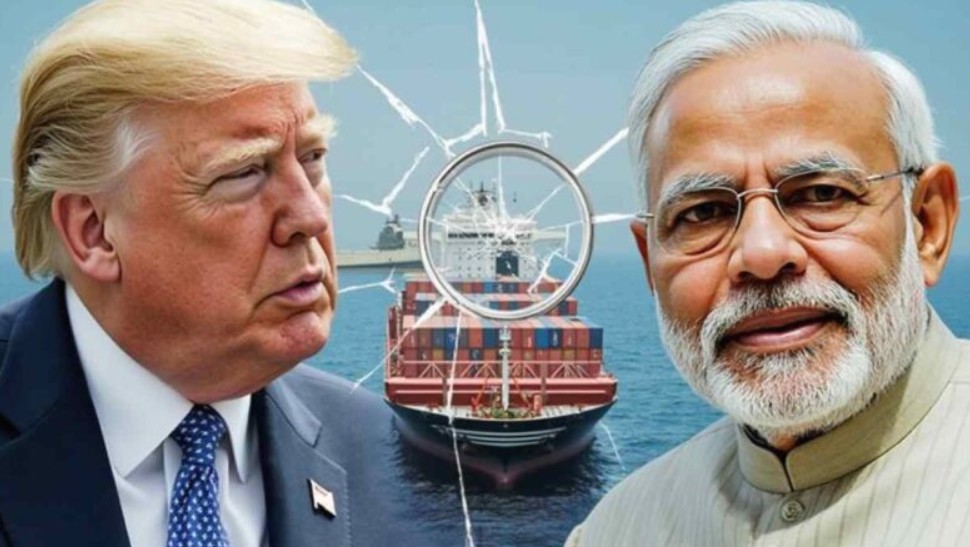
In a development that has sent ripples through global markets and diplomatic channels, U.S. President Donald Trump has announced a 25% tariff on Indian goods, coupled with an additional, unspecified penalty targeting India’s ongoing trade relations with Russia. Whilst the broader implications for India’s economy are likely to be considerable, the consequences for the Northeast region, a strategically significant and economically distinctive area, warrant particular attention.
Comprising eight states, the Northeast is renowned for its rich biodiversity, agricultural productivity, and proximity to international borders, including China, Myanmar, Bangladesh, and Bhutan. This region has long been a priority for India’s development initiatives, notably the Act East Policy, which aims to strengthen economic ties with Southeast Asia.
However, Trump’s tariffs and penalties pose a threat to the fragile economic equilibrium of the Northeast, potentially undermining its growth trajectory and India’s wider geopolitical objectives.
The Northeast’s economy, though diverse, depends heavily on sectors vulnerable to external disruptions. One such sector is oil refining, with facilities like the Numaligarh Refinery in Assam playing a pivotal role in processing crude oil, some of which is sourced from Russia. Trump’s additional penalty for India’s trade with Russia could directly jeopardise these operations by disrupting supply chains or escalating costs, thereby jeopardising employment and economic stability in the region. The region’s challenging topography, including its hilly terrain and limited transport infrastructure, exacerbates these risks, as alternative oil supply routes may prove logistically complex and costly.
Beyond oil, agriculture, particularly tea production forms the cornerstone of the Northeast’s economy. As a global leader in tea cultivation, the region faces the risk of depressed demand, lower prices, and eroded livelihoods for countless tea growers and workers due to tariffs on agricultural exports. Assam’s tea estates, which contribute significantly to India’s export earnings, may see profit margins shrink, threatening the welfare of over a million workers dependent on this industry. The tea industry in the Northeast, which employs over a million workers, could face significant challenges as tariffs reduce demand for Indian tea in international markets, potentially forcing smaller estates to close and exacerbating unemployment.
Moreover, other key industries such as handicrafts and horticulture, including the production of citrus fruits and spices, could face similar pressures, as tariffs disrupt export markets, further straining rural economies.
The ripple effects could extend to infrastructure development, a linchpin of the Northeast’s modernisation efforts. Ambitious projects aimed at enhancing connectivity such as roads, railways, and airports may face delays or cancellations if the tariffs precipitate an economic slowdown or deter foreign investment. For example, the planned expansion of Guwahati’s international airport, intended to boost trade and tourism, could stall if funding dries up amid tariff-induced economic pressures.
Moreover, small and medium enterprises (SMEs), nurtured through government schemes to foster entrepreneurship, could find themselves disproportionately burdened by restricted access to international markets and heightened economic uncertainty. These SMEs, often family-run or community-based, lack the resources to weather prolonged market disruptions, risking a wave of closures.
The social toll could be particularly acute for tribal communities and women workers, who form a significant portion of the tea and handicraft workforce, potentially deepening socio-economic inequalities in the region.
Geopolitically, the Northeast’s strategic location amplifies the stakes. Its borders with China and other neighbouring countries position it as a cornerstone of India’s security architecture. Economic instability, exacerbated by external pressures such as Trump’s tariffs, could create vulnerabilities that adversarial actors might exploit, heightening tensions in an already sensitive region. Given the Northeast’s history of ethnic tensions and cross-border smuggling, economic downturns could embolden insurgent groups or destabilise local governance structures.
The tariffs could also strain India’s relationships with its neighbours, particularly China, which has been increasing its influence in the region through infrastructure projects and economic partnerships, potentially complicating India’s efforts to maintain regional stability. This prompts critical questions about the intent behind Trump’s decision. Is it a genuine attempt to address trade imbalances, or a calculated effort to press India into closer alignment with U.S. foreign policy, particularly regarding Russia and China? The imposition of penalties for trade with Russia suggests a geopolitical agenda veiled in economic rhetoric. The U.S. might be leveraging these measures to pressure India into reducing its strategic flexibility, particularly in its energy and defence dealings with Moscow.
Furthermore, the lack of clarity regarding the penalty’s scope, whether it will target specific sectors or apply broadly, introduces uncertainty that complicates India’s response. The Indian government, in a measured statement, has pledged to “take all steps necessary to secure our national interest,” signalling a commitment to safeguard vulnerable sectors like those in the Northeast. Potential measures could include subsidies for tea exporters or incentives to diversify energy sources, reducing reliance on Russian oil. One such option might involve accelerating renewable energy projects, like solar or wind farms, to offset oil dependency and create local jobs.
Yet, the long-term implications of Trump’s actions may not be wholly adverse. Some analysts suggest that the tariffs could spur India to accelerate domestic production and reduce import dependency, potentially benefiting the Northeast by fostering local industries. However, the tariffs could also spur innovation and diversification in the Northeast’s economy, such as focusing on its tourism sector by leveraging the region’s natural beauty and cultural heritage to attract global visitors. The region’s abundant bamboo resources, for instance, could be tapped to expand sustainable manufacturing, offering an alternative economic lifeline. However, this optimistic perspective risks underestimating the immediate hardships and the region’s entrenched reliance on certain imports and exports. A more pragmatic approach would involve leveraging the crisis to diversify trade partnerships, particularly through the Act East Policy, thereby opening new markets and mitigating the impact of unilateral U.S. actions. Engaging more robustly with Japan or Vietnam could provide new outlets for Northeast goods, whilst also strengthening India’s regional influence. Nonetheless, the absence of detailed information on the penalty’s application; whether it will disproportionately affect sectors critical to the Northeast; leaves the full extent of the economic fallout uncertain. As the August 1 deadline looms, further clarity from the U.S. administration will be essential in gauging the precise toll on the region.
In conclusion, whilst Trump’s tariffs and penalties are likely to inflict short-term pain on India’s Northeast, they also present an opportunity for recalibration. By prioritising economic resilience, through diversification, innovation, and strategic regional partnerships, the Northeast can navigate these turbulent waters and emerge more robust. The Indian government, in concert with local stakeholders, must act decisively to shield the region’s vital sectors whilst seizing the moment to fortify its economic foundations against future external shocks. This might include launching skill development programmes to prepare the workforce for emerging industries, ensuring the region remains competitive despite global upheavals. The interplay of economic policy and geopolitical strategy in this unfolding scenario underscores the complexity of the Northeast’s position, not merely as an economic entity, but as a critical frontier in India’s national and international aspirations.

Dr. Aniruddha Babar is a senior academician, policy analyst, writer, and researcher currently serving in the Department of Political Science, St. Joseph College, Ukhrul, Manipur. He is also the Co-Founder and Deputy Director of the Centre for North-East Development and Policy Research (CNEDPR), St. Joseph College, Manipur