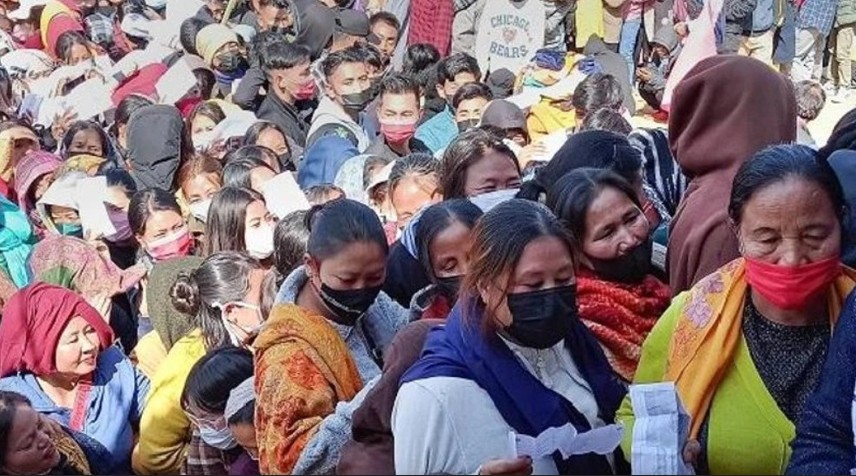
In Manipur, despite the state’s fractured social fabric and the gravity of its political, economic, and administrative challenges, elections are rarely anchored in pressing issues or substantive policy debates. The din of electoral contests is filled not with ideological clashes or manifesto-driven campaigns, but with whispers of favours, handouts, and promises exchanged in hushed conversations and backroom dealings. A phrase often heard—peisa da chatpa (voting for cash)—has become shorthand for the transactional nature of Manipur’s electoral culture.
At a recent conclave marking the first anniversary of Dr. Angomcha Bimol Akoijam’s tenure as Member of Parliament from the Inner Manipur Parliamentary Constituency (IMPC), a popular young farmer and YouTuber known as ‘Farmer Lairenmamit’ was asked about peisa da chatpa and the absence of issue-based elections in the state. He responded: “We can take the cash from all the candidates and still vote for whoever we want.” Seemingly humorous, his remark reveals a more complex political reality: electoral outcomes are not determined solely by monetary handouts, but by networks of relationships, expectations, and moral obligations that extend far beyond the immediate voting for cash. In this context, monetary inducements, sometimes, act more as a gesture, a sign of worthiness, a token of the candidate’s intent to care.
To understand why issue-based elections remain elusive in Manipur and why citizens often fail to hold leaders accountable for governance failures, we must engage with the deeper structure and the underlying logic of this political and electoral culture—often captured through the concept of ‘patronage politics’ or ‘clientelistic politics’—which continues to structure both voter behaviour and representative practices in Indian and other South Asian democracies.
Patronage Democracy and the Logic of Clientelism
In theory, representative democracy relies on autonomous voters making electoral choices based on policy issues, ideological commitments, and the merit of individual candidates—rather than coercion, kinship, or parochial loyalties. Sound political choices should reflect collective interests and be shaped by ideological commitments rather than private gain or social affiliations. Liberal democracy envisions an impersonal, egalitarian, and disinterested political sphere where political representation is understood as a contractual relationship between citizens and their representatives. This vision underpins the ideal of programmatic politics, wherein parties appeal to voters through universal policy platforms, and public goods are distributed impartially, not via personal ties or kinship networks.
Yet, across much of the world—and certainly in parts of India including Manipur—this vision remains more aspirational than reality. Here, democracy functions through a different grammar. Elections are performances of loyalty, reciprocity, and strategic calculation. Electoral choices are driven more by personal gain than by collective interest. Politicians secure support by distributing goods and favours, while voters use their electoral power to extract resources from both politicians and the state. In this dynamic, voters act as clients receiving material benefits or symbolic validation, while politicians serve as patrons responsible for their clients’ welfare. A hierarchical patron-client relationship shapes electoral behaviour. Voters often choose the candidate who can best deliver benefits—whether a job, a road, or a timely phone call to a bureaucrat. To appear worthy, patron-politicians must project power, wealth, generosity, and self-sacrifice. In voters’ assessments of the “best patron”, shared clan or ‘sagei’, kinship ties, co-ethnicity, or personal familiarity are all seen to be increasing the prospects for future benefits. Social relationships, which ideally should remain separate from electoral decision making and governance, come to influence both electoral choices and political representation.
Accordingly, vote-buying, constituency service, and selective use of state resources become core electoral strategies. Local brokers and community elders often mediate these exchanges, translating elite power into grassroots mobilisation. Welfare schemes and public goods are deployed not as entitlements, but as tools of political calculus—rewarding loyalty, punishing dissent.
The distribution of benefits is individualised—targeted to specific individuals or families or residents of a single street rather than to broader social categories like women, farmers, or disadvantaged communities—and discretionary— takes place not by standardised rules, but on a case-by-case basis, typically on the basis of ad hoc decisions of the political actors. Resources may come from state coffers or private pockets and can range from rations and road repairs to selective use of administrative power. Even in the absence of actual rewards, the expectation of future benefit keeps the patron-client bond intact.
This is the essence of clientelism or patronage politics. Prevalence of such politics and political culture is attributed mainly to the lack of economic development which led majority of people dependent on state largesse for their livelihood; education and political awareness to foster demand for universal entitlements over targeted, personalised benefits; weak administrative institutions vulnerable to political interference, particularly the misuse of transfers and postings as political tools; and crucially, the lack of effective institutional and legal safeguards against corruption.
Clientelism and the Crisis of Democracy in Manipur
No democracy is entirely free of clientelism. But when such logic becomes the primary basis of political competition—as it often does in Manipur—issue-based politics recedes, and elections become less about public problems than private exchanges. Manipur’s non-issue-based elections are reflections and reinforcement of patronage democracy. Even when policy issues are raised, they rarely shape outcomes. Instead, electoral behaviour is driven by access to resources, patron-client ties, ethnic loyalties, and local networks of influence. Binding citizens in hierarchical, short-term relationships, clientelism erodes free political and electoral choice shaped by collective interests. In such systems, accountability weakens, and the promise of democracy thins, replaced by a politics of proximity, dependency, and moral obligation. As Kitschelt and Wilkinson argue, it replaces genuine political accountability with transactionalism—trading votes for payments or favours—thus reversing the democratic principle of rule by the people.
Scholars like Anastasia Piliavsky offer a more forgiving view of patronage democracy, emphasising a ‘moral logic of relatedness’ between the electorate and their patron-politicians. Others note that clientelism increases voter turnout and occasionally benefit the marginalised groups. However, in the conventional understanding of clientelism, it is understood to undermine democratic ideals. Such understanding is particularly relevant in the context of Manipur.
The logic underlying clientelism or patronage politics also explains why voters in Manipur no longer place significant importance on candidates’ party affiliations or political parties as such. Political actors in the state are typically unmoored from ideological commitments, navigating the field instead through strategic opportunism. Frequent party-switching is a familiar—and often successful—tactic. Even after changing parties, influential politicians tend to retain their support bases due to their status as effective patrons. Such opportunistic and frequent defections have historically led to chronic governmental instability, punctuated by periods of President’s Rule. It was only after the anti-defection laws were tightened in 2003 that a semblance of political stability began to return.
Party labels matter to voters primarily insofar as they signal alignment with the ruling party at the Centre, which is perceived to enhance a candidate’s ability to form the government and secure material benefits for constituents.
When political parties are formed to represent specific ethnic groups and gain support by promising benefits to those groups—i.e., when ethnic identity politics is built on the logic of clientelism—an ethnic party system takes shape. However, in Manipur, such ethnic politics based on clientelism rarely takes root due to the state’s peculiar social, political, and institutional settings. As a result, the significance of political parties—as institutions facilitating citizen participation, policy formation, and government accountability—is becoming increasingly defunct.
Is Issue-based election possible in Manipur?
A pressing question arises: are issue-based elections possible in Manipur, where patronage democracy runs deep—arguably deeper than in most other corners of India? Can political parties or candidates truly rally voters around substantive concerns? Can issue based appeals ever outweigh the magnetic pull of clientelistic ties? Under ordinary conditions, the answer is likely no. As long as poverty remains widespread, dependence on state largesse continues, and administrative institutions lack strength and autonomy, non-programmatic politics will retain its grip.
Few examples illustrate this more starkly than the electoral defeat of Irom Sharmila, the “Iron Lady of Manipur,” in 2017. After fasting for almost 16 years to demand the repeal of the draconian Armed Forces (Special Powers) Act, her cause had become a symbol of moral courage and nonviolent resistance against the violations of human rights. Yet, when she entered the electoral fray—armed not with money or muscle, but with conviction and clarity—she secured only a handful of votes. Her crushing loss served as a sobering reminder: in a political culture governed by patronage, even the most selfless struggles may fail to translate into electoral capital.
However, the ongoing crisis in Manipur—marked by state failure, social conflict, and public disillusionment—has opened a window for issue-based politics to emerge. The scale of the crisis, amplified by media and civil society mobilisation, has created space for issue-based election. Dr. Bimol Akoijam’s recent parliamentary victory over the BJP candidate in Inner Manipur offers a powerful testament. His campaign focused on democratic values, state inaction, and substantive issues—demonstrating that under exceptional circumstances, issue-based voting is possible even in historically clientelist contexts.
Nevertheless, whether this shift can endure—especially in state assembly elections—remains uncertain. MLAs and state ministers, who control the distribution of state resources, are better positioned to offer clientelistic benefits. Until broader structural reforms take root, clientelism will likely remain central to Manipur’s political landscape—just as it persists, to some degree, in advanced democracies like the U.S., Italy, and Japan, where even sustained reform efforts have only partially curtailed patronage.
Way forward: Towards Ethical Patronage and Democratic Renewal
Given these realities, an abrupt rejection of patronage politics in favour of purely issue-based voting is unlikely to succeed. In such settings, reform strategies must navigate existing political realities, adapting tactically rather than attempting to bypass them altogether. What the state needs is not a wholesale break from clientelism but its ethical repurposing where the role of political leaders shall be immense.
Despite its normative shortcomings, patronage democracy is not inherently undemocratic; it often serves as a pragmatic mechanism for representation and resource distribution. Aspiring leaders and public-spirited actors—though often constrained by limited resources—can still engage with patronage politics without abandoning their ethical and ideological commitments and compromising their concerns with state’s issues. By cultivating trust-based relationships, offering modest yet equitable support, and ensuring transparent access to opportunities, they can humanise the patronage system rather than exploit it.
A moralised form of patronage can function as a transitional tool. Leaders may leverage their influence to promote democratic and constitutional awareness—particularly concerning political accountability and citizens’ rightful entitlements. Such leaders, by remaining ideologically committed and resisting opportunistic party-switching, exemplify what Edmund Burke and Germaine de Staël believed: that the bond of partisan attachment among representatives can moderate the corrupting effects of patronage. Over time, such engagement could nurture a political culture in which voters demand entitlements rather than favours, respond to issue-based appeals over clientelistic ones, and leaders govern by principle rather than paternalism.

The writer is a Ph.D candidate at the Centre for Political Studies, Jawaharlal Nehru University, New Delhi