Nearly three years after Manipur descended into one of the gravest violent conflicts witnessed by any Indian state in recent decades, the central question confronting both the Union government and the administration under President’s Rule is no longer merely one of security management, but of political intent and constitutional responsibility. What has the State – understood here as both the Union/Central government and the Manipur government whether elected or under President’s Rule, the Parliament and the Legislature, and other authorities within India or under the control of the Indian government – actually done to resolve the crisis, restore civic trust, and build a durable peace?
A critical examination reveals a deeply troubling pattern. The State has prioritised the optics of “normalcy” over the substance of reconciliation, justice, and institutional repair. Silence of guns has been conflated with peace, administrative continuity with legitimacy, and the containment of violence with the resolution of conflict. This narrow framing has allowed the deeper political, constitutional, and moral dimensions of the Manipur crisis to remain unaddressed. In short, the State has emphasised Normalcy Without Justice.
President’s Rule as a Missed Constitutional Moment
The imposition of President’s Rule in Manipur was widely perceived as a constitutional reset. It was expected to provide New Delhi with an opportunity to act with neutrality after the erosion of trust in the Bharatiya Janata Party (BJP)-led elected government, particularly among one of the principal communities involved in the violence. Direct Central rule was seen as a mechanism to transcend alleged partisan considerations, overcome administrative paralysis, and initiate a peace process insulated from local political compulsions.
Instead, President’s Rule has largely functioned as an instrument of crisis containment rather than conflict resolution. The absence of large-scale violence since its proclamation has been projected as “restoration of normalcy,” while the deeper pathologies of the conflict remain not only unresolved but, in several respects, institutionally entrenched. President’s Rule has not been used to dismantle the structures of segregation, impunity, and mistrust that the violence produced. Rather, it has stabilised them.
Peace Is Not the Absence of Violence
The Central government’s principal claim since the proclamation of President’s Rule has been that peace has largely returned to Manipur, citing the decline in daily incidents of violence. This framing is deeply problematic. Peace is not merely the absence of gunfire; it is the restoration of rights, mobility, livelihoods, trust in institutions, and the assurance of equal protection under law at least in the present context of Manipur.
By these measures, Manipur remains a deeply fractured and militarised space. Ethnic segregation has hardened into lived reality, displacement has become semi-permanent, and the writ of the State remains uneven and contested. What exists today is not peace but a frozen conflict – managed through force, silence, and separation rather than resolved through justice and political courage.
National Highways and the Collapse of Constitutional Freedom
Perhaps the most stark and indefensible manifestation of this failure is the continued restriction on free movement along the National Highways – NH-2 and NH-37 in Manipur. National Highways are not local roads; they are sovereign arteries of the Indian Republic, meant to guarantee unimpeded movement of citizens, goods, and services across the territory of India. The continued restriction of Meiteis from accessing National Highways in their own state represents not merely a security lapse but a constitutional rupture and suppression of an entire ethnic group.
The freedom of movement guaranteed under Article 19 of the Constitution cannot be suspended indefinitely for an entire community. That, Indian citizens can be prevented from travelling on National Highways within their own state – based on ethnicity – marks a grave abdication of constitutional responsibility. This is not law and order management; it is the normalisation of collective punishment and ethnic exclusion.
The first and foremost obligation of the State, especially under President’s Rule, should have been to reopen National Highways for free and safe movement of all citizens without discrimination. Security concerns, however real, cannot justify the creation of ethnic corridors and forbidden routes. To do so is to accept the logic of de facto partition and to concede sovereignty to armed militant groups who enforce these restrictions.
By failing to decisively secure National Highways and guarantee free movement, the State has sent a dangerous message – that the fundamental rights of citizens in Manipur are negotiable, contingent, and subordinate to the threats posed by armed non-state actors particularly Kuki-Zomi militants. No meaningful peace can be built as long as citizens are treated as outsiders on the highways of their own country.
Internal Displacement and the Normalisation of Loss
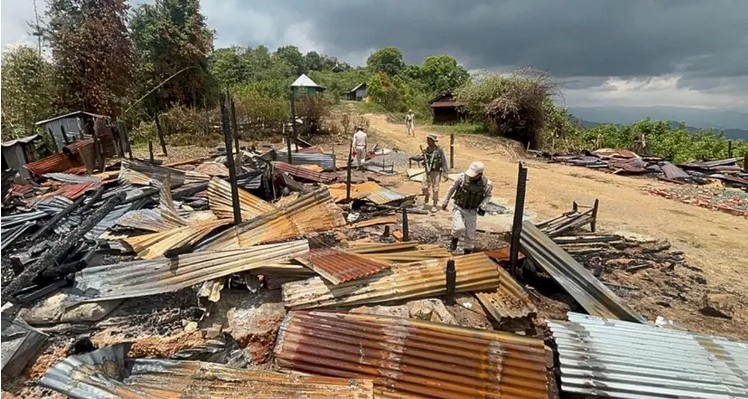
One of the most glaring failures of both the Central government and the President’s Rule administration in Manipur has been the lack of urgency in facilitating the return and resettlement of Internally Displaced Persons (IDPs). Tens of thousands continue to live in relief camps or precarious informal settlements. Their villages lie destroyed and/or inaccessible; their lands remain contested; their futures are frozen.
The longer displacement persists, the more it ceases to appear as a temporary humanitarian emergency and begins to resemble a structural reordering of space and population. History – from Kashmir to Sri Lanka – demonstrates that prolonged displacement alters demographic realities, entrenches grievances, and becomes a powerful driver of future conflict.
Despite possessing extraordinary powers under President’s Rule, the administration has failed to articulate a credible, time-bound resettlement policy. There is no publicly articulated roadmap for village reconstruction, no transparent mechanism for property restitution, and no comprehensive security framework guaranteeing safe return. Compensation schemes remain fragmented, opaque, and unevenly implemented.
This inertia raises deeply uncomfortable questions. Is prolonged displacement merely a consequence of administrative incapacity, or does it reflect an unwillingness to confront the political implications of return, particularly in areas where Kuki-Zomi militant groups exercise de facto control despite heavy deployment of Central Security Forces? The longer return is delayed, the stronger these de facto arrangements become.
Buffer Zones and the Cartography of Segregation
Closely linked to displacement is the issue of buffer zones, which have become one of the most consequential yet least interrogated instruments of the State’s conflict-management strategy. Seemingly introduced as temporary security measures, buffer zones have gradually hardened into quasi-permanent lines of separation.
These zones restrict civilian movement, reinforce ethnic segregation, and lend implicit legitimacy to claims of exclusive territorial control. That even a sitting Supreme Court judge or a Member of Parliament – if Meitei – cannot freely traverse certain areas illustrates the extent to which constitutional authority has been subordinated to ethnic enforcement.
By allowing buffer zones to persist without a clear exit strategy, the State has strengthened the ideological narrative of Kuki-Zomi exclusivism and territorial imagination. These zones now function as symbols of an emerging cartography of ethnic sovereignty. Their continued existence undermines Manipur’s territorial integrity and signals that the State is either unable or unwilling to enforce uniform law and order.
The argument that dismantling buffer zones would risk renewed violence cannot be accepted as final. Security challenges are real, but they are not insurmountable. Buffer zones should have been replaced with professionally managed, ethnically neutral security checkpoints that regulate movement without enforcing segregation. The refusal to attempt this transition reflects a preference for administrative convenience over constitutional duty.
Ethnicisation of State Forces
Equally troubling is the manner in which the Manipur Police and other state security forces have been managed during and after the violence. Instead of functioning as instruments of integration and impartial law enforcement, state forces have increasingly been reorganised along ethnic lines through transfers and postings.
Officers perceived as belonging to one community are routinely moved out of areas dominated by another, ostensibly to prevent bias or friction. While this may appear pragmatic in the short term, it is profoundly corrosive in the long run. A police force segmented by ethnicity ceases to function as a neutral institution of the State.
Such practices erode professional ethos, destroy morale, and undermine public trust. They also embolden the Kuki-Zomi armed militants who thrive in zones of weakened state authority. Under President’s Rule, the Central government possessed both the authority and responsibility to reverse this trend by reorganising the state forces on strictly professional, constitutional lines. That this has not been done speaks volumes about the State’s reluctance to confront hard truths.
Administrative Hollowing and the Absence of Courage
The failure to reinstate experienced civil servants and police officers who were transferred out or opted for deputation during the height of the crisis further compounds the problem of segregation on ethnic lines. Their absence has hollowed out governance and produced an administration hesitant to take decisive action. The State must first allow civil servants and police officers of all communities work together at the Manipur Secretariat, Police Head Quarters, district administrations, and show the public the way forward for reconciliation.
The continued segregation even among civil and police officers reflects either fear of internal dissent or an unwillingness to disrupt entrenched arrangements. President’s Rule, instead of restoring institutional coherence, has presided over its fragmentation.
Armed Groups and the Persistence of Impunity
Another dimension of State failure lies in its ambivalent approach to armed militant groups. While official rhetoric emphasises law and order, actions often suggest selective enforcement and selective operations. Delayed operations, uneven responses, and the persistence of armed mobilisation have created an environment of perceived impunity.
The violent attacks attributed to Kuki militants in December and on January 6 exposed the fragility of the so-called normalcy. These incidents were not aberrations; they were reminders that the conflict infrastructure remains intact. Yet the State treated them as isolated breaches rather than symptoms of a deeper failure.
The critical question remains unanswered – why do Kuki-Zomi militant groups continue to enjoy operational space, ideological legitimacy, and community protection? Without confronting this political reality, security operations will remain reactive and insufficient.
Frozen Conflict, Deferred Peace
At the heart of the Manipur crisis lies a profound breakdown of trust – between communities, between citizens and the State, and between the State and its own institutions. Restoring this trust requires more than troops and administrative orders. It demands a political process that acknowledges grievances, enforces constitutional equality, and dismantles structures of segregation.
The reluctance to push for peace, as opposed to proclaiming normalcy, reflects a deeper malaise in India’s approach to conflicts in the Northeast especially Manipur. Normalcy is easier to manage and market than peace. In Manipur, this has produced a dangerous stasis – violence is contained but unresolved; governance continues but legitimacy is fractured; the conflict is frozen, not healed.
The Choice Before the State
President’s Rule was meant to be a moral and constitutional intervention, not an administrative pause. The Central government cannot indefinitely outsource accountability to the language of security management. Every day that National Highways remain restricted, IDPs remain displaced, buffer zones persist, and state forces remain ethnically segmented is a day when the constitutional idea of Manipur is further eroded.
If peace is to be built, priorities must shift decisively. The State must first guarantee free movement on National Highways as a non-negotiable constitutional right. It must dismantle structures that legitimise ethnic segregation, reorganise state forces on professional lines, expedite the return of displaced persons, and reclaim its monopoly over legitimate force without fear or favour.
The tragedy of Manipur is not only the violence it has endured but the opportunity it continues to lose. History will not judge the State by how effectively it managed the optics of normalcy, but by whether it had the courage or political will to pursue peace when it mattered most. Until that courage and political will is evident, Manipur will remain suspended – not just administratively, but ethically and politically – between conflict and peace.

Senior Editor: Imphal Review of Arts and Politics