Manipur, a land celebrated for its vibrant culture, is also quite famous for its festivals. Some originated from the Manipuri soil and some were imported from outside, but nonetheless they are celebrated with joy and anticipation. Among them, the Sangai Festival is one of them. It is supposed to celebrate the uniqueness of the Sangai (Rucervus eldii eldii), but what we have seen was contrary to the ethos of the festival.
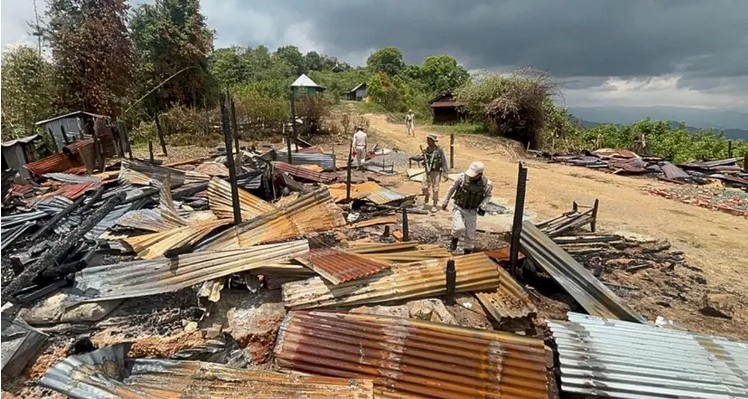
Since May 2023, Manipur has been in a precarious position amid the ethnic clash. Thousands of people have been displaced and many are struggling to survive on a daily basis. With the multiple failures of the state to restore normalcy, President’s Rule was imposed in February 2025. Many had believed that the PR would definitely deliver the long-awaited normalcy, but
it has been nine months with no significant development for reconciliation or proper applicable methods to restore normalcy. When the authority’s decision to organise the Sangai Festival 2025 was publicly known, many people, including the IDPs, had expressed their concerns to bring the attention of the authority to acknowledge the harsh living conditions of the IDPs first, but it seems the authority did not have the stomach to listen to the people. And it can be observed in the recent rally on November 20, one day before the commencement of the festival, where the security forces had resorted to undemocratic methods to suppress the crowd.
Whether the order for such security measures was already given days before or not is something that can be questioned. The fundamental concept of a festival is to reflect the livelihood of the people and their productive activity. But if the people were to be brutally suppressed for asking to acknowledge the material reality of the masses, the political situation of the state, and for asking the authority to reconsider its decision to organise a festival, then such a festival could potentially harbour certain hidden agendas behind it.
Is it supposed to be organised by the will of the people to celebrate the uniqueness of the Sangai, or is it supposed to be organised by the state to intimidate the people or to reflect the authority’s triumph over the citizens through lathi charge? Such an unfortunate incident reflected the detachment of authority from the livelihood of the masses, a rupture in the fundamental value of a modern democratic republic.
Or perhaps the authority had hoped to be seen as a good administrator and the festival would have been a testament to it, in fact seeking personal glory and a benevolent public image, or perhaps being adventurist. Among the security forces, it was observed that there was a certain degree of subjective approach towards the democratic rally of the masses. Such an approach reflected the nature of a mere perpetual perceptional understanding of the circumstances. For a cognitive being, that would be a negation of the human intellect.
Again, for the authority, there are still multiple things to discuss regarding the incident and the recent process of development of this festival. Could providing a few stalls to the IDPs deliver a favourable condition to all the struggling IDPs? It is quite well known to the people that, though the IDPs are citizens of a democratic republic, they would not get the chance to return home with proper security measures anytime soon, even by opposing the decision to organise the festival, which means they would not get it either by participating in the festival.
However, the failure of the authority is crystal clear and the purpose of a state is yet to be clarified. The audacity to turn a blind eye to the voice of the masses and the desperate attempt to organise a supposed people’s festival reflects the authority’s obsession with public image rather than the livelihood of the people. Perhaps the people are mistaken for mere subjects.
And it is quite a wonder to recall that the citizens are denied the basic democratic right of free movement in their own state while the tourists are granted such access, and some even seem very proud of it. A great success for tourism in the state!!! And believing that providing a few stalls to the IDPs, opportunities to the artists or the small businesses during the festival would bring positive changes would be no more than a laughing stock and the most rudimentary thought a cognitive being could ever conceive with their advanced human intellect. It is not those stalls that they need, for they are dispossessed of land, security, and their very citizenships are in question.
As Cicero once asserted in his De Legibus, the well-being of the people is paramount and must be the foremost duty of any just state. This principle now appears inverted, as public appearance increasingly outmaneuvers the material reality of the people. Providing farcical stalls and opportunities for a few days is nothing but a spectacle of inclusion with the substance in absence.
It is still questionable whether the presence of the IDPs or the artists is meant to enrich the festival, ornaments to please the foreign tourists, or to transform their living conditions. It is more logically convincing to infer that such an approach in organising a supposed people’s festival neither reflects nor celebrates the uniqueness of the Sangai or the human and non-human relationship for centuries, but rather serves the organisers.
Such a failure to exercise the democratic functions and the virtually seen constitutional rupture reflect the failure of a democratic republic and mark the return to outdated and inhumane colonial modality practiced by British rule in the country.

The writer passed out from the Centre for French and Francophone Studies Jawaharlal Nehru University