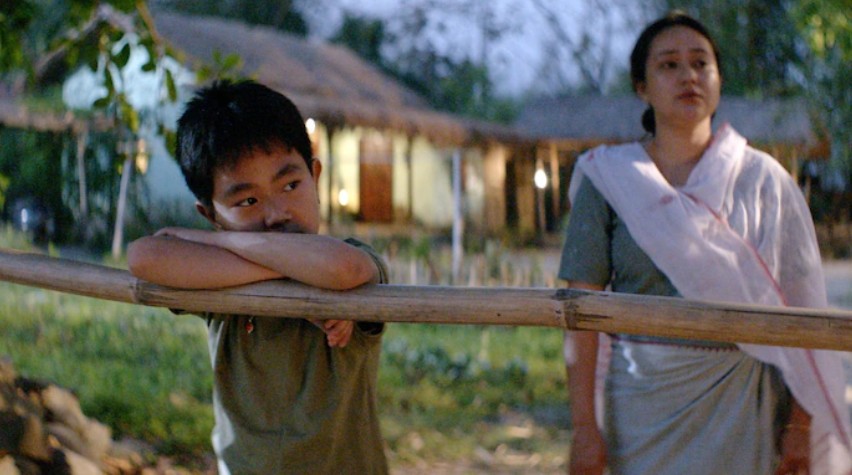
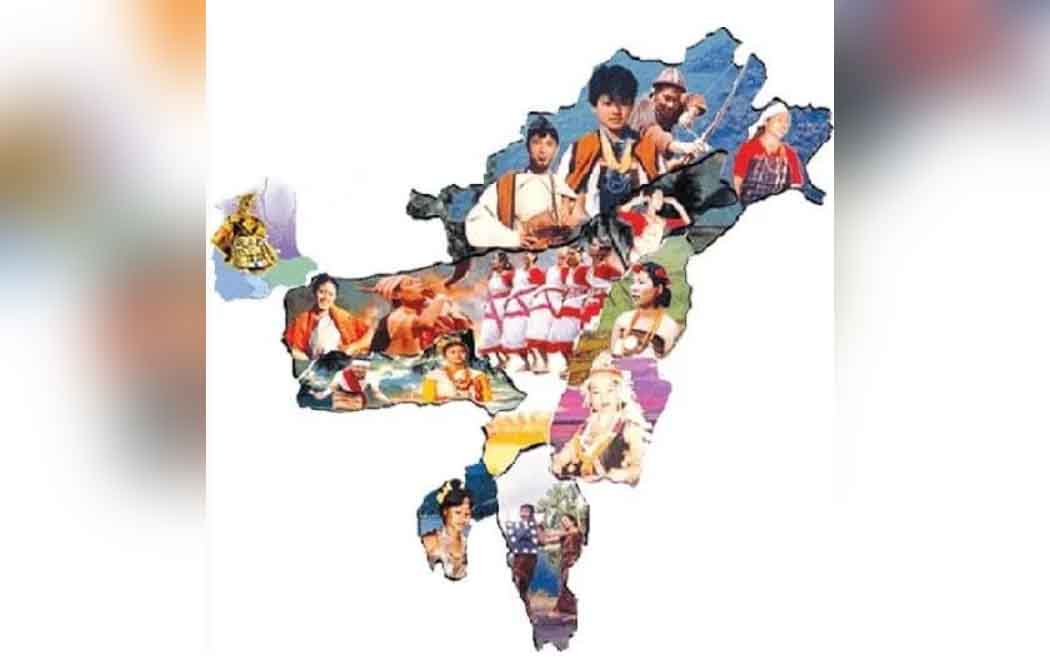
This week, two developments brought the Northeast back into focus in the national media. On February 23 a Manipuri language film ‘Boong’, directed by Lakshmipriya Devi and produced by Ritesh Sidhwani and Farhan Akhtar, won the prestigious British Academy of Film and Television Arts, BAFTA, awards 2026 in the Children and Family category, making every Indian proud.
The other incident happened on February 20 in South Delhi’s Malviya Nagar outraging the nation after a video of it went viral on the internet. In this, three girls from Arunachal Pradesh living in a 4th floor rented accommodation was heckled aggressively with insulting racial slurs by a couple in another flat just below theirs.
The provocation for the verbal assault was the installation of an air conditioner by the girls in their room and the dust kicked up during the installation process. They were heaped with loud derogatory stereotypes that most from the Northeast in Delhi would be familiar with, having faced them silently almost daily, though mostly as racial micro aggressions, normalised so much as to inhibit complaining lest they sound trivial or else incredulous to others.
Interestingly, what happened at Malviya Nagar was almost a dramatic vindication of what director Lakshmipriya Devi flagged in her powerful acceptance speech in London, praying for the return of peace in her troubled home state, Manipur, but also calling attention to the continued neglect, undermining and underrepresentation of the Northeast region in the rest of India.
Quite definitively the Northeast is part of the Indian state, but unfortunately the region is still struggling to fit into the larger Indian national identity, not so much on account of its own sense of alienation but because of the subliminal irridentist nature of the Indian identity and the unwillingness of those within this racial fold to accept the Northeast as it is within this fold.
CPM ideologue, the late Ashok Mitra, anticipated this national blind spot illustratively in a newspaper column titled ‘A dose of heresy’ years ago. Till 1937 Burma was a part of British India. However, when the British decided to bifurcate it from India to be a separate colony in that year, even though it was a time the Indian national movement was peaking, there was not even a squeak of protest. He also speculates that if the hill states of the Northeast too had been similarly separated in that year, there probably have been no protest either.
This nearly happened too. Several British administrators posted in the Northeast also noticed this psychological distance, and four of them had actually suggested that the “Excluded” and “Partially Excluded” hill territories beyond Assam’s Inner Line drawn by the Bengal Eastern Frontier Regulation of 1873, together with the contiguous hill regions of Burma, should be left as a separate ‘Crown Colony’, neither a part of India or Burma, when the British leave.
The most elaborate of these suggestions came as a 22-page note from Robert Reid, Governor of Assam, 1937-1942. This plan came to be taken seriously, and as David R. Syiemlieh notes in his book ‘On the Edge of Empire”, the then Secretary of State for India, L.S. Amery, forwarded a copy of it to Oxford Professor, Reginald Coupland to be used in the third and final volume on the constitutional problem in India that he was working on at the time. The professor did so, but lazy scholarship later resulted in this ‘Reid’s plan’ coming to be also referred to falsely as ‘Coupland plan’.
The plan was almost adopted, but ultimately dropped, not for any objections from Indian leaders, but because other British administrators felt such a place would be ungovernable.
A comparison between counterfactual scenarios of Burma and Northeast should be interesting. In a hypothetical situation, had Burma not been separated from India in 1937, it would have become India’s sacred territory to be defended at all cost from any aggression. In an imagined reverse situation, had the Northeast been made a ‘Crown Colony’, it would have become no more than just another exotic neighbour. “The territory colonial powers bequeath to it, …every new government was to hold fast to it”, Gunnar Myrdal is cited in Neville Maxwell’s ‘India’s China War’.
What is also evident is, the east has never registered too deeply in India’s heart. If Burma’s separation from India in 1937 went virtually unnoticed, ten years later when Pakistan was also similarly separated, a holocaust followed, leaving several millions dead or displaced. Obviously, India and Pakistan were seen as once constituting an organic whole, while the territory and people east of Bengal seldom figured in this imagined national community.
It is tragic that nearly eight decades after independence, the Northeast still remains incompletely integrated into the Indian mainstream ethos. The faults for this is often attributed to those who cannot integrate with this mainstream, but this logic must now be reconsidered.
In the early decades of independence, the official approach has been to require all sub-nationalities to leave their individual streams to join an Indian mainstream, which though unspecified, is generally understood to be closer to the soul of the Gangetic plains. Hangover from this outlook still persists and the Malviya Nagar racial outrage is a reminder.
The ideal situation would be when this binary between sub-streams and mainstream disappear. For a frictionless union, rather than the familiar appeals for those in the sub-streams to leave their streams and join the mainstreams, the mainstream must widen to accommodate all sub-streams as they are, thus add to the beauty of a unity in diversity that India’s Constitution proclaims as its intent.
For this diversity to not become anarchic, there will however have to be a common pathway to conform and adhere too. This consensual pathway must be constitutionally defined, and not be under the shadow of any religion or ethnicity. It must be forged by the aggregate of the diverse aspirations of all, and by aggregate of all the sacrifices each will have to necessarily make to accommodate each other.
This article was first published in The New Indian Express. The original can be read HERE

Editor, Imphal Review of Arts and Politics and author