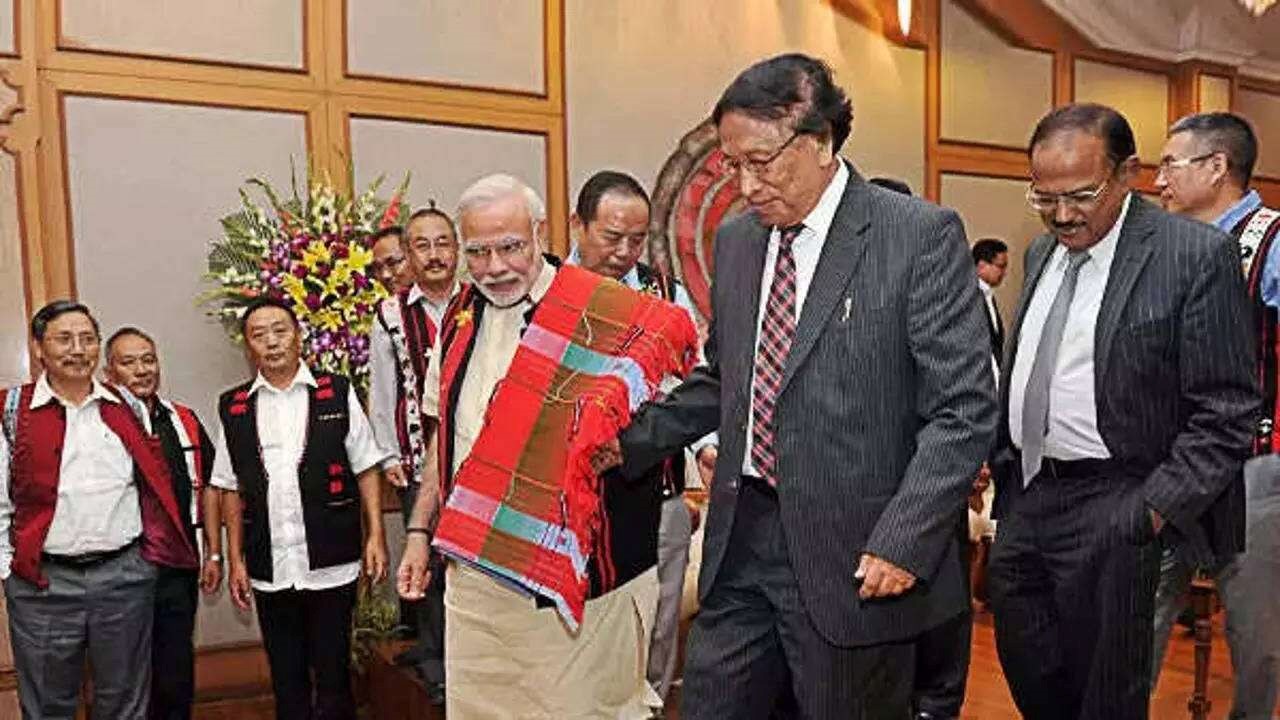
There has been much speculations on the strategic significance Thuingaleng Muivah’s visit to his home village Somdal in the Ukhrul district, Manipur. From the official point of view, Muivah is the chief hurdle before a resolution to the Naga problem, for it is only he who continues to insist on two conditions deemed outside the purview of the Indian constitution – that of a separate constitution and flag for Nagas – as a precondition for such a settlement.
This however is probably over-reading. Muivah is now 91 and not in good health. His abiding wish hence is probably to see his birthplace he left 51 years ago, not knowing if this would be his last chance. He is revered amongst Manipur Nagas, especially his tribe, the Tangkhul for whom he is a father figure, Avakharar. As with anybody who has led an armed movement and having had to exercise brut coercive force to silence oppositions, there are also his detractors. On the eve of his home visit, Zeliangrong United Front, of the Zeliangrong Nagas, for instance called for an apology from him for atrocities allegedly inflicted on many of their tribesmen.
Naga underground politics too has become complex, and Muivah does not anymore command overwhelming support of all Nagas, especially among Nagaland Nagas. The tremendous love and affection shown to him during his home visit therefore may not easily transform into the kind of political energy capable of lifting the Naga issue out of its present stalemate.
Most Nagas today arguably have reconciled to a solution within India. This ironically has complicated the matter further. The lofty ideal of Naga sovereignty, even if impossibly elusive, once provided an advocacy platform for a united Naga struggle. Acceptance of a settlement within India has meant the splintering of even the idea of a solution package, between myriad emerging interest groups. Naga movement too had correspondingly fragmented unrecognizably.
Muivah joined the militant Naga National Council led by A.Z. Phizo, in 1964. From his testimony as well as those of other rebel colleagues published in Nandita Hakshar’s “Kuknalim”, he earned respect for his commitment, determination and intelligence. He was also among the first Naga rebels to slip into China’s Yunnan province to get training as well as to woo international support for the Naga cause.
It was during one of his trips to China that a faction of NNC entered into the Shillong Accord, 1975, to resolve the Naga issue within the Indian Constitution. Muivah rejected this accord as a betrayal and together with Isak Chishi Swu and S.S. Khaplang left the NNC to create the National Socialist Council of Nagaland in 1980.
Perhaps it is the recoil from this rejection which is inhibiting Muivah now from accepting another peace deal within the Indian constitution. If he did, the troubling question would be whether the additional 50 years of trauma for Nagas after his rejection of the Shillong Accord, was meaningless.
The NSCN split in 1988 when S.S. Khaplang, a Hemi Naga from Burma violently parted ways, an eventuality anticipated by Bertil Lintner in “Land of Jade” after having stayed in the NSCN headquarters in Burma in mid-1980s. This split was broadly between the more backward Nagas tribes, most of whom were in Burma, and Nagas from India.
The NSCN faction of Isak Chishi Swu and Muivah, is still the most powerful and well-organised amongst the two dozen or so splinter groups of the original NSCN, most of which are under a federal conglomeration styled as Naga National Political Group, NNPG. Almost all of them are united in their opposition to NSCN(IM).
The seeds for Naga rebellion were evident even before the British left India. For instance, the Naga Club which in 1946 morphed and radicalised into the NNC, made it clear in its memorandum to the Simon Commission in 1929 that Nagas were not Indians and would like to be left unaffiliated to India as and when the British leave.
World War-I was a game changer in the consolidation of the Naga identity. Disparate and often mutually hostile Naga tribes and villages, came to be enlisted in the British Labour Corps, to be transported to Europe in the latter’s war effort. Exposure to the outside world and also the realisation that they were treated as a category different from the rest, even other Indian soldiers, made the Nagas realise their common destiny.
It is no coincidence that the Naga Club, the seminal organisation that fostered a new Naga nationalism was formed by Naga veterans of WW-I, with the assistance of some British officials sympathetic to the Naga predicament.
After the British formally annexed Assam at the end of the First Anglo-Burmese War 1824-1826, not just the Naga Hills, but the entire stretch of mountainous territories surrounding the Assam plains were left “unadministered”, although claimed as British territory. The Government of India Act 1919, redesignated these “unadministered” territories as “Excluded Areas”. The GOI Act 1935, upgraded some of these “Excluded Areas” to “Partially-Excluded Areas”.
When India’s independence became a certainty, there were four British proposals to leave these excluded and partially excluded areas as a separate “Crown Colony” as David Syiemlieh writes in “On the Edge of Empire”. The best known of these is by Robert Reid, a former Governor of Assam. In a 22-page note in 1941, he contended the people of the region are alien to India’s nationhood and would be best left separate. The idea was ultimately dropped as other British officials felt such a place would be ungovernable.
This foreboding however proved somewhat prophetic and several separatist insurgencies spawned in this region in postcolonial India and Nagas were the first to revolt. Muivah’s heroic struggle and tragic failure in this way is a poignant portrayal of both the historical logics as well as the futility of rigidified rebellions, stubbornly hanging on to slogans made redundant by lapsed decades. Maybe it is also a pointer towards what a constructivist approach to a win-win solution can be to this problem endemic to the Northeast region.
This article was first published in The New Indian Express. The original can be read HERE

Editor, Imphal Review of Arts and Politics and author