
To be Meitei in Manipur today is not merely to inhabit a cultural or historical identity; it is to constantly prove one’s legitimacy under conditions of manufactured vulnerability. Meitei-ness is no longer a settled social fact. It is now calibrated by how securely one is positioned within mutable hierarchies of belonging. Identity here is conditional. It is tested, evaluated, and often weaponised.
What is crucial to understand is that Meitei-ness today is not produced primarily through shared culture or language, but through positioning against an antagonist. Vulnerability becomes the currency through which identity is negotiated. Those who feel most insecure, economically, politically, or socially, are compelled to overperform loyalty. And in the current political climate, loyalty is proven through hostility.
This is not unique to Manipur. Political theory and social history repeatedly show that when communities experience anxiety without clear avenues for redress, they redirect fear toward proximate and weaker groups. Vulnerability rarely produces solidarity on its own; more often, it produces scapegoating. The logic is brutal but effective: survival is sought not through structural change, but through identifying an “internal enemy” whose exclusion promises stability.
In normal time, this dynamic has already been visible within Meitei society. Meitei-ness has often been articulated through anti-Muslim sentiment directed at Pangals and, at other moments, through suspicion and hostility toward Christians. These antagonisms are not spontaneous cultural reflexes; they are political performances. They allow Meitei identity to align itself with power by distancing itself from those marked as “less legitimate.”
Pangals, despite being historically embedded in Manipuri society, are repeatedly rendered suspect. Their loyalty is questioned, their belonging conditional. Anti-Pangal sentiment serves as a rehearsal space for majoritarian politics: it allows the assertion of dominance without confronting the deeper sources of insecurity. Similarly, Christians, particularly from the hills, are framed through narratives of conversion, foreign influence, or demographic threat. These narratives closely resemble mainland Indian Hindutva discourse, merely translated into local idiom. This is where vulnerability mutates into aggression.
Critical social theory—from René Girard’s scapegoat mechanism to securitisation theory articulated by the Copenhagen School (Barry Buzan, Ole Wæver), helps explain why vulnerable sections within dominant communities often become aggressively exclusionary. When structural insecurities cannot be resolved politically, they are displaced socially. Everyday anxieties, about land, jobs, culture, are transformed into existential threats. Once securitised, these anxieties demand enemies, not solutions. The most vulnerable sections within a dominant community often become the most vocally hostile, because aggression becomes their shield. To survive socially, one must demonstrate that one belongs to the majority not merely by birth, but by attitude. Thus, to prove Meitei-ness, one must be visibly anti-someone.
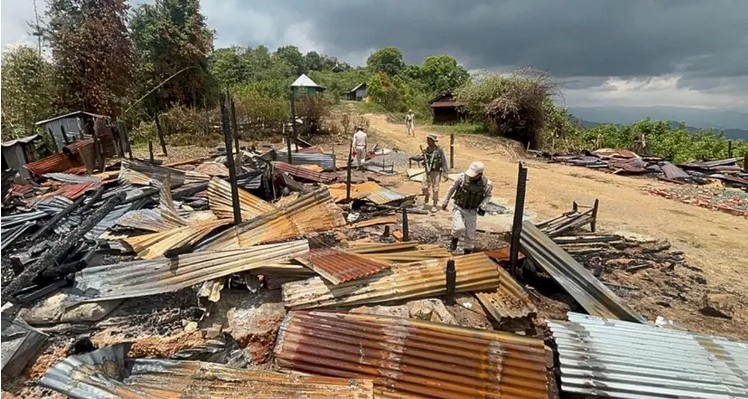
This mechanism intensifies often during any conflict. When violence escalates, symbolic antagonism is no longer sufficient. The enemy must be clearer, larger, and more threatening. It is at this point that pro-Meitei politics, already shaped by exclusion, slides seamlessly into anti politics. This shift is not accidental; it is structurally predictable.
Any conflict offers a stage where loyalty can be spectacularly performed. To be neutral is to be suspect. To ask questions is to betray. Vulnerability is now collective, and survival demands alignment. In this environment, ideological forces like the RSS do not impose themselves by force; they are invited in by fear.
The RSS thrives precisely in such moments. It offers a ready-made script for insecurity: you are under threat, your land is being taken, your culture is being erased. It identifies a clear antagonist and supplies moral justification for hostility. For sections of Meitei society, aligning with this framework offers immediate emotional relief. Confusion is replaced with certainty. Complexity is replaced with binaries. But this alignment comes at a devastating cost.
By internalising RSS logic, Meitei nationalism is hollowed out and reoriented. As Arkotong Longkumer shows, Hindutva in the Northeast expands not by erasing local identities but by working through them, adapting, vernacularising, and aligning with indigenous revivalisms to appear as a civilisational ally rather than an external force. Sanamahi and local traditions are not rejected, only repositioned within a majoritarian moral universe, through which the hills and the valley are recast from political spaces of negotiation into civilisational battlegrounds.
This is ideological super profit for the RSS. It gains a new frontier without investing in historical understanding. It converts local conflict into proof of its worldview. Manipur becomes not a place with its own political trajectory, but a laboratory for majoritarian expansion. The irony is that this does not resolve Meitei vulnerability, it deepens it.
A politics built on permanent antagonism cannot stabilise itself. Each moment of exclusion creates the conditions for the next. Once Pangals are marginalised and Christians demonised, the logic will demand new enemies. Vulnerability must be continuously reproduced to justify power.
Meanwhile, dissenting Meitei voices, those who refuse the script of hatred, are silenced. They are accused of betrayal, labelled anti-Meitei, or dismissed as naïve. In this environment, the community does not merely police others; it polices itself. Fear becomes internalised discipline.
What is lost is Manipur as a shared political imagination. Nationalism, instead of being a project of collective self-determination, becomes an instrument of internal domination. The Indian state benefits from fragmentation, ideological forces benefit from expansion, and ordinary people inherit endless conflict.
The present crisis should therefore be read not only as ethnic violence, but as a warning about ideological capture. A community that seeks survival through exclusion eventually mortgages its future. Aligning with majoritarian power does not protect small nationalisms; it consumes them.
The question facing Meitei society is not whether vulnerability is real—it is—but whether vulnerability will continue to be managed through hostility. Can Meitei-ness be articulated without producing enemies? Can insecurity be addressed politically rather than morally? Can Manipur imagine a future not dictated by ideological imports from the mainland?
These are difficult questions because they require refusing the comfort of certainty. Hatred is easy; political responsibility is hard. But without such a reckoning, Meitei-ness will remain trapped, defined less by what it is, and more by whom it excludes. And in that exclusion, Manipur itself will continue to be lost.

The writer is an independent researcher holding a Ph.D. from the CSLG at Jawaharlal Nehru University (JNU), New Delhi. His research focuses on questions of constitutionality, governance, and indigeneity in India’s Northeast, as well as issues related to insurgency and counterinsurgency.