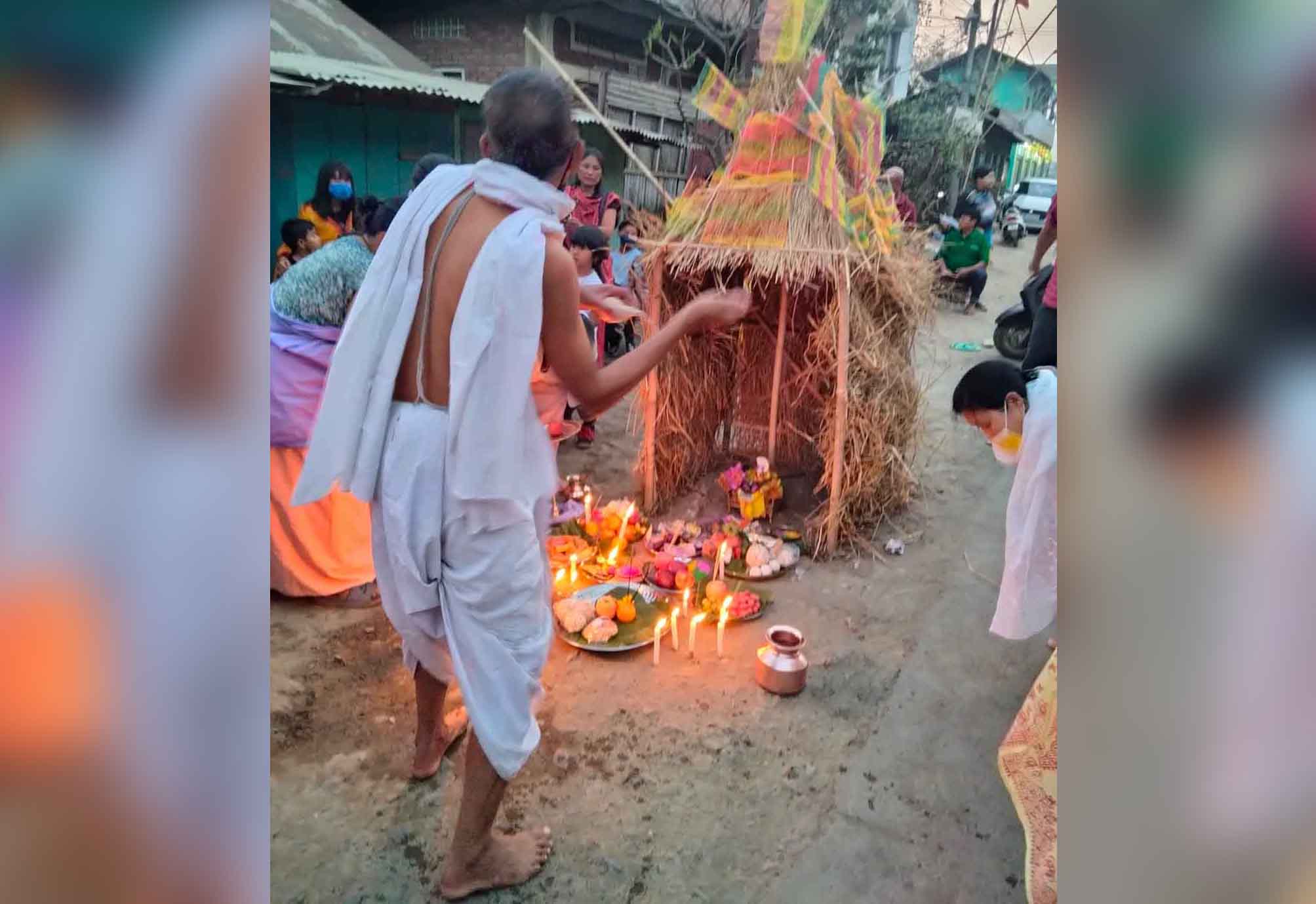
There is a lesson for those in power currently amidst the tectonic move they are introducing to homogenise nationality and nationalism in the country, from the manner festivals in Manipur, traditional as well as newly reinvented ones, are inching towards a cultural confluence. If this trend continues, we are sure a natural synthesis of cultural outlook as well as collective political aspiration can result. Purists may frown at this, but this is a reflection of the reality of Manipur from which none can turn away unless he is bent on fooling himself. Manipur has no other way than for the different communities to live together and discover their individual salvations in this collective existential predicament.
We for one welcome this inevitable trend, not only because it is inevitable but because it is desirable. It is for this same reason we are disturbed by the push for forced singularity of the definition of Indian nationalism by the current power dispensation. Indeed, “Mankind would die of a great loneliness” if the world was to become a monoculture. This line, borrowed from a letter by Chief Seattle of the Suquamish and the Duwamish he is believed to have written in 1854 when the Great White Chief in Washington, Governor Stevens, wanted to buy his land and offered him and his people to live in a Reservation, explains a great many things. Chief Seattle said this in a different context, and his immediate point of reference was the White settlers’ well known and notorious way of mindless slaughtering the beasts and fouls which share and inherit the bounties of the earth with humans. However, the spirit is virtually the same – it is variety which makes life colourful and interesting. Cultural and identity exclusiveness can only lead to friction and disequilibrium.
There is a fine line to be drawn here. We want identities to remain distinct so that they do not meltdown into a monoculture, but we also want each identity to be open and accommodative of the others. No cliché encapsulates this ideal more than the one about letting a 100 flowers bloom together. It is also one which should fittingly define Manipur’s and indeed the Northeast’s or for that matter the entire country’s ideal for peace and harmony.
This has been the trend of many other festivities in the state. Be it Christmas, Yaoshang, Eid and so many more. It is almost as if religious and ethnic identities are in a profound way, transforming to acquire attributes of a new secularism perhaps as part of what social scientists now call Creolization of cultures and identities in which without anybody merging or being swallowed up by another, each of the different groups just by virtue of being in close proximity of each other, begin to look more and more like the other, and the walls that separate them become in a progressive manner, more permeable.
Cultures and identities, there can be no doubt, do respond to osmotic pressures of their own, and with time, tensions and differences between them invariably come to be sublimated. To push the osmosis analogy a little further, it seldom does good to rush the issue, for the semi-permeable membrane that separate different solvents and make osmosis possible is also vulnerable to rupturing under excessive strain. What is essential are gentle policy nudges here and there to catalyse the process, and the phenomenon would initiate and acquire a momentum of its own. Even as the state celebrates the indomitable spirit of hope, justice and peace, let us celebrate this new outlook so visible today is the herald to the end of a dark era in the life and times of this troubled state, and the beginning of a new dawn of understanding and empathetic co-existence.

Editor, Imphal Review of Arts and Politics and author