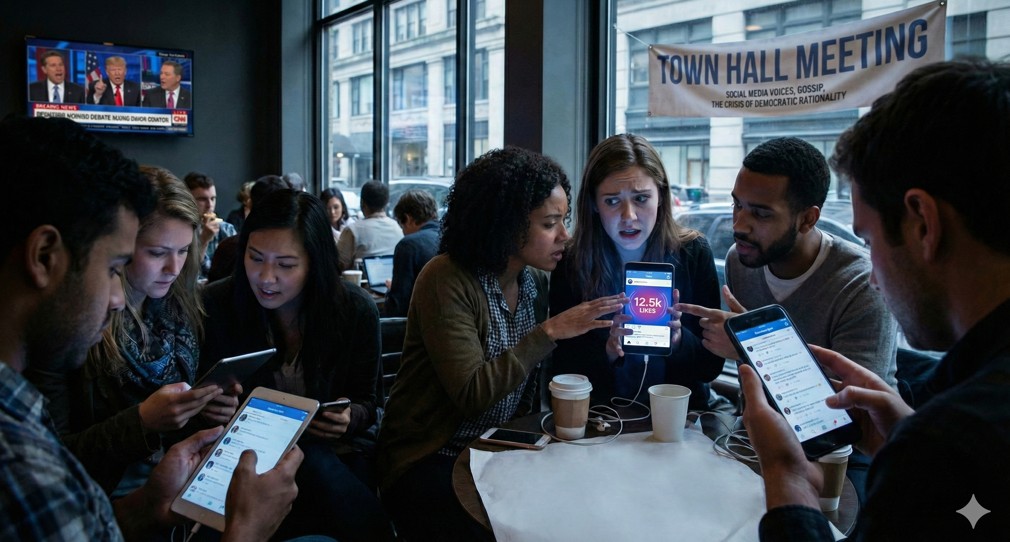
Democratic practices have historically depended on the cultivation of reasoned public judgment, institutional accountability, and communicative responsibility. From classical liberalism to deliberative democratic theory, public opinion has been understood not merely as the aggregation of voices, but as the outcome of processes that privilege rational justification, epistemic responsibility, and normative restraint. In this light, the growing tendency to treat social media expressions as democratic voices represents not an expansion of democracy but a profound conceptual confusion. Social media platforms are not neutral spaces of civic participation; they are technologically engineered environments that reward speed, affect, visibility, and virality rather than reflection, verification, or responsibility. The dominance of gossip, rumour, and emotionally charged commentary in these spaces exposes a fundamental incompatibility between unregulated digital expression and the normative requirements of democratic life.
At the heart of democracy lies the assumption that citizens are capable of offering reasons for their claims and of subjecting those claims to public scrutiny. Social media communication, however, operates in a mode that actively undermines this assumption. Discourse on digital platforms is fragmented, episodic, and detached from the burdens of justification. Posts circulate independently of authorial accountability, often anonymously or pseudonymously, and are rarely required to meet standards of coherence, evidence, or consistency. Gossip thrives precisely because it evades these demands. It substitutes insinuation for argument, repetition for verification, and emotional resonance for rational persuasion. In doing so, it transforms public communication into a spectacle of reaction rather than a forum of judgment.
This communicative irrationality is not accidental but structurally produced. Social media platforms are governed by algorithmic logics that prioritise engagement over truth and intensity over accuracy. Content gains visibility not because it is well-argued or publicly justifiable, but because it provokes outrage, fear, or curiosity. Gossip is thus not a deviation from digital public discourse but its most efficient product. The more speculative, morally charged, or scandalous a claim is, the more likely it is to circulate. Such conditions render democratic deliberation impossible, as the criteria for communicative success are fundamentally misaligned with the criteria for democratic legitimacy.
Equally troubling is the absence of accountability in social media discourse. Democratic speech presupposes that speakers can be held responsible for their claims, whether through institutional checks, legal consequences, or reputational costs. Social media dissolves this chain of responsibility. Gossip spreads through networks without clear authorship, ownership, or liability. False claims persist even after correction, reputations are damaged without due process, and collective judgments are formed without mechanisms for appeal or redress. In this environment, power operates without accountability, and speech acts produce real consequences without corresponding obligations. Such conditions are antithetical to democratic norms, which depend on answerability and the possibility of contestation.
It is crucial to note that the call for regulation implicit in this critique should not be misunderstood in an authoritarian sense. Regulation here does not refer to state censorship, ideological policing, or the suppression of dissenting voices. Rather, it denotes the presence of normative, institutional, and procedural constraints that render public communication intelligible, accountable, and answerable to shared standards of reason and responsibility. Democratic regulation has historically functioned not to silence speech but to distinguish public judgment from arbitrary assertion. Parliamentary debate, judicial reasoning, journalistic practice, and academic discourse are all regulated forms of communication, not in spite of their democratic character but because of it.
The absence of such regulation does not produce freedom but a vacuum in which unaccountable power flourishes. In the case of social media, this vacuum is filled not by democratic self-rule but by opaque algorithmic governance, commercial incentives, and informal coercions such as mob pressure and reputational violence. What appears as unmediated popular voice is, in fact, speech shaped by platform architectures that are neither publicly transparent nor democratically accountable. To call for regulation in this context is therefore not to constrain democratic expression but to expose and restrain the hidden forces that currently structure it.
Regulation, understood democratically, is inseparable from accountability. To regulate public discourse is to insist that speech claiming political relevance must be open to contestation, correction, and responsibility. This includes traceability of authorship, proportionality of judgment, mechanisms for redress, and temporal distance between accusation and collective condemnation. Such requirements do not suppress dissent; they protect democratic judgment from impulsive affect and irreversible harm. Without them, social media gossip acquires punitive force without due process, producing consequences that resemble political power while lacking political legitimacy.
The epistemic implications of unregulated digital discourse are severe. Democratic decision-making relies on a shared commitment to distinguishing truth from falsehood, even when disagreement persists. Social media gossip collapses this distinction by treating plausibility, popularity, and repetition as substitutes for evidence. Truth becomes a function of virality, and credibility is detached from expertise or verification. This erosion of epistemic standards does not merely distort public opinion; it renders the very idea of informed consent incoherent. A public guided by rumour and algorithmic amplification cannot meaningfully authorise political power, as its judgments are systematically detached from reliable knowledge.
Moreover, the emotionalisation of digital discourse undermines the reflective distance necessary for democratic judgment. While emotions have always played a role in politics, democracy requires that affect be mediated by deliberation and institutional restraint. Social media gossip amplifies immediate emotional reactions and converts them into collective judgments without temporal or procedural delay. Outrage replaces evaluation, moral certainty replaces doubt, and denunciation replaces critique. The result is not democratic engagement but moral volatility, in which public attention shifts rapidly from one spectacle to another without sustained understanding.
The inclusion of such unregulated voices under the banner of democracy also obscures the role of power in shaping digital discourse. Far from being egalitarian, social media is structurally asymmetrical. Visibility is unevenly distributed and frequently manipulated by platform algorithms, influencers, coordinated campaigns, or automated accounts. What appears as spontaneous public opinion is often the product of strategic amplification. To treat these outputs as democratic expressions is to mistake engineered attention economies for civic participation and to conflate volume with legitimacy.
To describe social media gossip as a democratic tool is therefore to abandon the normative foundations of democracy itself. Democracy is not merely the presence of many voices, but the regulation of those voices through norms of reason, responsibility, and accountability. Without such regulation, plurality degenerates into cacophony, and participation into spectacle. The problem with social media is not that it contains irrational voices – irrationality has always existed in public life – but that it institutionalises irrationality as the dominant mode of communication and presents it as political legitimacy.
An expository analysis of social media’s role in contemporary politics must therefore resist the temptation to romanticise digital expression as a new form of democratic vitality. Unregulated social media discourse does not deepen democracy; it corrodes its epistemic and moral infrastructure. It produces publics without responsibility, opinions without justification, and power without accountability. Until democratic practices are insulated from these pathologies – or social media itself is subjected to genuinely democratic forms of regulation – digital gossip must be understood not as an extension of democratic dialogue but as one of its most serious contemporary distortions.
Finally, particular scrutiny must be directed toward those who actively weaponize social media in the name of democracy and liberty. By equating unrestrained expression with democratic freedom, such actors hollow out the very concepts they claim to defend. Democracy is reduced to volume, liberty to impulsive utterance, and dissent to spectacle. In practice, this rhetoric often serves to legitimise manipulation, harassment, misinformation, and the concentration of communicative power in unaccountable hands, while shielding these practices from critique by invoking the moral authority of freedom itself. To invoke democracy in defence of communicative irresponsibility is not an act of political emancipation but a form of ideological evasion—one that disguises the erosion of public reason as its radicalisation and mistakes the degradation of judgment for the expansion of liberty.
When Einstein has fewer followers than a pop star, it is no longer clear whether democracy has expanded participation or merely replaced judgment with applause.

The writer is Assistant Professor, Imphal College