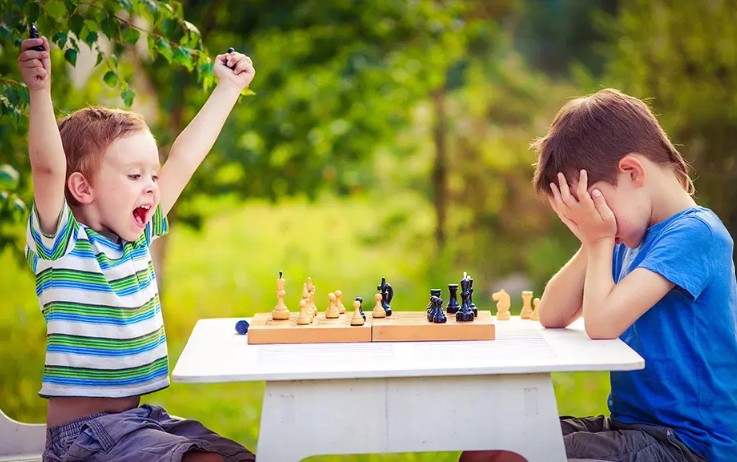
We learn to win very early in life. We learn to win races and games, to come first in class, to answer before someone else does, to win an argument with a sibling, and perhaps without quite noticing it, we begin to associate winning with being right and losing with being wrong. There is something reassuring about a winner because a winner gives us an ending. Someone has prevailed, someone has been proved right, someone has got what they wanted, and the uncertainty that came before can finally be put away.
But sometimes, winning is not everything.
Sometimes we can win and still be the loser, and sometimes we can lose something we desperately wanted and somehow emerge as the winner. The difficulty is that we are often much better at recognising the first kind of victory than the second. We know what it looks like to hold the trophy, to have the last word, to get the decision we wanted, to see our argument accepted. We are less certain about what it means to walk away from something without having got our way and still believe that we have not lost.
Perhaps that is because winning is usually measured by what we have gained, while life is often measured by what remains.
A person can win an argument and lose a friend. A parent can win a disagreement with a child and lose the chance to be heard the next time. Two people can spend an evening proving which one of them was right and discover, when the argument is over, that neither remembers what they were trying to protect in the first place. There are victories that feel wonderful for a few minutes and expensive for many years.
We know this, of course. Most of us have lived it in some form. We have said something simply because we wanted the other person to admit that we were right, only to realise later that being right had not been worth the hurt we caused. We have held on to a position because giving way felt like losing, even when the thing we were holding on to had become much less important than the relationship we were putting at risk.
And yet we keep doing it.
Perhaps because losing carries a particular humiliation. To lose is to admit that somebody else got there first, knew better, argued better, fought harder, or simply had more power. We do not like that feeling. We want our side to prevail, our history to be recognised, our version to be accepted, our demands to be met. Sometimes these desires are entirely justified. There are things worth standing for and things that should not be surrendered merely to keep everyone comfortable.
But even when we are right, there remains a question we do not always ask: what is the victory for?
It is a simple question, but it changes the nature of the argument.
If the purpose of winning is to make life better, then we should be able to look beyond the moment of victory and ask whether life is actually better afterwards. If the purpose of securing something is to give people a future, then we should be concerned about the kind of future that victory produces. If the purpose of defending our identity is to preserve our sense of belonging, then perhaps we should also ask whether the way we defend it is making it harder for others to feel that they belong.
This is where winning becomes more complicated.
In Manipur, we have lived for long enough with questions of land, history, identity, rights, memory and belonging to know that none of these questions are small. They touch things people inherit before they are old enough to understand them. They are tied to homes, ancestors, stories, villages, hills, valleys, institutions and memories, and when people feel that any of these are under threat, asking them simply to compromise can sound like asking them to give away a part of themselves. So this is not an argument for giving up what matters.
It is an argument for asking what happens when every disagreement becomes a contest that somebody must win.
Because once that happens, compromise begins to look like weakness. Listening begins to look like surrender. Changing one’s position becomes an admission of defeat. The other person’s gain begins to feel like our loss, even when the two things do not necessarily have to cancel each other out.
And then we start keeping score.
Who got what. Who gave up what. Whose voice was heard. Whose history was accepted. Who moved first. Who refused to move. Who was seen to have prevailed.
The strange thing about keeping score in a society is that the score never really ends. Someone who feels that they have lost today will remember it tomorrow. Someone who feels that they have won may spend the next generation defending that victory. A victory that is not accepted by the other side does not necessarily settle anything; sometimes it simply becomes the memory from which the next argument begins.
Perhaps this is why some victories become inherited burdens.
We teach children what we won and what was taken from us, what our people endured and what we were able to protect, and there is value in remembering these things. But memory can become complicated when it is used only to explain why the other person must never be trusted, never be forgiven, never be given anything, never be allowed to forget that they once lost.
At some point, we have to decide whether the purpose of remembering is to keep a scorecard or to understand how we arrived here.
There is another kind of winning that we rarely celebrate because it does not look like victory.
It is the decision to walk away from an argument when we know we could win it. It is the willingness to give someone else the last word because the relationship matters more. It is the leader who chooses not to turn every disagreement into a test of authority. It is the person who can say, “I was wrong,” without feeling that the admission has made them smaller.
Sometimes losing is an act of generosity. Sometimes it is an act of courage. Sometimes it is simply an acceptance that not everything has to be possessed, answered, defeated or settled today.
And there are times when what looks like losing is actually the beginning of something better.
A person may lose a position and gain a clearer understanding of what they really wanted. A family may give up its insistence on having everything its own way and discover that it has saved a relationship. A society may make concessions that are painful in the present but create space for people who would otherwise have no reason to trust one another.
None of this means that justice should be traded for peace or that truth should be sacrificed because disagreement is uncomfortable. Some losses are imposed upon us and should be resisted. Some victories are necessary. There are moments when refusing to stand up is not wisdom but cowardice.
But even then, perhaps we should be careful about confusing winning a battle with winning the future.
A battle ends at some point. A future does not.
And the people who live in that future will have to live with whatever our victories have produced.
Perhaps that is why the measure of a victory cannot always be found in what we gained at the moment we won. It has to be found in what remained afterwards: the relationships that survived, the dignity that was preserved, the trust that was not destroyed, the possibility of sitting together again, the children who did not have to inherit another unfinished argument.
We often imagine that the opposite of winning is losing.
Maybe it is not.
Maybe the real opposite of winning is wasting the opportunity that victory gave us.
Because what good is it to win if we have made the place we live in smaller? What good is it to secure our position if we have made it impossible for someone else to imagine a future beside us? What good is it to prove that we were right if, by the time we are finished proving it, there is nobody left willing to listen?
Perhaps we need a different understanding of victory.
Perhaps sometimes the winner is not the person who got everything.
Perhaps the winner is the person who knew what could be given up.
Perhaps the winner is not the side that finally stood alone.
Perhaps it is the side that found a way for everyone to remain.
And perhaps, in a place like Manipur, where so much of what we call victory can carry another person’s memory of loss, the most important question is not who won.
It is what kind of future did our winning make possible?

Sam Khumanthem writes about home, identity, and the quiet complexities of life in Manipur. His work reflects a deep connection to place, shaped by both love and uncertainty.